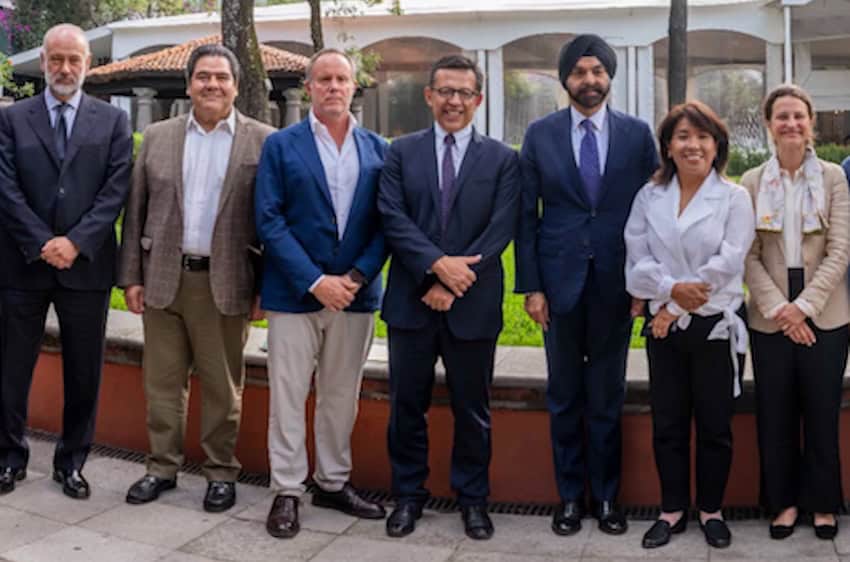
World Bank Group President Ajay Banga is in Mexico this week with plans to move forward a new Country Partnership Framework (CPF) to support future investment in Mexico.
On his organization’s first official visit in over five years, Banga is meeting with senior government officials and private-sector leaders to advance the CPF 2026-2030, which will be developed in line with the Sheinbaum administration’s overarching Plan México economic development strategy.
World Bank President Ajay Banga:
I come from Punjab which was India’s agricultural centre. Today you’ll find young kids there who have just sold their farms. They are rich for 4 years and buy an SUV, smoke and drink a lot. Soon they are broke and end up trying to find gig jobs. pic.twitter.com/oa0q5mHQbE
— Shashank Mattoo (@MattooShashank) June 21, 2026
The CPF will therefore focus on strengthening competitiveness, developing human capital, expanding productive investment, consolidating domestic industries and strengthening value chains.
The World Bank’s previous CPF with Mexico was established in February 2020 at which time it aligned with the previous Morena government’s National Development Plan.

Banga emphasized that the new framework will concentrate more resources on fewer objectives, compared to the seven aims outlined in the 2020-2025 framework.
“We are trying to narrow these priorities to put more resources to work on fewer things and make a difference at scale over the next five years,” Banga said.
The current discussions in Mexico City are focusing on sectors with high potential to boost growth and employment in Mexico, such as agriculture and manufacturing, as well as emphasizing support for small and medium-sized enterprises (SMEs).
SMEs are the lifeline for job creation, Banga stressed.
As president of the World Bank Group — an international organization that oversees five development agencies, including the International Bank for Reconstruction and Development (IBRD) and the International Development Association (IDA) which two together are referred to as the World Bank — Banga is discussing strengthening the organization’s partnership with Mexico’s agricultural sector through its AgriConnect program, which focuses on transforming smallholder farming, creating jobs, and strengthening global food security.
Through the program, the World Bank aims to provide smallholder farmers with better inputs and connect them with regional and international export markets to add value to their agricultural activities.
The World Bank aims to work closely with authorities to create curated CPFs that fit the country’s context. Banga also emphasized the need to raise greater private-sector investment to support growth.
“We need to mobilize private capital,” said Banga. “The World Bank as a whole closed the last fiscal year having mobilized US $122 million of private capital to emerging markets.”
Banga said that, in Mexico, the World Bank aims to direct private investment toward sectors such as energy, health and pharmaceuticals.
With reports from El Economista and Bloomberg Línea