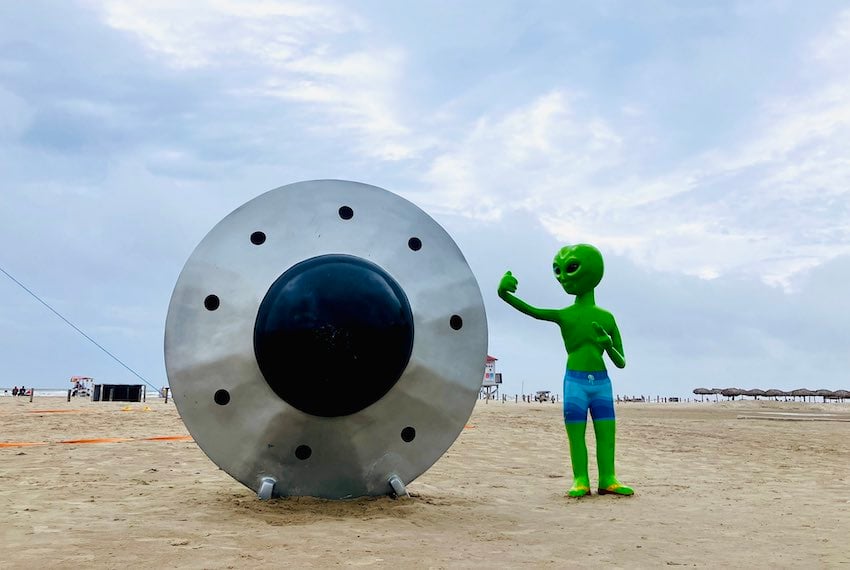
Plans for a UFO museum are gaining traction in Tampico, Tamaulipas — a northeastern Mexican city on the Gulf of Mexico where alien-themed tourism has grown from a local curiosity into a craze.
Vendors in municipal markets and at Miramar Beach have for a while been reporting strong sales of green alien hats, plush toys and T-shirts, often outpacing traditional souvenirs tied to beach activities and local wildlife.
👽 Desde historias de avistamientos ovnis, musica de otro mundo, hasta lucha libre galáctica. Todo eso y más se vivió en el Marciano Fest 2025 en Ciudad Madero 🛸
¿Listo para el 2026? 😎 pic.twitter.com/ZRFhL2u2XJ
— Fórmula Noticias Tampico (@formula_tampico) October 31, 2025
Tourists from Mexico and abroad often leave with UFO merchandise and photos from spots associated with alleged sightings.

And some come to the area expressly in search of those things — such as the estimated 20,000 people who in late October attended Marciano Fest, a weeklong UFO- and extraterrestrial-themed festival that concluded with 947 people dressing up as aliens.
Meanwhile, researcher Nembra del Carmen Jiménez is reviving a project she first presented in 2012: to establish a UFO Museum in Tampico built around her archive of images and materials.
She has documented alleged spacecraft and mysterious spheres over Tampico and neighboring municipalities since the 1980s, along with objects she says show unusual electromagnetic behavior.
Her material also includes coordinates tied to a supposed underwater, magnetic, extraterrestrial base off Miramar Beach, which local legend credits with deflecting hurricanes for the past 70 years (as seen in season 1, episode 3 of the Netflix docuseries “Investigation Alien”).
City officials say they are open to adding a UFO-focused venue; the tourism director has said authorities are willing to hear proposals and view potential exhibits, noting growing public interest in extraterrestrial themes.
Separately, private investors have proposed an alien-themed museum along the Cortadura Canal, as well as a fishing museum, as part of a broader push to redevelop port and customs areas for tourism.
Tampico already hosts UFO-related conferences and mass events such as Marciano Fest in October, which included an attempt to set a Guinness World Record when 947 people dressed up as aliens.
Participants in these events have included renowned Ufologists such as Mexican Jaime Maussan and Giorgio Tsoukalos, host of “Ancient Aliens” on the History Channel. In 2023, Maussan presented to Mexico’s Chamber of Deputies two bodies that he claimed were 1,000-year-old corpses of extraterrestrials.
The most recent Marciano Fest was centered at Playa Miramar in Ciudad Madero, which is part of the Tampico metropolitan area.
Moreover, the area is home to the Mexican UFO Reporting Center (CROM), a new digital platform that gathers cases, videos, photos and academic explanations “to provide certainty, understand the events, make the data available to experts and expand its reach beyond Tampico.”
Given all this, it’s no surprise that earlier this year, the newspaper Milenio ran a headline: “Tampico seeks to become the UFO capital of the world.”