A Facebook post about an archaeological find in the southern state of Oaxaca led to a simmering dispute and a flurry of accusations about how Mexico safeguards its heritage.
This past weekend, Señor Blue, a history and archaeology social media influencer, shared a video of the discovery of roughly 60 pre-Hispanic artifacts in San Pedro Jaltepetongo, a rural town in the mountains about 140 kilometers north of the state capital, Oaxaca city.

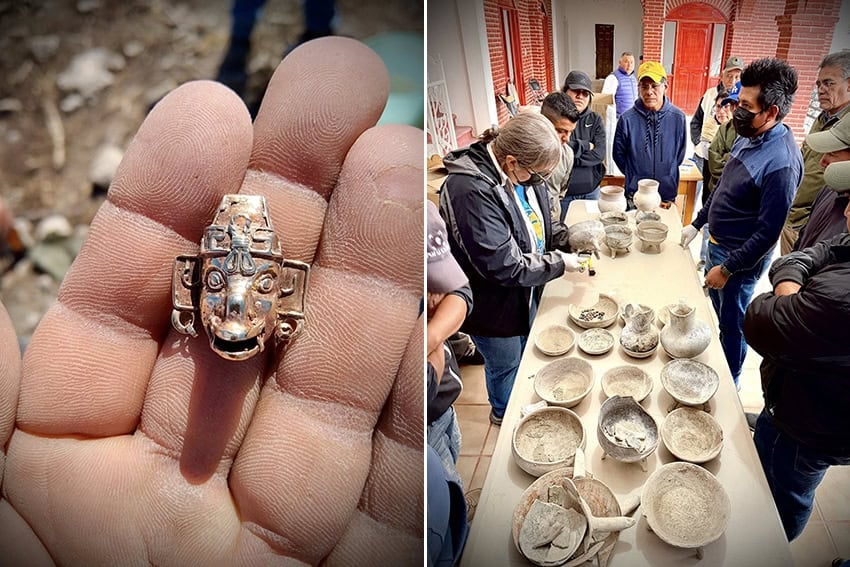
The post was accompanied by photographs showing dozens of vases, pots and a piece of gold extracted from a well, prompting the National Institute of Anthropology and History (INAH) to warn against irresponsible reporting.
INAH issued a statement urging citizens, journalists and content creators to “exercise due care when disseminating information about archaeological sites not open to the public,” lest they facilitate looting by revealing their location.
“It is everyone’s responsibility to care for and preserve our heritage for future generations,” the statement said, “and to avoid misinformation that … promotes looting and the destruction of the pre-Hispanic legacy of the people of Oaxaca and Mexico.”
As the story spread, some criticized the amateur excavation for destroying the archaeological context of the find, while others thanked Señor Blue for his offer of legal support to keep the artifacts in the local community.

In response to one social media comment that “If you have so much love for the past, … you should know this: it’s a serious mistake to dig pieces out of that hole,” Señor Blue wrote: “The most serious thing is when INAH removes everything, cleans it up and takes the items away, storing them in a warehouse, in the best of cases, or selling the pieces.”
Señor Blue claims to have infiltrated Facebook groups where pieces are offered for sale, saying some individuals even display INAH employee credentials to “authenticate” the pieces being sold. INAH did not respond to the allegations.
The influencer said the residents of San Pedro — who he’d worked with before — contacted him for fear that INAH would sell the artifacts on the black market.
He also defended his actions, arguing that the townspeople should have a say in what happens to the artifacts, citing the removal of treasures from the village of San Francisco Caxonos in Oaxaca’s Northern Sierra.
Archaeologists find a massive, 3,000-year-old map of the universe in Tabasco
An INAH dig there in the late 1990s uncovered six tombs with valuable Zapotec pieces — including a gold pectoral — from the Late Postclassic period (1300 to 1521 AD). The archaeologists removed all the pieces without informing the community, which, only years later, discovered the objects were housed in a Mexico City museum. They have since been returned and can be viewed at the local community museum.
“I prefer that people safeguard their local treasures,” Señor Blue wrote, “I hope INAH will provide them with a museum, but they will say there are no resources.”
INAH has confirmed that the collection of artifacts found in San Pedro — discovered after a local woman gathering epazote in the fields outside the town came across a hole in the ground — are part of a pre-Hispanic funerary context that corresponds to the Late Postclassic period and exhibits distinct characteristics of the Mixtec cultural tradition.
With reports from El País, Excelsior and El Universal