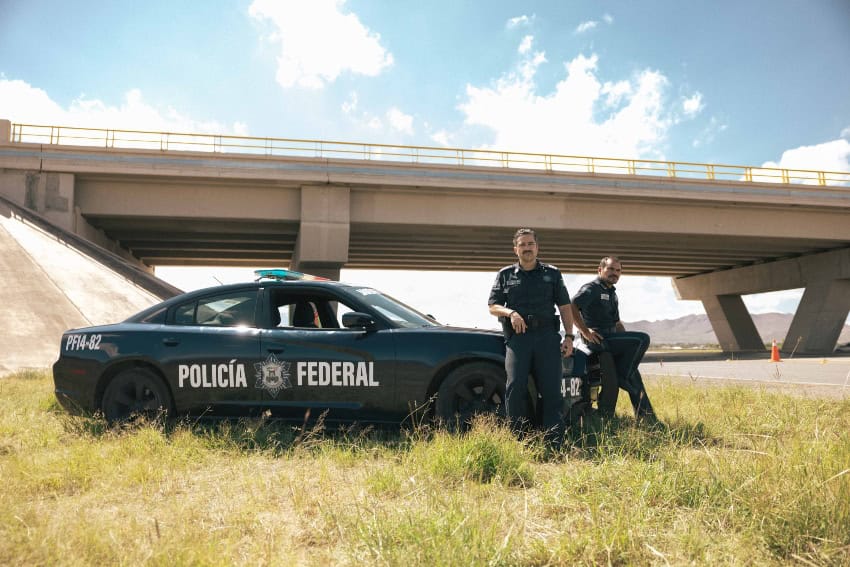
Netflix’s “Facing El Chapo” (originally titled “La Captura”) has established itself as a true milestone for Mexican cinema. Directed by Chava Cartas, the film racked up more than 18 million views in its first weekend.
What’s truly surprising is that, without a massive advertising campaign and driven primarily by word-of-mouth, this police drama managed to claim the No. 1 spot on the global Top 10 chart, officially crowning itself as the streaming service’s most successful non-English-language debut of the year.
Inspired by the real-world events of the January 2016 military operation “Cisne Negro” and the journalistic chronicles of Héctor de Mauleón, the plot reconstructs the third and final arrest of Joaquín “El Chapo” Guzmán Loera.
However, the story does not focus on the drug trafficker or his head of security, Jorge Iván “El Cholo” Gastelum. Instead, the film portrays the suffocating ordeal of two police officers — portrayed by Alfonso Herrera and Noé Hernández — who, by a twist of fate, arrest the drug lord during a routine traffic stop on a highway in Los Mochis, Sinaloa, and must temporarily guard him before criminal cells locate their position. Of course, complications soon pile up as the officers struggle to maintain control of the situation and resist both Guzmán’s attempts to bribe them and the external siege.

Although rooted in a criminal environment, “Facing El Chapo” distances itself from glorifying crime or illicit opulence. Instead, it weaves together a buddy cop drama, psychological suspense and a modern western to tell a story where the dramatic tension stems from resisting crime rather than participating in it.
To understand how this Mexican streaming phenomenon came to be, we spoke exclusively with its screenwriter, Bernardo Esquinca, a renowned master of horror and crime fiction, as well as the creator of the celebrated “Casasola” series.

The official secrecy and the challenge of the screenplay
While writing “Facing El Chapo,” Esquinca faced a major challenge: the official secrecy surrounding the case.
Beyond the widely known events that took place at the motel — where the officers were locked in while the drug lord tried to bribe them — the specific details of the operation were, and remain, scarce. Furthermore, the identities of the real police officers are under strict protection, and the production team had no contact with them.
Great Mexican television series that have returned in 2026 (and two more we can’t wait to see)
Faced with this lack of information, the author used Héctor de Mauleón’s journalistic chronicles — “Cómo atrapamos al Chapo” and “Veinte minutos a solas con ‘El Chapo’” — as a roadmap, taking creative liberties to develop the characters, expand on the situations and craft a solid plot.
“The screenplay presented several challenges, as does any story that needs to be adapted for the big screen,” Esquinca tells me. “But for me, the main (challenge) was addressing the fact that most of the action (in the early drafts) took place on the highway. Precisely because so little is actually known about it.”
With this in mind, the screenwriter explains that his priority was to prevent the narrative from becoming monotonous if it were confined to the road trip. After extensive research, he decided to expand the dramatic universe by devising narrative detours, such as a sudden lack of gas or an unexpected encounter with local criminals (there are many other surprises, but I don’t want to give too much away).
A true story that steals the spotlight from drug trafficking
View this post on Instagram
It’s no secret that, over the past few decades, narco-genre productions have increased dramatically in Latin America, especially in Mexico. This narrative usually humanizes or glorifies the drug lord by portraying his lavish lifestyle, his unlimited power and an almost religious aura. “Facing El Chapo,” however, subverts this tendency by shifting the spotlight entirely to two honest and dedicated Federal Police officers.
The plot centers on the officers’ experiences and the enormous moral dilemma they face in balancing their institutional duty against the potentially deadly consequences of holding one of the world’s most dangerous criminals in custody.
The author explains it clearly: “It’s not the typical drug trafficking story that focuses on the bad guys — the drug traffickers, the villains — but rather on the police officers who capture El Chapo and do the right thing.”
Without a doubt, this shift in focus is the story’s main appeal: taking the spotlight away from drug trafficking and placing it on ordinary citizens who, despite the violence in the country, continue to strive to do their best.
Esquinca believes that the resounding success of “Facing El Chapo” offers important lessons that should not be overlooked. For the industry, the message is “that stories about the good guys can be told successfully.” At the same time, the message the audience is sending “is that we do want stories like this.”
The rescue of the Mexican hero
Much like the film “Counterstrike” (2025), “Facing El Chapo” continues the artistic vision of Mexican filmmaker Chava Cartas, who has embarked on a crusade to restore the image of the national hero. His primary goal has been to challenge the cultural prejudice that almost relentlessly brands the authorities of Mexico as incompetent or corrupt.
In this project, it’s a great move for Cartas and Esquinca to steer clear of the superhuman, nearly indestructible action hero of commercial cinema. The story instead focuses on flesh-and-blood characters who feel fear, struggle to get by and have a family to protect, defining heroism as their ability to maintain moral integrity in the face of extreme danger.
Thus, we meet Arturo Carmona (Herrera), overwhelmed by financial pressures as he prepares for the arrival of a new child, and Héctor Rosales (Hernández), recently transferred to the police station and facing the vulnerability that comes with retirement.
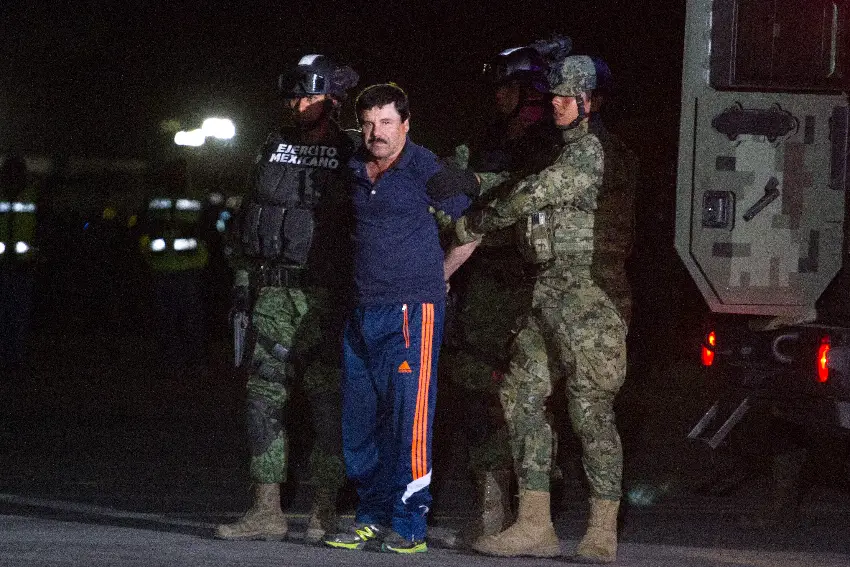
“This film precisely offers many reflections, but the main takeaway is that there really are good people out there,” Esquinca says. “And those good people can succeed, and their adventures can be very exciting and keep you on the edge of your seat.”
Beyond the bullets
Although the production features scenes of armed confrontations, tactical operations and highway chases, the true dramatic power of “Facing El Chapo” lies in the way the events are told. Beginning with the accidental arrest, Esquinca opts for an almost claustrophobic psychological suspense that transforms the story into an intense survival thriller.
In this story, Carmona and Rosales are partners who have recently been assigned to work together, so neither of them trusts the other very much. In their unexpected situation with Guzmán and his lieutenant, the tension grows palpable, as the officers don’t know each other well and aren’t sure who to rely on while their surroundings become increasingly dangerous.
‘A Child of My Own’: 4 reasons the Netflix film breaks the true-crime mold
When asked about the emotional suffocation that defines the plot, Esquinca explains that the main driving force behind his writing was to put the viewer in the officers’ shoes.
“The viewer should feel as if they were there, as if they had to make the choice,” he says. “So the guiding principle was basically: What would you do? That’s what we’re trying to convey to the viewer the whole time. What would you do if you were in their place? Would you take the money or resist?”
The high cost of doing the right thing
With no complacent endings or filters to gloss over the country’s harsh social reality, “Facing El Chapo” highlights the true value of everyday heroes. A very human lesson that, to be fair, is always worth revisiting.
Esquinca notes that, although both the historical events and the film demonstrate that good can triumph over evil, it’s clear that doing the right thing can come at a significant cost.

“That ending also tells us that this (being a hero) comes at a cost, and they had to pay a price,” Esquinca says. “They had to change their lives and go into hiding … because there is a danger — a sword of Damocles, as they say — hanging over them.”
Almost a month after its release, this 91-minute film remains a strong contender on global charts. If you haven’t seen “Facing El Chapo” yet, there’s still time to discover it. If you have, it’s worth returning to it with a fresh perspective.
Carolina Alvarado is a Venezuelan journalist who has devoted much of her career to creative writing, university teaching and social work. She has been published in Lady Science, Latina Media, Global Comment, Psiquide, Cinetopic, Get Me Giddy and Reader’s Digest, among others.