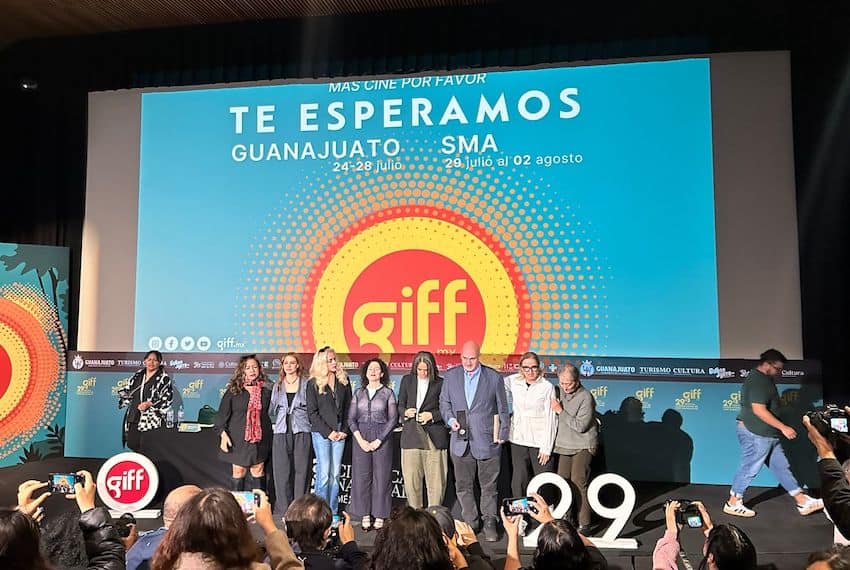
This year’s Guanajuato International Film Festival (GIFF) will present 203 films from 55 countries, while spotlighting women who have reshaped Mexican cinema, organizers announced Monday.
The 29th edition of the festival — whose theme last year was inspired by Alfred Hitchcock’s 1958 “Vertigo” — will run July 24 to 27 at nine venues in the historic city of Guanajuato, then continue July 29 to Aug. 2 at 10 venues in the expat hub of San Miguel de Allende in the same state.
¡Buenos días, cinéfilos! ✨
Estamos a muy poco de vivir #GIFF2026. Conoce todas las funciones, conferencias, homenajes y actividades en nuestro programa oficial: https://t.co/T4hznAIm1e pic.twitter.com/7ljP4J8fvU— Guanajuato Film Fest (@giffmx) July 7, 2026
Backed by Mexico’s Culture Ministry through its Profest festival support program, the nine-day event will offer a mostly free lineup of screenings along with talks, workshops and other activities.
In a press release, GIFF director Sarah Hoch said the festival will honor actresses Marina de Tavira and Cecilia Suárez and producer Inna Payán, highlighting a broader push toward gender equity in the industry.
The honorees will receive Más Cine awards, while Suárez — who starred in Netflix’s “La casa de las flores” (“House of Flowers”) — will also be recognized by the film archive of the National Autonomous University of Mexico (UNAM).

“I can only express my gratitude for this beautiful and utterly unexpected recognition,” said De Tavira, whose performance as Sofia in the 2018 drama “Roma” earned her an Academy Award nomination for best supporting actress and a Silver Ariel, Mexico’s top film prize, for the same role.
“Films made by women haven’t had the same level of recognition as they are getting now, and it continues to grow,” she added.
Payán, who has produced more than 30 films and six TV series over two decades, said she felt very honored “that it is my fellow women who are giving me this recognition.”
She is vice president of the Mexican Academy of Film Arts and Sciences and a member of the Academy of Motion Picture Arts and Sciences, which present the Ariel Awards and Oscars, respectively.
The festival will also include a posthumous tribute to Spanish actress Marisa Paredes with a screening of her final film, the surrealist road movie “Emergency Exit.”
Paredes, who died in 2024, acted in more than 75 films across a six-decade career and was known for collaborations with director Pedro Almodóvar, notably “All About My Mother” in 1999.
Organizers said 155 of the selected films will compete in various categories. This includes 14 Mexican features, 10 of them world premieres.
An emphasis on emerging technologies — a GIFF trend over the past few years — will continue with panels and discussions on artificial intelligence. New programs will spotlight mavericks and luminaries, as well as filmmakers who are disruptive and push boundaries.
The festival will also include an eight-film showcase from Qatar as part of a bilateral cultural initiative.
Screenings are set for iconic venues such as the Teatro Juárez in Guanajuato city and Teatro Ángela Peralta in San Miguel de Allende, along with outdoor squares and unconventional spaces.
Most screenings are expected to be free on a first-come, first-served basis. For more details, visit the festival website in English or Spanish.