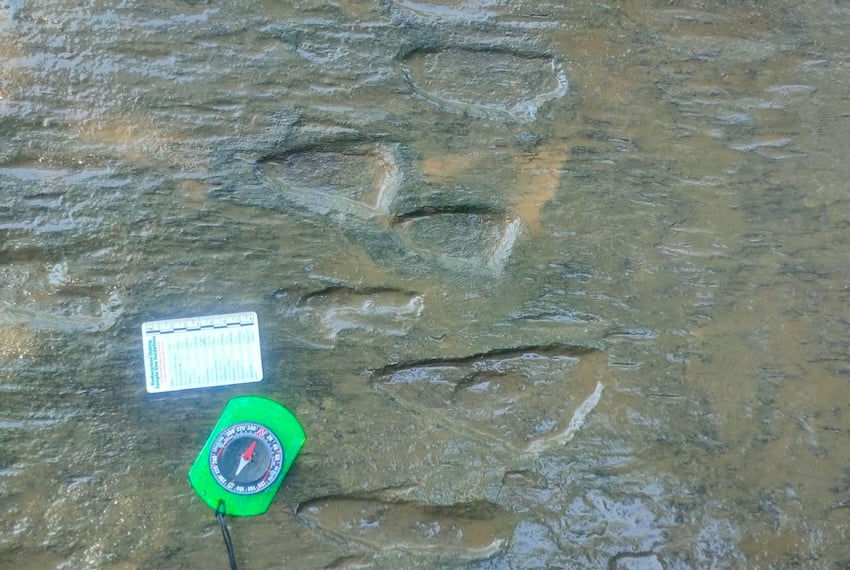
Residents who spotted unusual marks in a streambed in the Michoacán countryside have helped lead researchers to at least 50 dinosaur footprints.
Mexico’s National Institute of Anthropology and History (INAH) announced the discovery Monday, hypothesizing that the tracks were left by three types of dinosaurs: large meat-eaters possibly belonging to the tyrannosaur family, smaller raptor-like predators and duck-billed plant-eaters.
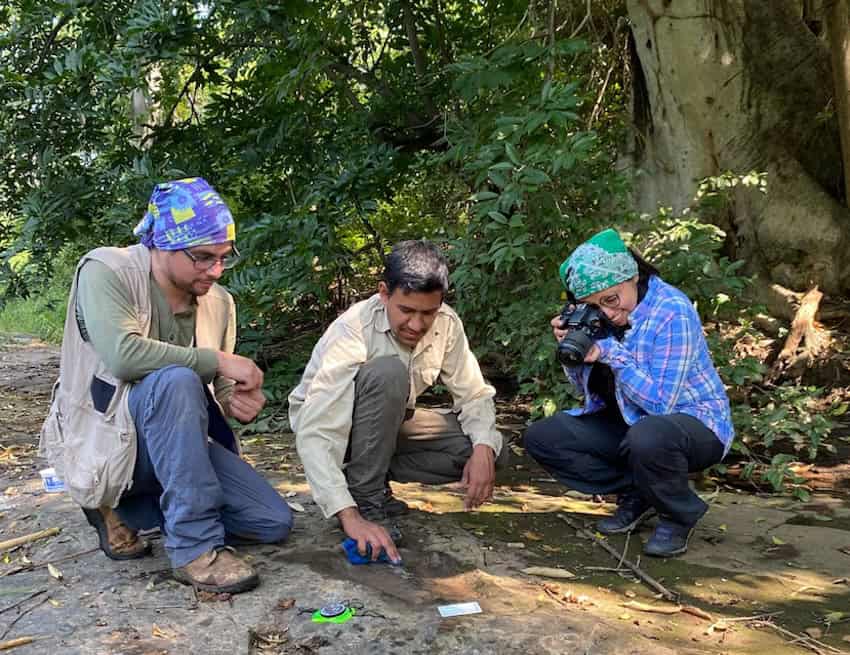
The footprints were found in San Juan de los Plátanos, a small lime-growing community in Apatzingán — a municipality of 126,000 in the sizzling lowlands of Michoacán’s Tierra Caliente region.
Raymundo Cervantes Barriga, a paleontologist with INAH’s Michoacán center, inspected the site, where footprints cover about 40 square meters (430 square feet) of sedimentary rock beside the stream.
They measure 12 to 48 centimeters (about 5 to 19 inches) long and up to 30 centimeters (12 inches) wide. Researchers believe additional tracks could extend beyond the area surveyed.
Based on their size, shape, depth and toe impressions, Cervantes tentatively linked the tracks to three dinosaur families known to have roamed Mexico — but it’s too early to say definitively if some of them are, say, T. rex footprints.
The number of species remains undetermined. Researchers say further paleontological analysis is needed to refine those identifications.

Cervantes placed the animals in the Late Cretaceous, which lasted from about 100 million to 66 million years ago, when he said the region had bodies of water where dinosaurs came to feed.
Specialists began documenting the site last week. They have collected rock samples and are making molds and using photographs to create detailed models of the footprints.
The tracks could help researchers study how dinosaurs moved, their travel directions and possible interactions among species, archaeologist José Luis Punzo Díaz said in an INAH press release.
The discovery would bring Michoacán’s recorded dinosaur footprint sites to four, according to INAH, which has registered just over 30 nationwide.
San Juan de los Plátanos is a community of about 1,300, roughly 145 kilometers (90 miles) southwest of Morelia, the state capital.
The Apatzingán area has struggled with organized crime and violence, but it is also known for its lime orchards and its Tierra Caliente regional cuisine, namely morisqueta, a paella-like dish of white rice served with beans and tomato-chile sauce, often topped with cheese or meat.
There is also an airport in Apatzingán. Pablo L. Sidar National Airport used to have regional commercial flights but now serves general aviation.
With reports from Expansión and Gaceta UNAM