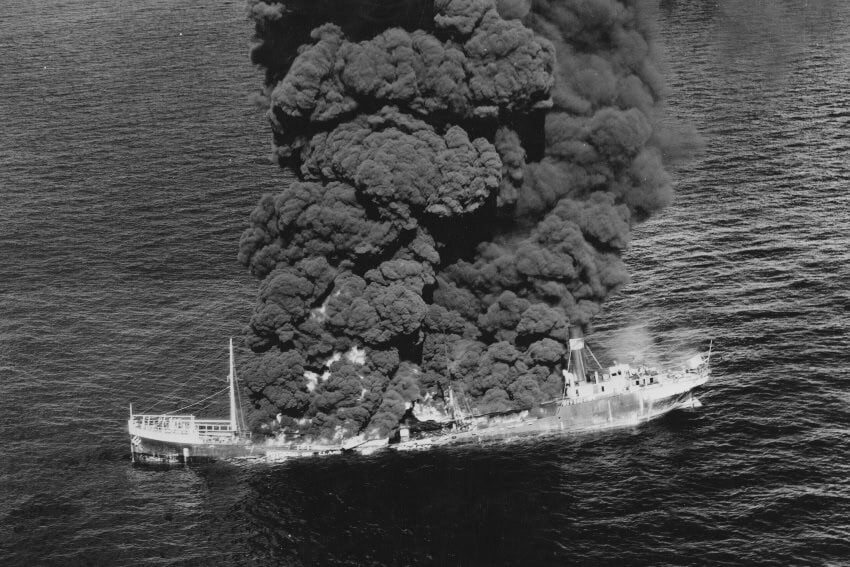
On May 14, 1942, the Potrero del Llano, a Mexican oil tanker, was sailing from Tampico to New York City, a journey of five to six days. With the U.S. at war, there was a hungry market for Mexican oil, and the 30-year-old ship was carrying 6,132 tons of petroleum. She had been built in Britain, sold to a company in Belgium, and then purchased by Società Italiana Transporti Petroliferi.
In June 1940, she had been in Tampico, where she was first interned and then, after Pearl Harbor, seized by the Mexican government and renamed the Potrero del Llano. Now she was sailing along the coast of Florida on what should have been a routine delivery. As the sun came up, the crew was unaware that they were being followed by a German submarine, the U-564.
The sinking of the Potrero del Llano
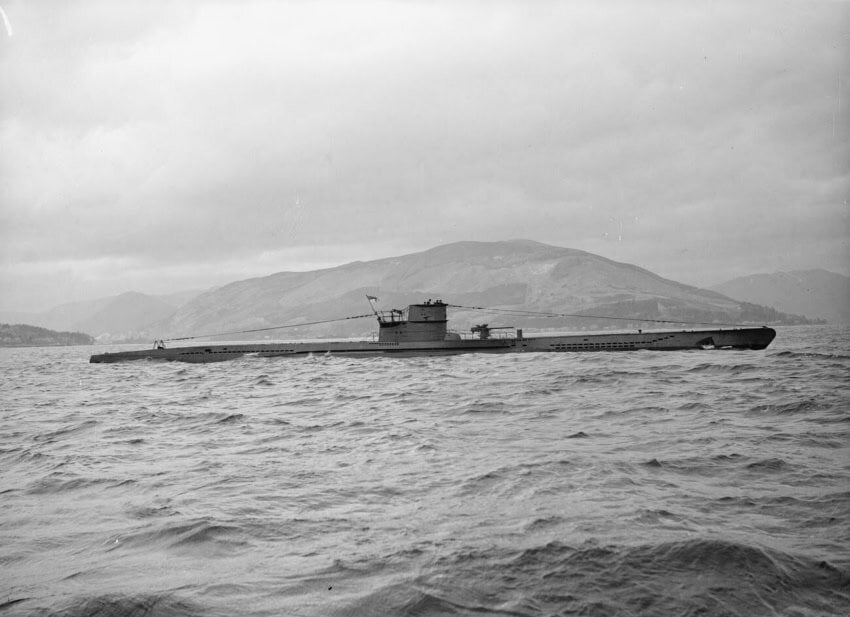
The U-564 was a Type VII submarine, the workhorse of the German Navy. The boat was based in Brest, giving easy access to the Atlantic Ocean, but sailing to the Gulf of Mexico took her to the very edge of her range. Given the right conditions, a skillful captain could use the boat’s electrical engines on the surface to save fuel, and it was sometimes possible to rendezvous with a U-tanker, a large submarine that set off ahead to refuel the attack submarines in the Mid-Atlantic. A captain might even ration how much water they carried, which allowed for extra fuel.
Making the long journey west was worth the hardships. By early 1942, the North Atlantic had become a dangerous place for German U-boats, but here, off the coast of America, the defenses were thinly spread. It became the “Happy Time” for German submarines, which sank 609 ships and lost “only” 22 U-boats.
The commander of the U-564 was Reinhard Suhren, still only 26 but already a veteran captain. U-boat crews were noted for being the mavericks of the navy, with officers and men mixing far more informally than on a bigger surface ship. Nicknamed “Teddy” from his training days, where a colleague had once said he looked like a teddy bear when marching, Suhren combined a sense of humor with a professional approach to his work. It was a good combination for a U-Boat captain, and he was popular with his crew.
A U-boat attack for which Mexico demands satisfaction
As Captain Suhren stalked this small tanker off the Florida coast, there was some initial confusion. To advertise her neutrality, the Mexican flag had been painted on her hull, and Suhren mistook this for the Italian flag. As it seemed inconceivable that an Italian ship should be in these waters this late in the war, Suhren ignored the flag and identified the ship as a legitimate target. His torpedo ran true, striking below the captain’s cabin and causing a large explosion that split the vessel in two.
Twenty-two of the crew were pulled from the burning water, one of whom would later die. The Captain and 12 others were killed. News of the attack reached Mexico the same day, May 14, and President Manuel Ávila Camacho dispatched a letter to Berlin, Tokyo and Rome demanding compensation for the ship and assurances that no such event should occur again. If they did not receive an acceptable response, he warned, “The Republic will immediately adopt the measures required by national honor.”

The case for war in Mexico
The fact that a reply was demanded within a week (the deadline would run out on Thursday, May 21) has led historians to argue that the President was, at this point, already set upon Mexico entering the war. Feelings within the country, however, were mixed. The political left, including the trade unions, was pro-Russia and had already been calling for a declaration of war. The center and right were more concerned with the U.S. If Mexico entered the war, the U.S. was likely to request bases on Mexican soil, particularly in Baja California, where it was feared Japanese submarines might rest up along the deserted stretches of coast. Given recent history, many Mexicans were uncomfortable with the idea of having American troops on Mexican soil.
Apathy among average Mexicans
For the average Mexican, with no strong political beliefs, the main response to the sinking appears to have been apathy. There was a fear that young Mexican soldiers would be used as cannon fodder, and a rumour went around that the U.S. had sunk the ship to drag Mexico into the war. When the Potrero’s survivors, along with the body of Engineer Rodolfo Chacon Castro, who had died of wounds in a Miami hospital, arrived in Mexico City’s Zocalo, a crowd of 100,000 had been anticipated. In fact, no more than 15,000 turned out.
Seeing no passion for war amongst the general population, politicians were unusually quiet. Some believed there might be benefits to Mexico in supporting a war that the Allies looked increasingly likely to win. Others thought that participation would be a hollow gesture that would just show how weak the country was. Even Senator León García, leader of the Upper Chamber, who initially took a militant stance, toned down his rhetoric as, like everybody else, he waited for direction from President Camacho.
A second oil tanker is sunk
On May 20, 1942, a second Mexican tanker was attacked and sunk, this time by U-106. It too had been seized by the Mexican government while docked at Tampico, gifted to Petróleos Mexicanos, and renamed the Faja de Oro. The Faja de Oro was sailing south on her return trip to Mexico and was empty of fuel. She was spotted by Kapitänleutnant Hermann Rasch off Key West. He fired two torpedoes, one of which hit, and the ship was finished off 20 minutes later. Ten of the crew were killed, and 27 were rescued.
News of this second sinking reached Mexico on May 21 and was headline news the following day. By then, the date for receiving a reply to the Mexican ultimatum had passed. Japan and Italy had not sent an answer, and Germany had not even acknowledged the letter. On the evening of May 22, there was an emergency cabinet meeting, and it was clear from the beginning that the ministers were there to listen, rather than to debate the issue.
Camacho declares, or at least acknowledges, war with the Axis powers
After the opening speech, President Camacho handed the floor to his Secretary of Foreign Affairs, Ezequiel Padilla, who outlined the case for war. At the end of the meeting, the press was informed that the President had summoned a special session of Congress to authorize a formal statement that a state of war now existed between Mexico and the Axis powers.
The wording was important. Mexico did not declare war on the Axis but acknowledged that “a state of war existed.” This would give them considerable powers, such as seizing Axis property, spying on suspects, monitoring communications and suspending constitutional guarantees. However, such wording did not necessarily commit Mexico to sending young boys to fight. This wording might well have been adapted to pacify General Lázaro Cárdenas, who objected to troops being sent abroad. As a popular former President, his word carried considerable weight and, more importantly, President Camacho had penciled him in to be his Minister of War.
And so Mexico entered the war. More ships would be sunk, the United States would send weapons to upgrade the Mexican army, and, eventually, a small group of Mexican airmen would see active service in the Philippines.
Bob Pateman lived in Mexico for six years. He is a librarian and teacher with a Master’s Degree in History.