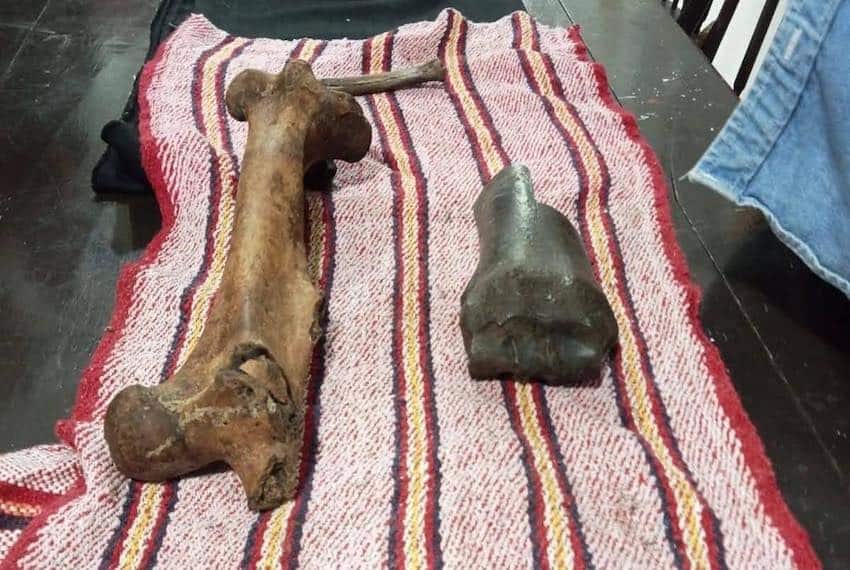
The Huasteca Potosina, that lush region in the eastern part of San Luis Potosí state, best known as an ecotourism and cultural cauldron dating to pre-Columbian times, is becoming a paleontological paradise as the repository of one of the most significant fossil finds of the century.
The accidental discovery of more than 750 fossilized bones of Ice Age-era megafauna — mammoths, saber-toothed tigers, giant ground sloths and various horse species that disappeared from the Americas before the Spanish arrived with modern breeds — was first revealed more than a year ago. It was the subject of a detailed article in MND last April, which can be read here.
More recently, however, the find has burst into the public limelight after Luis Espinasa, a biologist from the Marist University in New York and graduate of the National Autonomous University of Mexico (UNAM), briefed the media on what he called “the largest paleontological deposit identified so far in the Huasteca Potosina region.”
If all goes according to plan, part of the collection will be housed locally in the Huasteco Regional Museum AC, located in Ciudad Valles, the Huasteca’s major city. The rest will remain in the Institute of Geology of the UNAM, where specialized analyses will continue.
According to Espinasa, budget limitations are hampering the full scientific potential of the discovery. Of the 750 bones found, only five have been dated using carbon-14 testing, with results showing the oldest specimen — a saber-toothed tiger — dates back 30,000 years, while the most recent, a bison, is 8,000 years old. The research team is now seeking sponsors to finance pending scientific analyses, including ancient DNA extraction from key specimens like the giant ground sloth, bears, saber-toothed cats and dire wolves.

For safety reasons related to bats, potentially dangerous fungi and steep drops, the exact location of the cave hasn’t been revealed. The site has legal protection and authorization from the National Institute of Anthropology and History (INAH).
According to Espinasa, the exploration was originally intended to study blind cavefish, a species adapted to subterranean ecosystems. However, during the expedition, the team located numerous bone fragments that did not belong to present-day fauna.
Espinasa explained that the cave’s mineral conditions fostered an exceptional fossilization process, allowing the remains to be preserved in a remarkable state, uncommon in this type of environment. He added that the discovery will bring more insight into the food chains that existed in the region during the Pleistocene era.
This is not the first time Ice Age-era fossils have been found in San Luis Potosí. In 2015, scientists in Cedral, a small municipality not in the Huasteca but in the dryer altiplano region north of the state capital of San Luis Potosí, found bones of a mammoth and other animals in what was an ancient basin with springs where they had become trapped.
With reports from El Universal, La Jornada de Oriente and Potosí Noticias