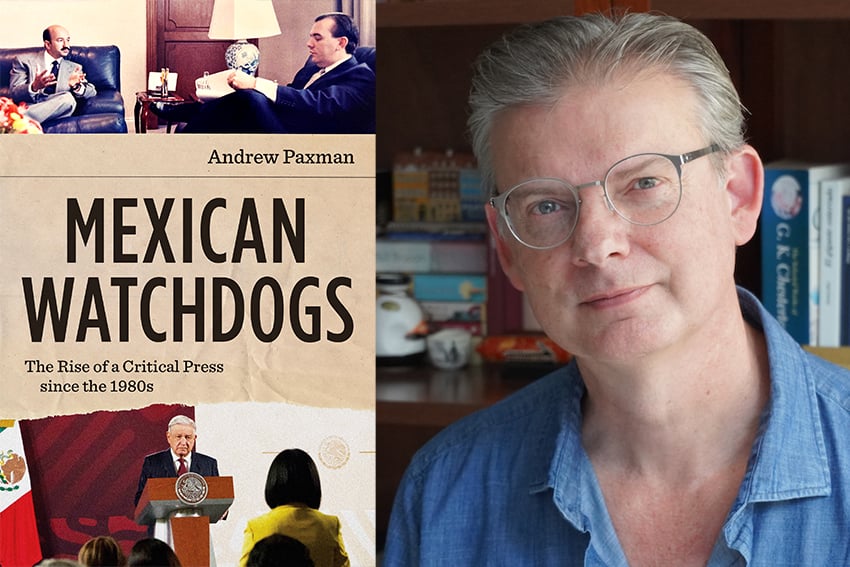
As a young man and aspiring fiction writer inspired by the seminal works of Jack Kerouac and Gabriel García Marquéz, Englishman Andrew Paxman spent the summer of 1990 in Mexico City working on a novel and watching Italia ’90 matches in the capital’s ubiquitous taquerías.
A year later, Paxman returned to the capital and landed a job with English-language newspaper The News, embarking on a journalism career that continued later in the ’90s with a stint as a writer for Mexico Insight, a short-lived news magazine affiliated with the Excélsior newspaper, and subsequently as Latin America correspondent for Variety.
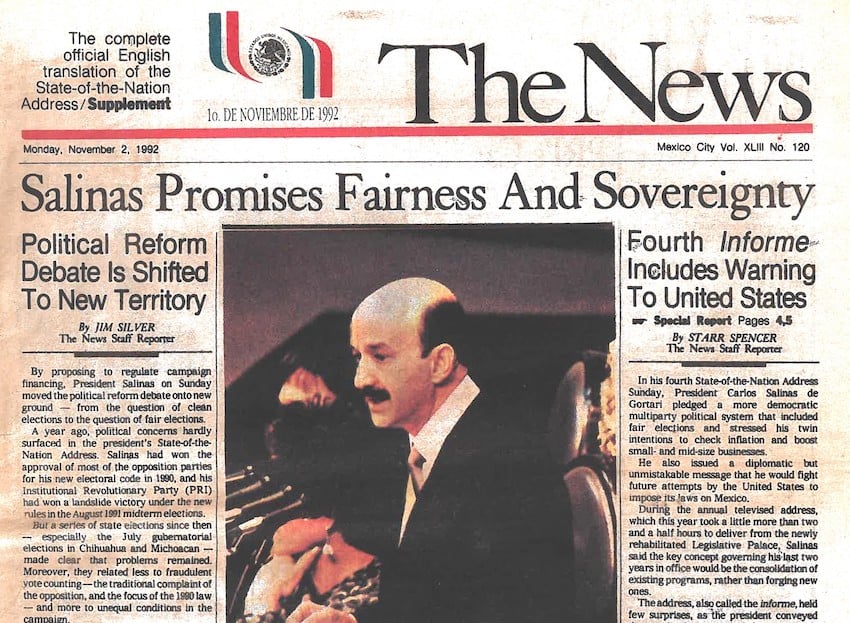
Fast forward 35 years from his debut in The News‘ downtown Mexico City newsroom and Paxman is not a published novelist, as he may have envisioned in his early 20s, but he is the author of three non-fiction books, the latest of which is “Mexican Watchdogs: The Rise of a Critical Press since the 1980s.”
Described as “the first narrative history of Mexico’s contemporary press,” the book charts the emergence and development of a more broadly critical media in Mexico, one that began to break free of the shackles of remunerated subservience to successive Institutional Revolutionary Party (PRI) governments and moved toward editorial independence.
Paxman, now a research professor at the Aguascalientes campus of the Center for Economic Research and Teaching (CIDE), is uniquely qualified to tell the story of the rise of Mexico’s critical press, having worked as a journalist here at a time when the media was in a period of transition and the international focus on Mexico was intensifying in the lead-up to the signing, and subsequent entry into force, of NAFTA. Since leaving journalism for academia, he has continued to closely monitor the Mexican press.
I recently met up with Andrew at a Mexico City cafe to discuss his latest book, which includes chapters on “the (mostly) sell-out press” between 1896 and 1988, and on some of Mexico’s best-known newspapers.
Informed by interviews with some 180 current and former journalists, “Mexican Watchdogs” also includes an introduction in the form of “An Expatriate Memoir,” in which Paxman tells a detailed and colorful story of his own experience working in the Mexican media. An extended version of that introduction can be read on Paxman’s website.

The inspiration for ‘Mexican Watchdogs’
Paxman told Mexico News Daily that he drew his “initial inspiration” for “Mexican Watchdogs” from fellow British historian Benjamin Smith, who is best known for the 2021 book “The Dope, The Real History of the Mexican Drug Trade.”
He noted that Smith’s previous book was “The Mexican Press and Civil Society, 1940-1976,” and recalled that he and the University of Warwick-based historian spoke about collaborating on a sequel.
However, time constraints for Smith meant that Paxman took on the project on his own.
Paxman also said that his experience teaching a Mexican media course to working journalists, and his own background as a journalist in Mexico, were sources of inspiration for “Mexican Watchdogs.”
“My sort of fairly intimate knowledge of Mexican journalism developed over the course of 30 years or so and that all informed the book too,” he said.
A narrative history for a ‘crossover audience’
I asked Paxman how his book appeals to a general, non-academic readership, to people who are interested in learning more about Mexico and its history, but are perhaps not “Mexican media nerds” as such.
“Although I went with a university press, I very much wrote this for a crossover audience,” he said.

“I wrote this in part for people who live in Mexico, who are interested in Mexico. I think it will appeal to the general public because it’s written as a narrative history. It’s not an analytical exercise. There is analysis, but it’s interwoven,” Paxman said.
He explained that the book “interweaves a lot of stories, initially tales of great servility, but chiefly tales of vision and courage — often under fire.”
“… [It’s] largely a collection of stories. It’s the story of a number of significant publishers and writers and reporters and how they have helped democratize Mexico over the last 40 years or so through the media,” Paxman said.
“And so the book is the story of the press, but it’s also the story of how Mexico became a democracy and how Mexico became a country that in some ways became more similar to the United States and Canada in the sense that it developed a plural media and it developed elections that actually mattered, as opposed to the largely theatrical elections that took place for most of the 20th century,” he said.
Some of the most interesting and enlightening parts of the book, I believe, are about the emergence and evolution of Mexican newspapers, including Reforma, which was founded in Mexico City in 1993, becoming a sister paper to the already well-established, Monterrey-based El Norte and bringing what Paxman calls “a breath of fresh air” to the media landscape of the capital.
Among the other fascinating parts of “Mexican Watchdogs” is Paxman’s description of how a cub reporter for Guadalajara’s Siglo 21 newspaper investigated and wrote a story of “pending disaster” a day before a series of explosions rocked the Jalisco capital and claimed more than 200 lives in April 1992. The journalist was Alejandra Xanic, who two decades later became the first — and currently only — Mexican to win a Pulitzer Prize.
Equally insightful is Paxman’s account of how the media covered the launch of ex-president Felipe Calderón’s militarized war on drug cartels in late 2006.
He also considers the very real dangers journalists face in Mexico, with one section focusing on the 2005 kidnapping of Lydia Cacho by Puebla state police.
Indeed, Paxman writes in “Mexican Watchdogs” that “explaining why Mexico’s journalists are so often murdered and why they have an unfairly poor reputation are two of the main purposes of this book.”
The liberalization of the government-press relationship from 1988
As indicated by the full title of “Mexican Watchdogs,” Paxman’s narrative history focuses on the development of the press from the 1980’s onwards.
In our conversation, he noted that Carlos Salinas de Gortari won the presidency in 1988 “in an election that is widely considered to be fraudulent,” and set about “clawing back some credibility” via a liberalization of the relationship between the government and the press.
One of the ways he did that, Paxman explained, was by reducing tariffs on foreign newsprint, effectively ending a state-controlled monopoly of the material.
“This was a signal to publishers that we’re not going to censor you, we’re not going to have this sword of Damocles over your heads like we used to, because in the old days, if your newspaper became too critical, the head of PIPSA, this newsprint company, would tell you, ‘Oh, I’m sorry, there’s no paper for you next week,'” Paxman said.
“So there was a constant threat. And Salinas was saying, we’re not going to use that threat any longer. … And then little by little during the course of his sexenio [six-year term], he made half a dozen or so changes to further liberalize the relationship,” he said.
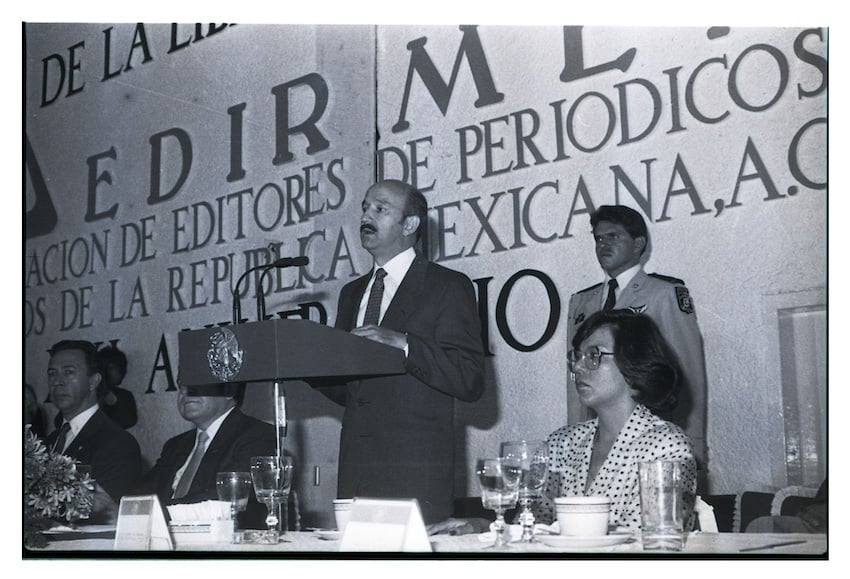
In addition to the “credibility issue,” Paxman said that Salinas’ liberalization of the government-press relationship was motivated by his desire to “make the country look more democratic” amid international scrutiny during the NAFTA negotiations.
NAFTA brought U.S. and other foreign companies into Mexico and they promptly became advertisers, allowing newspapers to wean themselves off government subsidies, and thus break the cycle of subserviency to the PRI, Paxman explained.
“So you have this convergence of factors and then one other really important one is that there was a generation of students in the late ’60s, the so-called generation of ’68, who were involved in the student protests of that year and witnesses to the massacre of Tlatelolco,” he said.
“That didn’t democratize the press at all, but what it did do was plant seeds of discontent and determination to hold the government to account when that became possible. And so young men — and they were mostly men — who were students in ’68, by the time they’re in their 40s, they are in positions of authority in newsrooms. They’re editors and so forth,” Paxman said.
“And so they’re bringing their own convictions to bear at a time that the government is starting to liberalize. So you have all these factors contributing to a real flowering of independent journalism in the Salinas period and that continues under [former president Ernesto] Zedillo in the late 90s and under [Vicente] Fox in the early 2000s.”
AMLO and the media
In “Mexican Watchdogs,” Paxman writes that “press freedoms in Mexico arguably peaked under Fox and certainly began to recede under Calderón,” whose presidency concluded in late 2012.
During Enrique Peña Nieto’s 2012-18 presidency, “the forces that had assailed press freedoms under Calderón persisted,” and legacy media outlets “holding power to account diminished in number,” he writes.
However, during Peña’s sexenio, “new hope arose for Mexican journalism in the form of digital media,” writes Paxman before opining that three news sites — Aristegui Noticias, Animal Político and Sin Embargo — stood out for their investigative work in this period.
He highlights that during his 2018-24 presidency, Andrés Manuel López Obrador held morning press conferences — known as mañaneras — every weekday in a “remarkable feat of nonstop agenda-setting that reduced the press to a secondary role.”
Paxman also acknowledges that AMLO “repeatedly named and shamed columnists, including some who in the past had been equally critical of the PRI and the National Action Party.”
He told Mexico News Daily that it was “very ironic and unfortunate” that AMLO “turned upon” media outlets such as Proceso, Reforma, Aristegui Noticias and Animal Político that “did a lot” to expose corruption in the government led by Enrique Peña Nieto (2012-18) and therefore helped him get elected in 2018.
“He turned upon them because they were holding him to account in the same way. In other words, they were practicing journalism,” Paxman said.
In “Mexican Watchdogs,” he writes:
“Employing a dichotomizing discourse — the ‘good’ press supported his government, the ‘filthy.’ ‘bribe-taking,’ or ‘criminal’ press criticized it — López Obrador not only stigmatized Reforma, Animal Político, Proceso and Aristegui Noticias, he also deprived them of subsidy support. … La Jornada, by contrast, was rewarded for its new role as quasi-propagandist … with more than four times as much government advertising as any other paper.”
Sheinbaum and the state of the press today
After fortifying ourselves with breakfast and more coffee, our conversation turned to the current president’s attitude toward the media and the state of the Mexican press today.
“Claudia Sheinbaum is much less prickly, much less confrontational [than AMLO],” Paxman said, although the president has, at times, criticized media outlets for what she saw as inaccurate or unfair reporting.
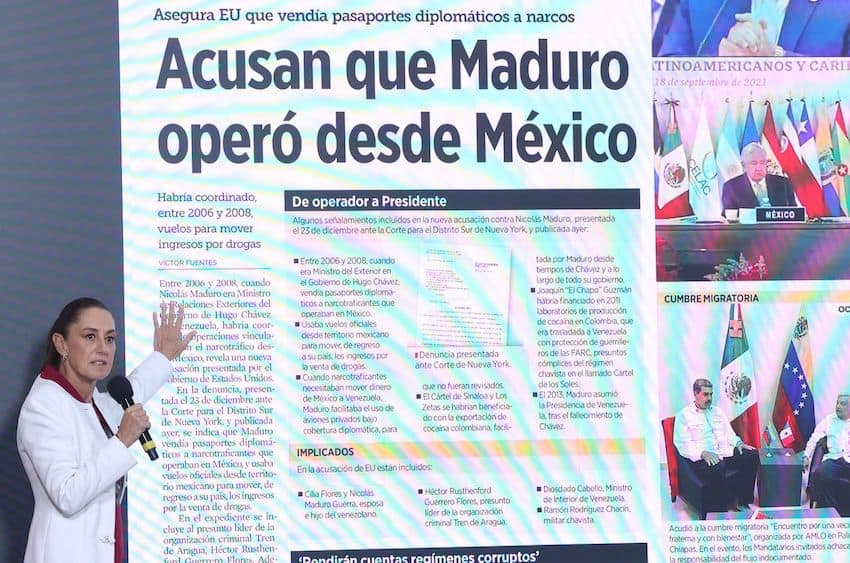
“I think she’s still pretty evasive. She often doesn’t give straight answers. But I think it would be very hard for any politician who undertakes a daily press conference, a politician in any country, to not be evasive when you’re facing the press for two hours every morning,” Paxman continued.
“So it’s partly a consequence of this press conference model that she inherited from AMLO. I think she made a mistake. I think she should have undertaken a weekly press conference rather than a daily one. But she’s hewn very closely to the AMLO style of government,” he said.
With regard to the Mexican media today, Paxman said “there are fewer spaces for critical and investigative journalism than there were 10 years ago, largely because of defunding.”
“AMLO cut public support, subsidy support for the press, by 80%. He said he was going to cut it by 50%, but he actually cut it by 80%. So that meant a lot of layoffs, it meant a lot of further reduction of page counts in papers, and it meant a lot of growth of recycling of information without credit,” he said.
Nevertheless, “investigative journalism is still being done,” Paxman said.
“It’s being done by small, scrappy outfits online. It’s being done occasionally by the major media. Most of them still do it; they just don’t do it as often as they were doing it before,” he said.
“It’s being done by true believers who are working in the states, they may have other jobs, they may be taxi drivers, but they feel the need to hold power to account and so they’re using their spare time to write investigative pieces, sometimes at great risk to their safety.”
Toward the end of our hour-long conversation, Paxman told me he hoped that “forward-looking politicians” in Mexico, “realizing that an independent press is fundamental to democracy,” would “follow the example of most Western European companies in setting up an independent subsidy body for traditional media.”
“… We need an INE for the [Mexican] press,” he said, referring to Mexico’s independent electoral body.
“We need an INE that is going to allocate subsidies, not as political favors … but in order to enable at least a small number of print and online media to survive and carry on doing good work,” Paxman said.
By Mexico News Daily chief staff writer Peter Davies (peter.davies@mexiconewsdaily.com)
* “Mexican Watchdogs” can be purchased online from retailers including Amazon (Mexico and U.S.) and Bookshop.org. It is also available at Under the Volcano Books, a bookstore in the Mexico City neighborhood of Condesa.