
There is a particular unease that arises from hearing stories about crossing a border you have also crossed, but in the opposite direction and under radically better circumstances. I savored Reyna Grande’s new memoir, “Migrant Heart: Essays About Things I Can’t Forget,” in the comfort of my home in San Miguel de Allende, Guanajuato, a gorgeous town famous for its architecture, arts scene, climate and ever-growing expat population. Grande’s life story began only a day’s drive but a world away, in Iguala, Guerrero — a town most of the world now knows, if they know it at all, as the place where 43 students from the Ayotzinapa Teachers’ College disappeared in 2014, an atrocity that still hangs over Mexican public life like an unfinished storm.
The book itself deserves to be met on its own considerable terms, because “Migrant Heart” is not a polemic. It is something much rarer and better: a mid-career writer’s attempt to loosen her grip on the story that made her famous. Grande’s earlier memoirs, “The Distance Between Us” and “A Dream Called Home,” shared the traumas of her childhood and young adulthood, and relayed them so devastatingly that a friend of the author’s once suggested, not entirely as a joke, that the publisher bundle a box of tissues with each copy.
Reyna Grande is the ‘queen of misery’ no more
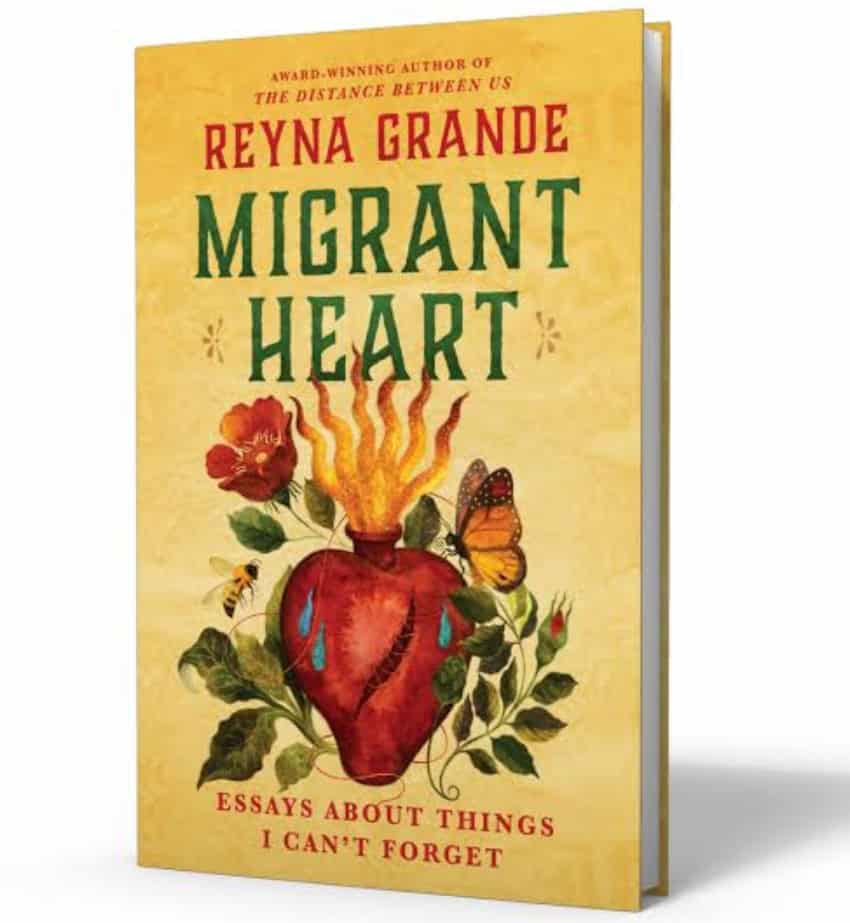
In this new memoir-in-essays, Grande resists that role. She opens by recounting her experience of being crowned the “queen of misery,” and the whole book can be read as her working out what it might mean to put down that crown without abandoning the truths that earned it.
The 18 essays here range further afield than her previous work, into failing eyesight, gardening, motherhood, menopause and the peculiar vertigo of raising American children who will never fully understand her scars or carry her burdens. She writes about the Ayotzinapa disappearances not as distant news but as a wound in her hometown’s soul. She writes about losing fluency in Spanish as the price of gaining English, and about the complicated inheritance of colorism within Mexican and Mexican American communities — including, in one unsparing passage, her own mother’s hope that her grandchild would have blue eyes.
Grande has said in interviews that she has worried about repeating herself, about her writing calcifying into “immigrant trauma porn,” and in these essays you can feel her actively resisting that fate, reaching instead for the harder, less marketable material of an ordinary life continuing after the extraordinary parts are over. This is a writer who has spent two decades making readers weep; here, she seems more interested in proving she can let herself, as well as her readers, breathe.
In “Migrant Heart,” Grande again affirms that pain can be transformed into power. But she finally permits herself to set some careful boundaries, too, no longer feeling compelled to reexamine every wound for the reader’s benefit.
Not a comfortable read, but one filled with ‘hard truths’
For us expats reading this book in any of the beautiful, sunny Mexican towns that serve as havens for people fleeing not violence and brutal poverty but cold winters, polarized politics and high property taxes, “Migrant Heart” is not entirely comfortable reading, and I don’t think it should be. But it is essential reading precisely because our comfort here was built on a complicated history that these essays insist we look at directly. Living where I live, I could not read this without feeling implicated, gently but unmistakably, in the very economic and political inequities that produced both the author’s and my own radically different migrant experiences.

Grande has written a book about what it costs to leave home when you have no choice; the least those of us who have enjoyed that choice can do is read it all the way through and wrestle with some hard truths along the way.
Ann Marie Jackson is a book editor and the award-winning author of “The Broken Hummingbird.” She lives in San Miguel de Allende and can be reached through her website: annmariejacksonauthor.com.