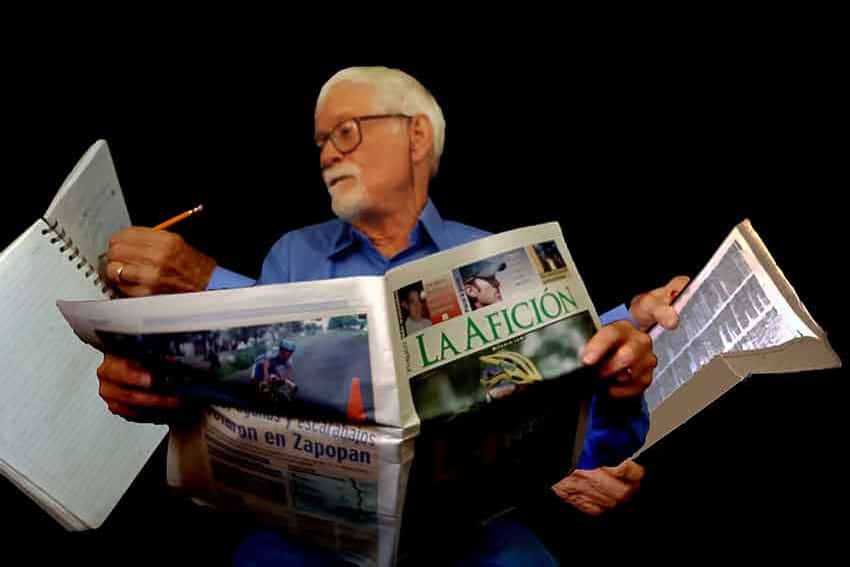
Long ago, I reached the point where I could carry on a conversation in Spanish about practically any topic. It gave me the feeling I had reached a certain mastery of the language.
After all, I’ve spent years living in a genuine Mexican community with very few foreigners. On top of that, my wife just happens to be a first-rate Spanish teacher who never fails to let me know cuando metí la pata (when I made a blooper).

Nevertheless, every time I picked up a newspaper and glanced at the front page, I would wince. It seemed like every headline contained at least one word I had never heard of. A few examples:
- Otorgan premio a Selene Argueta
- El Congreso insta a modificar la ley
- El Banco Central sale al quite para frenar la caída del peso.
- La Comisión avala el nombramiento del subsecretario
- El tribunal suspende cautelarmente la aplicación de la norma
- El Congreso subsanará omisiones del dictamen
Buying the newspaper and reading a few paragraphs frequently left me even more depressed, as I would inevitably come upon yet more words that I’d swear had never been spoken in my presence. In fact, I questioned whether they had ever been spoken in anybody’s presence!
So, what’s going on here?
Conversational versus cool
First, it’s important to note that journalists around the world — writing in any language — delight in using expressions beyond those commonly used in casual conversation: trendy words, sports jargon, idioms, metaphors and allusions — anything to spice up those headlines.
Here are just a few examples in English. The italicized words would probably perplex most nonnative speakers of our language, no matter their fluency:

- Iran war roils markets
- Gulf states fend off attacks
- Mexican peso tanks
- “Don’t turn Kharg Island into America’s next quagmire”
- Couple snared in phony kidnapping scheme
- North Korea vows to ramp up nuclear weapons production
In the Spanish-speaking world, this tendency to “juice up” headlines and stories leads writers to use metaphors and sport-inspired expressions, just like their colleagues around the world. Just bear in mind that one of those sports could be bullfighting, with jargon all its own.
Spanish-language journalism’s formal vocabulary
In addition, the Spanish-speaking world has something that journalists and linguists call el registro formal, a kind of elevated journalistic register that was shaped over the years by law, bureaucracy and editorial tradition.
In this elevated lexicon, decir is replaced with a more precise word like aseverar. Hacer may become confeccionar. Instead of tener, you may see ostentar, and buscar is elevated to indagar.
Admirers of this lexicon claim that it brings precision, conciseness and clarity to journalism, substituting vague expressions with more exact terminology.
I think the same could be said for the lexicon you find in legal contracts. After all, who but a lawyer enjoys reading “legalese?”
This Spanish journalistic register differs sharply from everyday speech. Headlines favor abstract, authoritative words that sound precise and official — but are rarely used in daily conversation.
In other words, newspaper Spanish is not harder Spanish. It is a different kind of Spanish.
Less-official-sounding Spanish

Here are the Spanish headlines presented earlier, followed by a less-elevated version of the same.
- Otorgan premio a Selene Argueta
→ Le dieron un premio a Selene Argueta.
(Selene Argueta was given an award.)
- El Congreso insta a modificar la ley
→ El Congreso pide que se cambie la ley.
(Congress is calling for the law to be changed.)
- El banco central sale al quite para frenar la caída del peso
→ El banco central actúa para frenar la caída del peso.
(Central bank steps in/comes to the rescue to halt the peso’s fall. Note: salir al quite is an expression used in bullfighting for the maneuver by which one torero distracts the bull to save another who is in danger.)
- La Comisión avala el nombramiento del subsecretario
→ La comisión aprueba el nombramiento del subsecretario.
(The committee approves the appointment of the undersecretary.)
- El tribunal suspende cautelarmente la aplicación de la norma
→ El tribunal frena temporalmente la aplicación de la norma.
(The court temporarily halts the enforcement of the regulation.) - El Congreso subsanará omisiones del dictamen
→ El Congreso corregirá los errores de la opinión.
(Congress will fix the omissions in the ruling.)
Reading the newspaper in Mexico doesn’t just require good Spanish. It requires familiarity with institutional Spanish.
The six-arm solution
In bygone days, the procedure for mastering journalistic vocabulary was simple but overwhelming: You would take in hand a good bilingual dictionary (the thicker the better), the newspaper of your choice and a spiral notebook where you would write the new words and their translation for future review and reference. It was an approach that required the patience of a monk, and to do it, you needed six arms.
Today, you can whiz through a newspaper or an obra of Spanish literature using the tap-and-hold feature of your smartphone or e-book reader, which will give you an instant definition or a translation of “elevated” words like otorgar and cautelarmente.
Try MND Tutor
To help you find your way through the maze of las noticias en español, take a look at our own MND Tutor. It operates at three levels, plunging you into topics like los carteles, the FIFA World Cup, Mexico’s dark colonial past and the deep roots of El Día de San Valentín. After each reading, you will take a quiz to let you know how much you’ve picked up.
For even more help, you can visit websites like EasySpanishNews or Spanish in Levels, designed to help you expand your vocabulary in Spanish.
Just be warned: Teachers of Spanish as a foreign language consider learning to read the newspaper one tiny step along the long road to the mastery of Spanish literature. But take that first step!
John Pint has lived near Guadalajara, Jalisco, for more than 30 years and is the author of “A Guide to West Mexico’s Guachimontones and Surrounding Area” and co-author of “Outdoors in Western Mexico.” More of his writing can be found on his website.