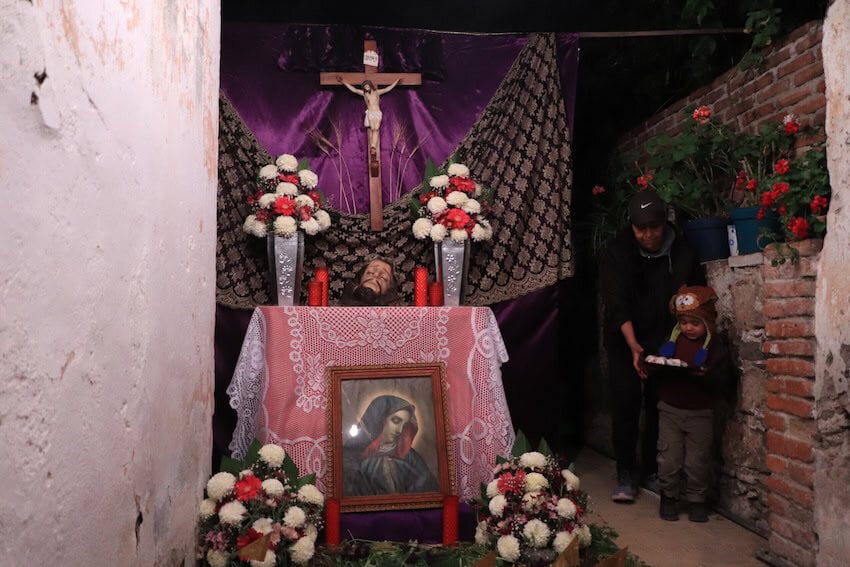
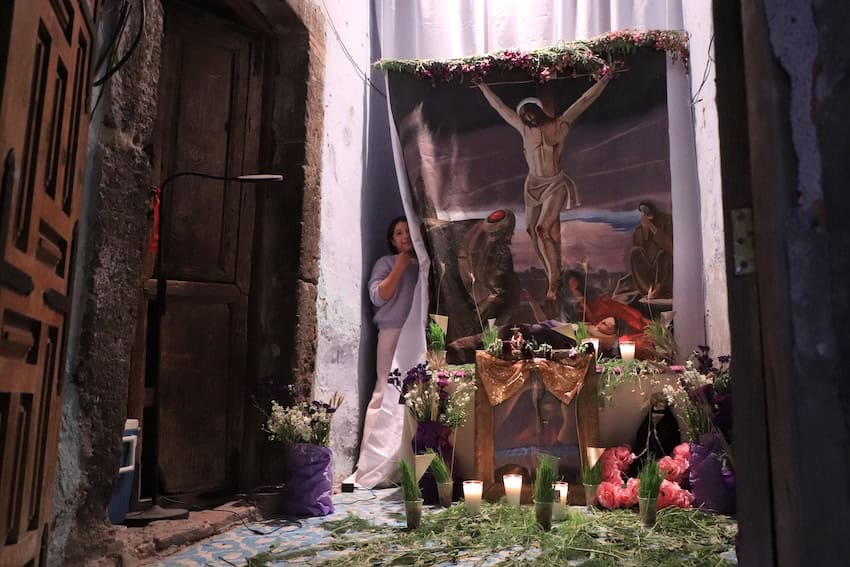
Each year, at the beginning of Holy Week, the homes of San Miguel residents get ready to open their doors to visitors on the day known to Catholics as the Friday of Sorrows, or Viernes de Dolores. On this day, two days before Palm Sunday, the scent of chamomile mingles with that of tuberoses and the white and purple flowers that decorate the altars.
At the center of each display — carefully assembled by the families — stands the image of Our Lady of Sorrows, the undisputed protagonist of this celebration.
A tradition binding a displaced community
In the afternoon, neighbors go out to walk the streets, visiting house after house to admire the altars. In exchange for their visit, they receive a refreshing treat: a glass of flavored water, a popsicle, an ice cream cone, a piece of candied chilacayote squash, or a delicious capirotada bread pudding. In this way, Friday of Sorrows becomes not only an act of faith, but also a ritual of togetherness that has kept San Miguel families united for generations.
For as long as I can remember, this has been one of my favorite traditions. At first, I was excited about the idea of collecting popsicles for every altar I visited. Over the years, however, I learned to appreciate its mystical essence: the warmth of the candles, the fragrance of the flowers, the songs playing over the loudspeakers and that unique feeling of being invited into the intimacy of a neighbor opening their home to you.
Today, the tradition faces new challenges: Rising housing costs, tourism and gentrification have displaced many San Miguel de Allende families from the downtown area and, with them, part of Holy Week’s original spirit.
Although some houses — such as those on Aldama, Terraplén, or Tenerías streets — still preserve the magic, other emblematic ones, like that of the Dobarganes family — which had their altar in the patio of their house on Correo and Recreo, with its famous hand on the door — are now hotels that no longer set up their altar.
This year, the atmosphere changed even more with a salsa show organized in the city’s main plaza, the Jardín Principal, breaking with the calm and mysticism that characterize the Friday of Sorrows. While tourists enjoyed an ordinary Friday in San Miguel, locals tried to find their identity amid the hubbub.

And then an inevitable question arises: how can we keep this tradition and its deeper meaning alive? To understand this, I spoke with Francisco Mota, creator of the page Memoria San Miguel, who completed a graduate degree in Territory, Tourism and Heritage at Benemérita Universidad Autonoma de Puebla and is a San Miguel de Allende native. He shared with me the history, the symbols and the value that this celebration holds for the community.
What is the Friday of Sorrows?
Viernes de Dolores (Friday of Sorrows) is a Catholic tradition that recalls the seven sorrows suffered by the Virgin Mary during the passion and death of Jesus Christ. Celebrated on the Friday before Palm Sunday, it marks the beginning of Holy Week in the liturgical calendar. This practice arrived in Mexico during the Viceregal period and took root especially in the central states — Guanajuato, Querétaro, Aguascalientes, Tlaxcala and Jalisco — while also remaining very strong in regions of Oaxaca and Chihuahua.
In San Miguel de Allende, the tradition has been documented since the 18th century, when the city was one of the main textile centers of New Spain and Our Lady of Sorrows was named patron saint of the weavers’ guild. It is no coincidence that the chapel of Our Lady of Sorrows is located precisely in the old neighborhood of shawlmakers and cambaya weavers, which extended around Barranca Street.
According to Mota, the altars for Viernes de Dolores have preserved their essential elements, although they have also incorporated new ones in recent decades. A distinctive hallmark of San Miguel is its use of “carpets” made of thousands of aromatic herbs in altars and processions. Relatively recently, if we consider that this has been a living tradition in the city for three centuries, carpets of painted sawdust have also been added.
Our Lady of Sorrows’ altars: Each detail a symbol
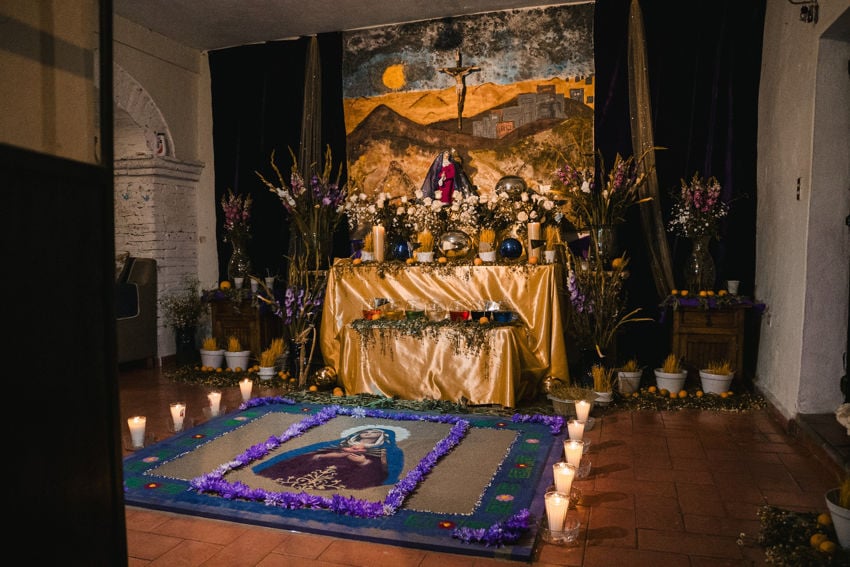
Our Lady of Sorrows is the main figure of the altar. This is an image of Mary dressed in mourning, wearing a blue or purple mantle and a sorrowful expression and, often, bearing one or seven daggers that pierce her heart, symbolizing the sorrows that accompanied the passion of Jesus. This imagery was very widespread in the 18th-century Hispanic world.
The altar is set on a table covered with a cloth and enriched with a series of symbolic elements:
- Bitter oranges with little flags of golden paper allude to Mary’s heart pierced by bitterness.
- Wheat sprouted in the dark, which must appear yellow, represents Christ as the hope of life and resurrection.
- The purple color in cloths, backdrops and papel picado expresses mourning and penitence. In San Miguel, the use of carpets made of chamomile, fennel and mastranto — aromatic and medicinal herbs that fill the space with fragrance — is also typical.
Finally, the altar is lit with candles or votive candles, a metaphor for the light of faith that accompanies sorrow. The altars are opened to the public in the afternoon of the Friday before Palm Sunday. Hosts offer a glass of fresh water, ice cream, an ice pop, capirotada or candied chilacayote — small delicacies that transform Mary’s sorrow into shared sweetness.
Tourism, gentrification and displacement
Viernes de Dolores is, above all, a popular and domestic celebration: It survives wherever the families of San Miguel live. Each altar reflects the personality of a household and the fabric of a neighborhood.
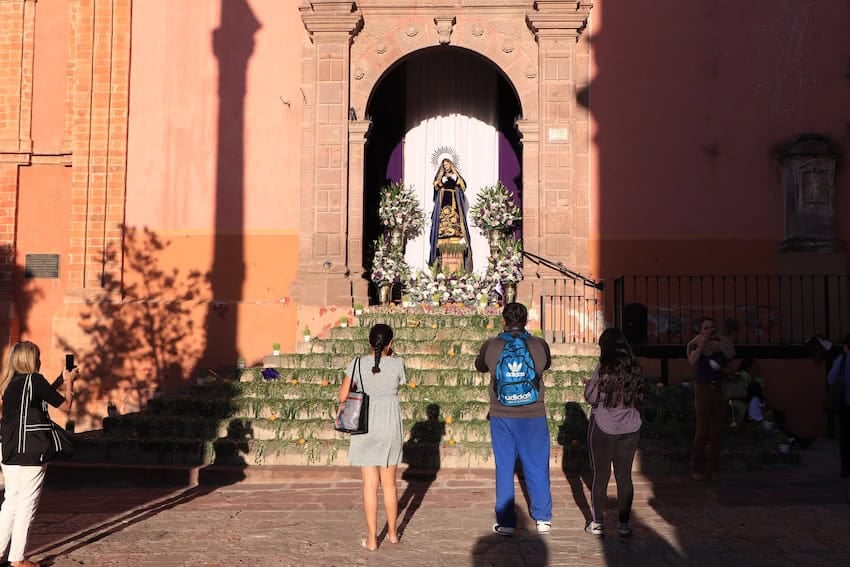
As San Miguel’s Historic Center has emptied of residents and is increasingly oriented toward tourism and short‑term rentals, home altars have decreased in this part of the city. Many of the most beloved ones now persist only in memory. However, the tradition does not disappear: It moves.
In recent decades, altars have flourished in neighborhoods outside the city center, such as Guadalupe, San Antonio, San Rafael and Infonavit Allende. Viernes de Dolores moves with its people and seeks new spaces where it can take root once again.
Viernes de Dolores offers anyone the chance to experience San Miguel in a hospitable, family atmosphere. Opening one’s front door to strangers and offering them something to eat or drink, without expecting anything in return, is a simple gesture that reminds us how urgent it is to trust one another, to weave bonds with our neighbors, to acknowledge each other and greet each other.
It also invites us to look back and acknowledge the work of the wool and cotton weavers who gave renown and prosperity to this viceregal city. Without their craft, the architectural beauty of San Miguel simply would not exist as we know it.
Today, few of these artists remain, and it is urgent to create spaces where their guild is recognized as one of the fundamental pillars of the city’s history.
What the day represents
Residents preparing San Miguel de Allende’s streets with colorful carpets of flower petals, sawdust and other materials last week in the city center, in honor of Viernes de Dolores. (Siente San Miguel/Facebook)
In many cities, traditions like Viernes de Dolores survive only behind museum glass. San Miguel de Allende, by contrast, still celebrates its traditions in the streets, in patios and in living rooms, with festivities that are two, three or even four centuries old.
This speaks to the deep roots of its inhabitants and to a capacity for resilience that has carried them through wars, epidemics, droughts, migration and crises that at various points nearly turned the town into an empty place. Keeping these practices alive is not just a matter of nostalgia: It means caring for a community network, a tradition that has allowed the city to rise again and again.
“Setting up the altar means continuing a chain of family memory. It means preserving a custom that my mother, Guadalupe, instilled in me when I was a child and that she, in turn, learned from aunts and grandmothers who lived on Loreto and Barranca Streets,” said Mota. “As I prepare the altar, I remember the afternoons when I helped her; although she is no longer here, I feel her presence among the flowers, the scents of the herbs and the wax sculpture she commissioned for our home.”
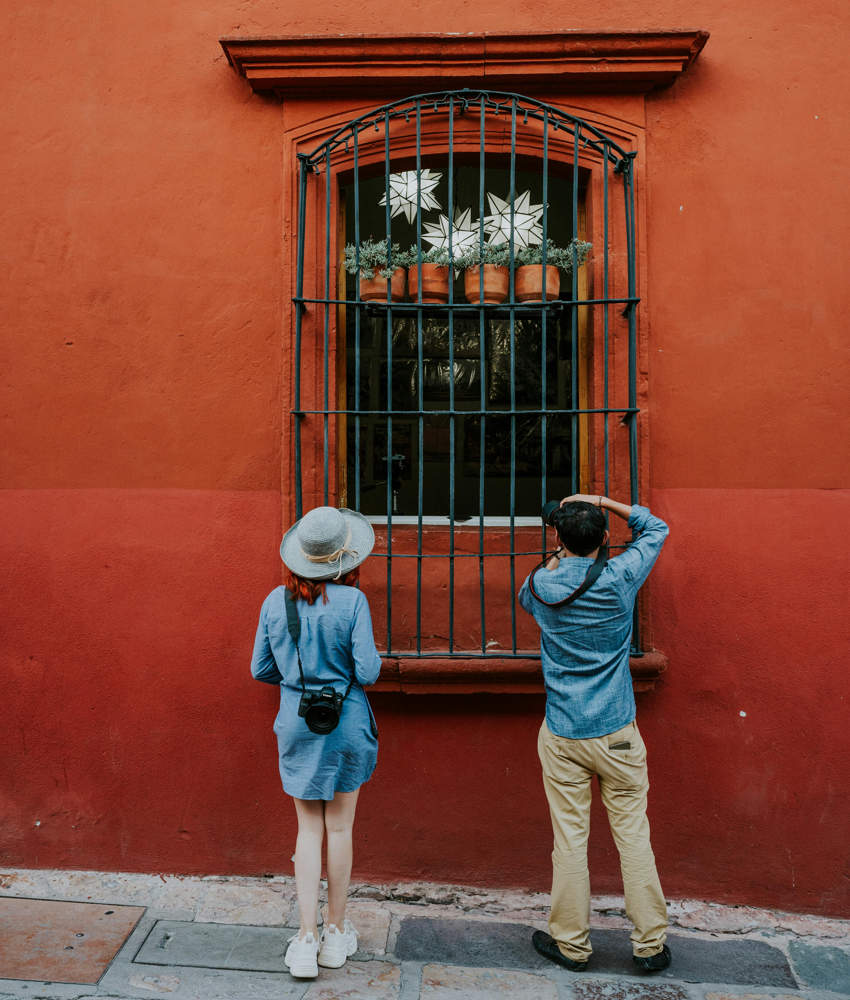
Tourist cities like San Miguel de Allende run the risk of sacrificing their identity in exchange for pretty but empty backdrops, designed for the perfect photo rather than for everyday life. When traditions are shaped only to please visitors, they cease to be community rituals and become mere scenery.
This phenomenon is not unique to San Miguel: it is repeated in many destinations around the world. That is why, faced with the city’s enormous popularity, the community must remain firm in protecting what makes it unique and what, paradoxically, is what attracts those who choose to live here.
In times marked by media saturation, war, climate crisis, political uncertainty, the irruption of artificial intelligence and an excess of digital life, it is vital to have real spaces in which to disconnect from the noise and return to what is essential. Traditions like Viernes de Dolores offer exactly that: a reason to go out into the street, look others in the eye, share food, stories and silences. Ultimately, they are a way to remember that we are not alone.
Voir cette publication sur Instagram
María Ruiz is the Director of Digital Marketing at Mexico News Daily. She enjoys photographing her hometown of San Miguel de Allende in her spare time.