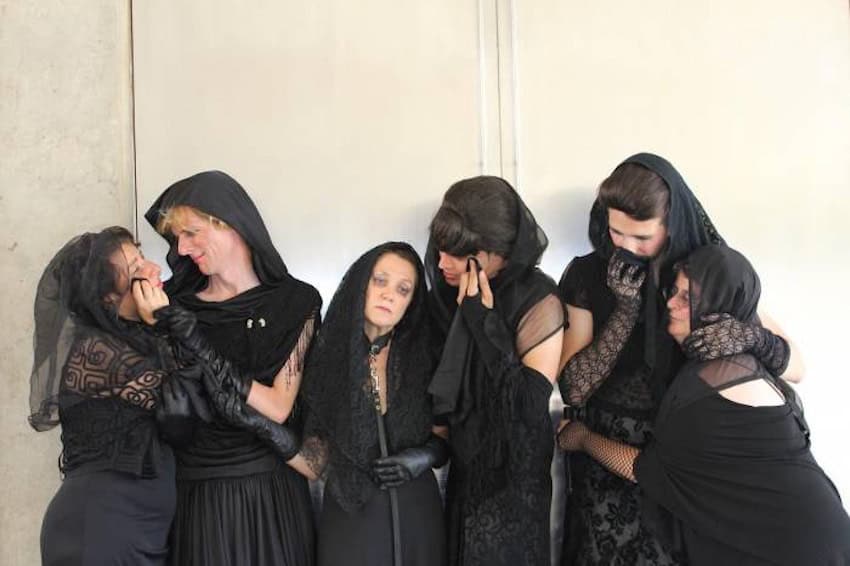
The expression “only in Mexico” holds true in many instances. To exemplify it, let me tell you about a very peculiar event that takes place every year during the Day of the Dead celebrations (and that only makes sense in Mexico): The National Mourners Contest, where participants compete to deliver the most authentic display of grief.
Historically referred to as plañideras in Spanish (mourners), these women were hired to weep inconsolably and theatrically during funerals to enhance the atmosphere of pain and sorrow. The tradition can be traced back to ancient Egypt, where women would join the funerals of royals and the elite to cry for the deceased.

How professional mourning arrived in Mexico
The tradition arrived in Mexico with Spanish colonization and flourished during the Mexican Revolution. It particularly thrived in the states of Michoacán, Querétaro, San Luis Potosí, Guanajuato, Mexico City and México state.
Although the tradition is not originally from Mexico, this is the only country in the world where the practice still survives, albeit with a comic twist — as a contest.
“I like people to applaud me,” Amelia Rodríguez, a professional mourner with 17 years of experience and five winning titles, told the Mexican newspaper Nmás. “Even if I don’t win, the audience’s applause is my biggest satisfaction.”
Since its inception in 2005, the competition has been held annually as part of the Day of the Dead festivities in the small city of San Juan del Río, Querétaro. The event is now a tourist attraction that receives hundreds of attendees from all over the country.
Comedy, not tragedy
But far from being a tragic event, the atmosphere has a somewhat comical feel. Karla Alvarado, who has won several editions, said that people go see the women cry not to dwell on their pain, but to have fun.

“There was one edition in which the environment was more serious, but I don’t think it was as successful because people are looking to have fun and a pleasant time with their family, with their children, not to feel more pain than what they’re already carrying. So, it’s funny now,” Alvarado told the news agency EFE in 2022.

Alvarado, along with her mother, Ana Patricia, has competed in the contest for 10 years.
How does the contest work?
At the event, the competing mourners dedicate their tears to two deceased individuals. One is previously assigned, while the other individual is revealed onstage. The crying performance lasts one minute.
To add to the drama, a coffin is typically installed on stage. Participants typically recite dramatic laments, pray, but also insert more theatrical elements, such as throwing themselves to the floor or over the coffin, pounding their chest, and whatever else it takes to achieve a crying victory.
A panel of judges evaluates the participant’s overall crying display, her creativity, outfit, authenticity, acting skills and body language.
“Crying cleanses the soul,” Olga Ibarra, winner of the 2022 edition, said. “And to make other people cry and shudder also cleanses the soul.”
Recognition, plus prizes
Winners take home not only audience recognition but also a monetary prize.

This year, the top winner will win 6,000 pesos (US $324), while second place gets 4,000 pesos (US $216) and third place 2,000 pesos (US $108). A recognition award is also granted to the most original outfit.
If you want to see the action for yourself, the contest takes place on Nov. 1 at 8:30 p.m. at the Plaza Independencia in San Juan del Río, Querétaro. Admission is free.
With reports from EFE and El Sol de México
Gabriela Solis is a Mexican lawyer turned full-time writer. She was born and raised in Guadalajara and covers business, culture, lifestyle and travel for Mexico News Daily. You can follow her lifestyle blog Dunas y Palmeras.