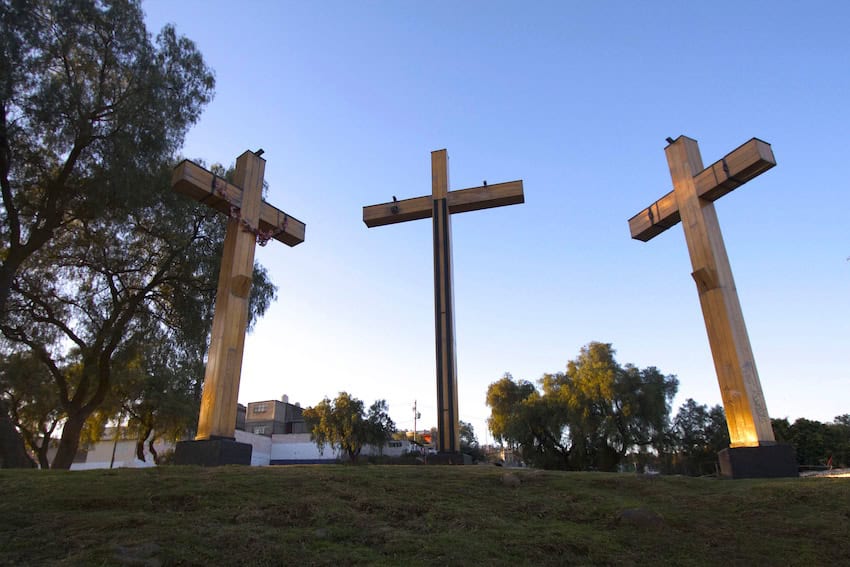
It’s a bit of a strange phenomenon. The tool conquerors used to impose their religion 500 years ago is now a deeply beloved tradition in Iztapalapa. It has even been designated as Intangible Cultural Heritage of Humanity. The Passion Play of Christ in the Mexico City borough was added to UNESCO’s list in December 2025, and this year’s reenactment will be the first to occur since the designation.
What is The Passion Play of Christ?
Celebrated since 1843, the Passion Play of Christ in Iztapalapa is more than just a theatrical representation. The tradition represents a communal moment for gathering and celebrating faith. It occurs every Good Friday on the streets of the borough. While the play is taking place, a market and a fair are held, attracting millions of visitors. According to local records, as many as 2 million spectators have attended.
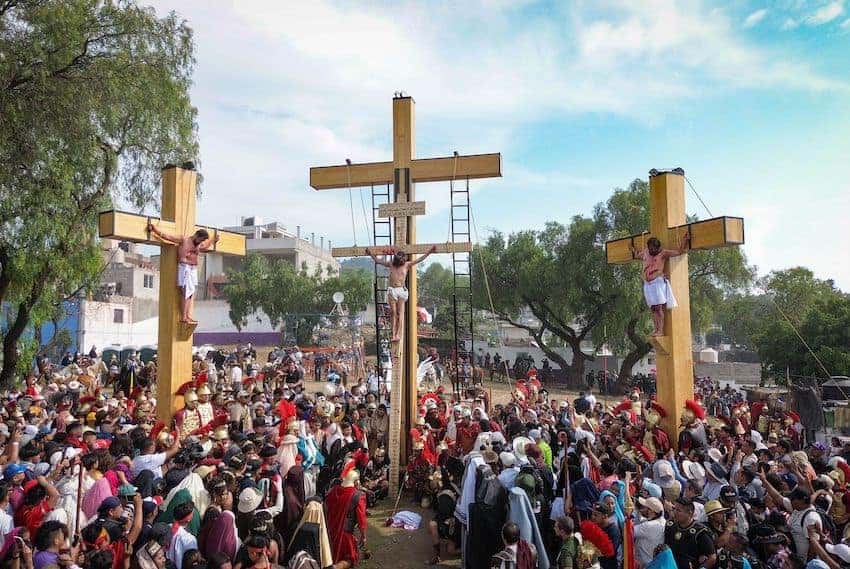
The depiction follows the 14 stages of the Via Crucis of Jesus, from the moment he is condemned to the moment he is laid to rest in this tomb. Throughout the play, devotion mixes with performance: everyone who dresses up as Jesus becomes him, suffering just like him, walking barefoot on the road — sometimes even carrying a human-sized wooden cross — while the sun intensifies as the hours go by.
The Mesoamerican past of Iztapalapa
To understand how these traditions intersect, it’s helpful to consider Iztapalapa’s Mesoamerican heritage. Iztapalapa has never been a forgettable part of the Mexican Central Valley. Its urban past dates to pre-Hispanic times. This settlement was the southern neighbor of the Mesoamerican city of Tenochtitlán. Iztapalapa was the perfect boundary for an amphibious metropolis. It marked the divide between fresh water from Xochimilco and saltwater from Texcoco. Pre-Hispanic Itzapalapa also had the mountain of Huizachtitlan (now Cerro de la Estrella) at its heart. This mountain provided the city with the best of both worlds. On one side was a wet ecosystem, ideal for growing food on chinampas. On the other side was a dry, firm highland.
Iztapalapa was also the site of one of the most important pre-Hispanic ceremonies: El Fuego Nuevo. A new cycle began every 52 years. Huizachtitlan was the ideal spot to receive it. According to Nahuatl translator and researcher Rodrigo Ortega Acoltzi, the ceremony was elaborate, featuring music and processions.
“Time is renewed every 52 years in pre-Hispanic Anáhuac. Existence itself was renewed every 52 years. This comes from the coordination of the two Mexica Calendars. One is the agricultural calendar (360 days plus 5), and the other is the divinatory calendar (260 days). This renewal represents going back to the moment when the world was created,” says the specialist.
Ortega explains that priestesses and priests came from Tenochtitlán, bearing the regalia of various deities. They danced on top of Cerro de la Estrella and finally sacrificed a prisoner, whose chest the fire was lit on, for the new period of 52 years.

If we compare this tradition with the one we can appreciate today at the Passion Play of Christ, some similarities are impossible to miss. This connection comes to light when considering the role of sacrifice: Mexica ceremonies often required physical pain, just as the Passion Play reenacts — and in some cases embodies — suffering. Renewal is another shared element. In both traditions, something sacred is destined to die and be reborn in a new form. There is also a pilgrimage, as people now gather in Iztapalapa to follow the performance, recalling past processions. Finally, the significance of caves links both traditions.
El Señor de la Cuevita
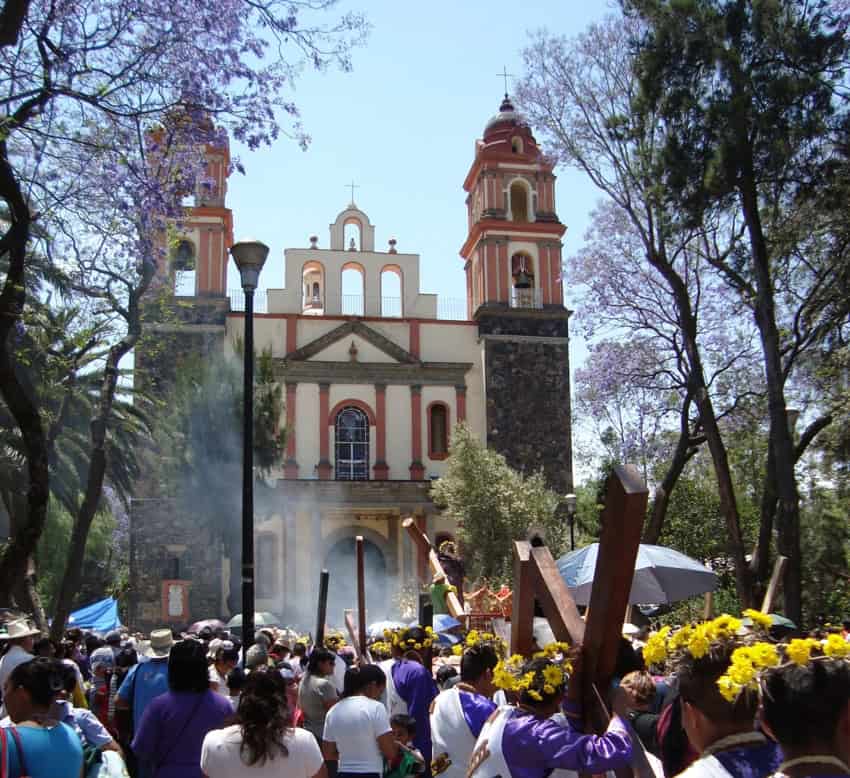
If there was something sacred in Mesoamerican culture, it was caves. These rocky, obscure formations represented not just the gate to the underworld but also the fertility that comes with their humid nature. That’s why it is not surprising that when a pilgrimage from Oaxaca arrived in Iztapalapa in 1687, a miracle happened inside a cave: El Señor de la Cuevita appeared.
The stewards who carried the images of Christ had to stop at Cerro de la Estrella to rest for a few hours. When they were ready to leave, the statue refused to go. The statue that had been easy to carry was now impossible to move. Instead of trying, a small sanctuary was built around the Lord of the Cave, El Señor de la Cuevita.
Almost 200 years later, an awful epidemic hit Iztapalapa. Locals went to El Señor de la Cuevita to ask for help. They promised to reenact the Passion of Christ every Holy Week in exchange for the tragedy to end. He completed his part of the deal, and the illness soon passed. Now, every year, locals keep the promise their ancestors made in 1833.
Since 1843, the Passion of Christ has been represented year after year in Iztapalapa. It has become a symbol of local identity. The plays and the market are always organized locally by those truly devoted to preserving the tradition. This devotion has continued for generations.
Lydia Leija is a linguist, journalist and visual storyteller. She has directed three feature films, and her audiovisual work has been featured in national and international media. She’s been part of National Geographic, Muy Interesante and Cosmopolitan.