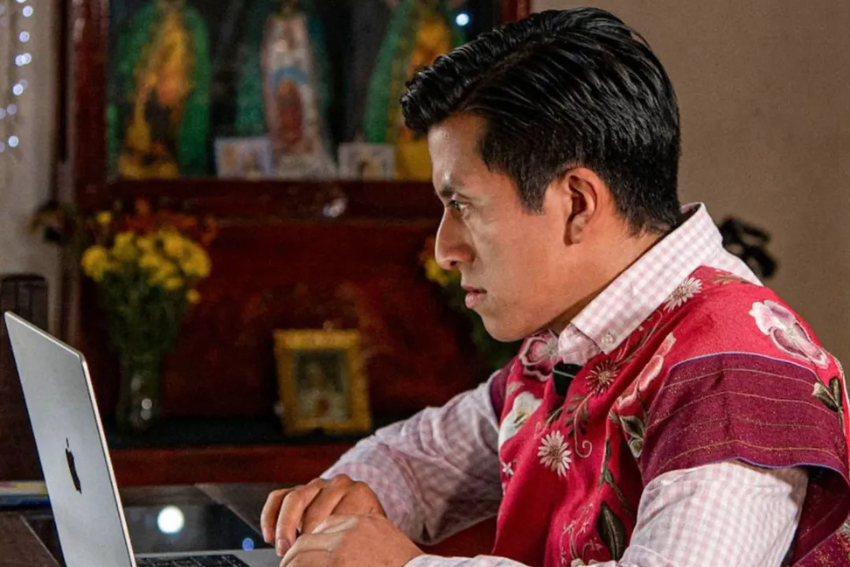
An educator in the southern Mexican state of Chiapas is bridging the gap between Indigenous language and artificial intelligence by teaching Tzotzil to ChatGPT.
Andrés ta Chikinib, a 29-year-old teacher and poet, had an amused grin on his face as he described his unusual pupil.
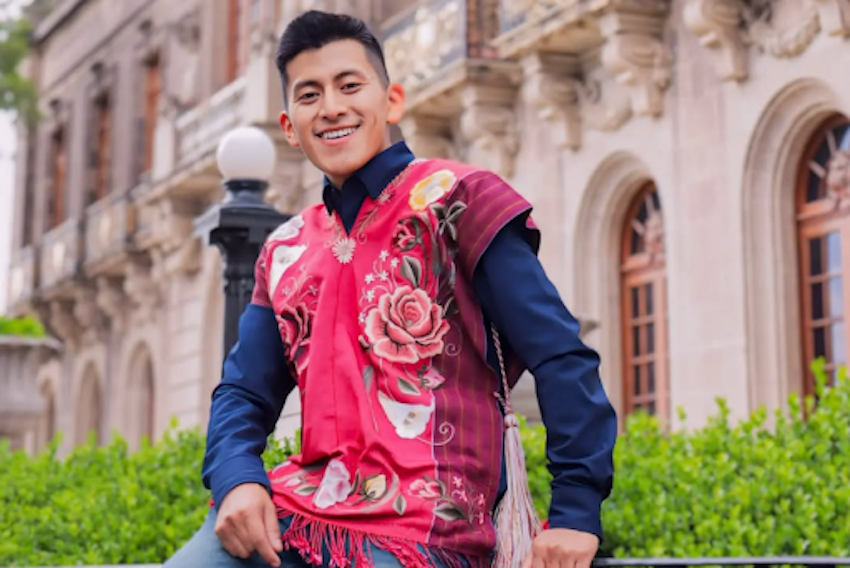
“ChatGPT has become another student, inquisitive and persistent, demanding clarity and coherence,” said the resident of Zinacantán, a municipality of 45,000 in the Chiapas highlands predominantly inhabited by Tzotzil Maya.
Chikinib has spent nearly a decade promoting Tzotzil literacy — despite only learning to read and write in his own tongue at age 19.
A lack of classroom materials led him to a novel solution: “As a Tzotzil language teacher, I couldn’t find any material to share, so I started creating it myself. But this work takes a lot of time.”
Chikinib began by feeding ChatGPT — an online, AI-powered chatbot — his dialect’s vocabulary, grammatical structures and core rules. He deliberately avoided any translations into Spanish.
He said he’s been using the Tzotzil dialect spoken in his own village or region. Tzotzil is made up of several distinct regional dialects that can differ in pronunciation, vocabulary and some grammar; intelligibility between them varies.

He said ChatGPT responded not only by repeating what was taught, but by asking questions, recognizing linguistic patterns and even catching roots unique to Tzotzil.
His goal extends far beyond novelty, nor is it to translate Tzotzil into Spanish or create a structured learning model.
Rather, he wants to ensure that the language — spoken by more than 400,000 people in Chiapas — has a presence in the digital world, is accessible to young people and future generations, and gets the same respect as it does in the community.
However, it is unclear exactly how his work will benefit others in the short term. Interactions with ChatGPT generally improve the AI’s performance only within that user’s session or context — unless the data is specifically used to retrain underlying models or converted into face-to-face teaching materials.
“If we don’t share, how can we demand institutional respect or visibility?” Chikinib said, responding to critics who question digitizing languages — such as José Daniel Ochoa Nájera, a linguist in Chiapas at the State Center for Indigenous Languages, Art, and Literature (CELAL).
Ochoa warned of a “linguistic colonialism,” in which “some languages” get expanded through digital technology, while others “remain marginalized.”
“AI can tell our stories, yes,” he added. “But who decides which stories and how they are told? Technology can be a tool or a dispossession.”
According to the latest figures from Mexico’s National Institute of Statistics and Geography (INEGI), Mexico boasts 68 Indigenous languages (encompassing 364 variants) spoken by some 7 million people. Mexico is among the top 10 nations globally with the most Indigenous languages, ranking second in Latin America behind Brazil.
About 6% of Mexico’s population of 132 million can speak Nahuatl, Tzeltal, Maya, Zapotec, Tzotzil, Mixtec or another Indigenous language. Still, language loss remains a serious concern, as nearly 300 Indigenous languages have disappeared historically in Mexico. The global rate is about 25 languages disappearing annually.
With reports from MVS Noticias, López-Dóriga Digital, Radio Formula and Diario de Yucatán