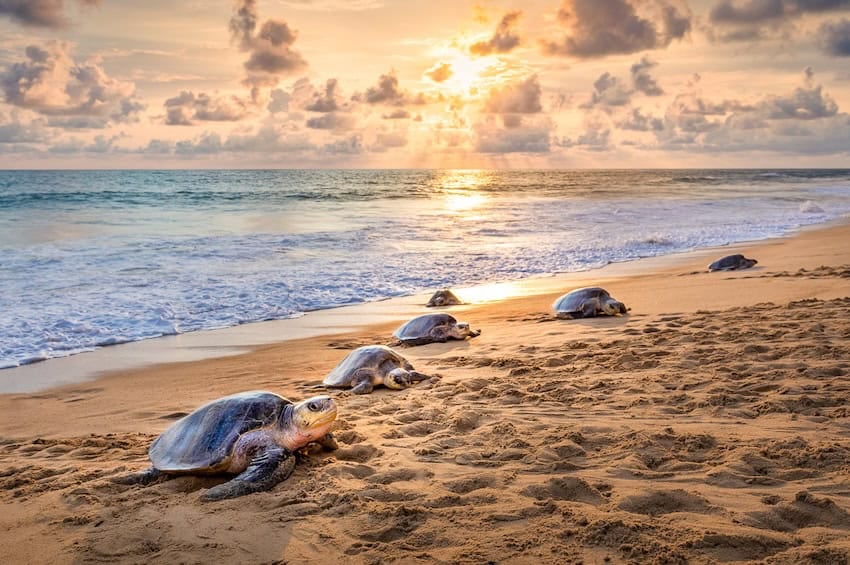
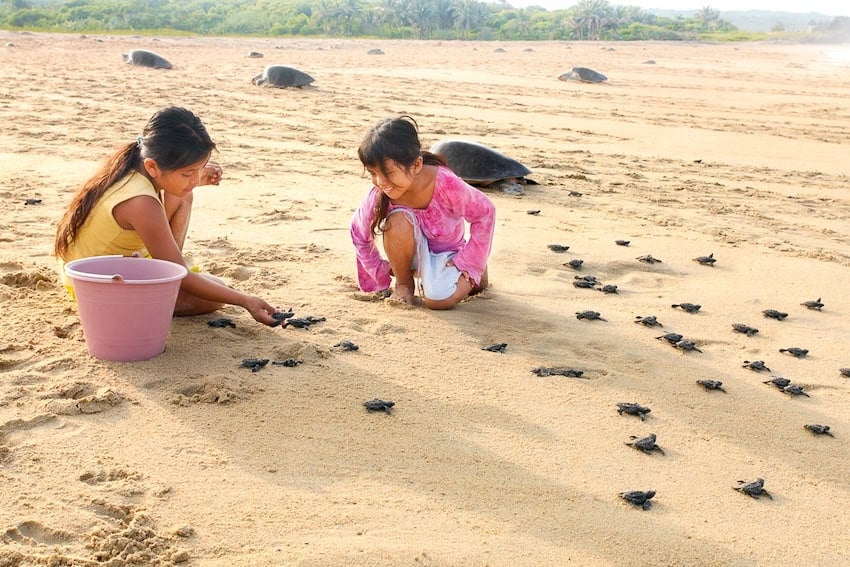
In August of 2010, I arrived in Ixtapilla, Michoacán after a curvy three hours on the coastal highway from Zihuatanejo, hoping to see some adult olive ridley sea turtles. Gilberto Reyes, head of the Campamento Tortuguero, walked me down to the beach where baby turtles were being released, an experience that is available to anyone visiting this area from June to October.
“What are my chances of seeing some of the big turtles come ashore?” I asked him.
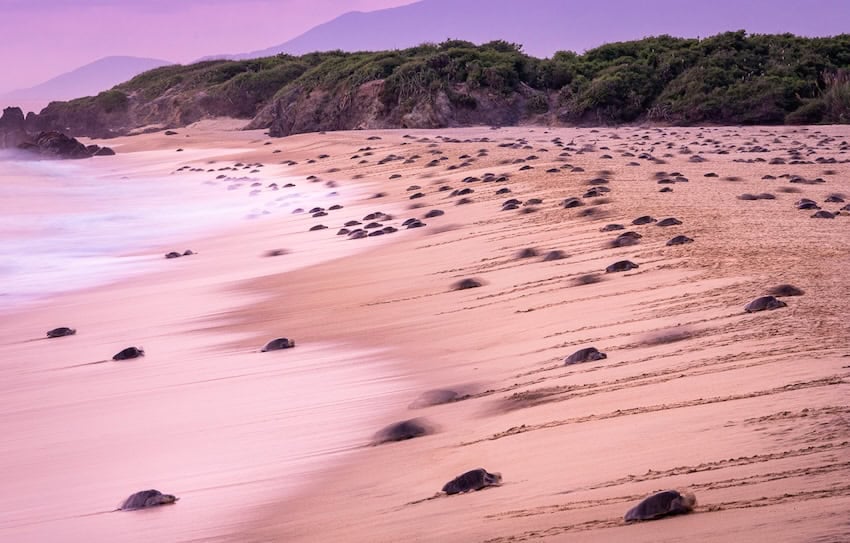
“Hard to tell,” he replied. “I saw some heads bobbing out in the ocean today so we’re expecting an arribada within the next five days.” Arribada, the Spanish for arrival or landing, is a synchronized mass nesting event which makes the olive ridley sea turtle unique. The only other species that nests this way is the closely related Kemp ridley sea turtle. It’s like a turtle convention, but with no set date.
Even though five days was longer than I had, I decided to stay the night nearby and hope for the best. I rented a bungalow in Playa Manzanillera, just ten minutes away, enchanted with the beauty and lack of development of this part of Mexico. By five a.m. the next morning, when awakened by red ants crawling over me, the charm had worn off. Wide awake, I decided to go see if any adult turtles had crawled up on the beach.
In Ixtapilla, the full moon was glowing off the Pacific. When I was forty yards from the beach, it hid behind clouds. Inching forward in darkness, only ten yards from the sand, a rock I almost stepped on moved. An adult olive ridley sea turtle lay there half buried in the sand. The turtles had arrived!
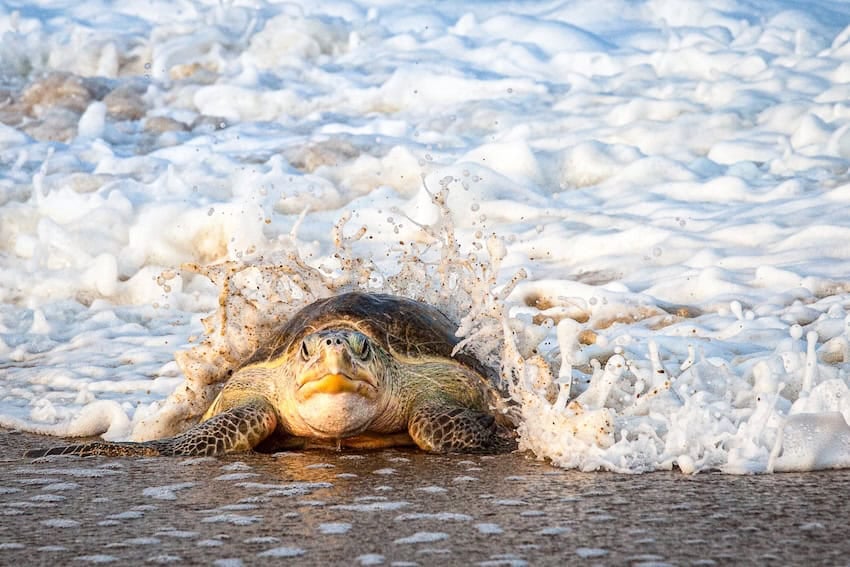
Thirty minutes later, the pinkish light of dawn revealed hundreds of large rocklike shells on a stretch of beach less than a mile long. A total of over two thousand turtles had arrived during the night, I was told, the beginning of an arribada that would last two to three days. Looking out to sea, I saw heads of new arrivals seesawing up and down in the surf. When the decision was made to land, many came in tumbling, got tipped over onto their backs, and had to wait for the next powerful wave to flip them right side up. By the time they laid their eggs, they were exhausted, having just finished the animal kingdom’s equivalent of a triathlon: Swim hundreds of miles, haul an 80-pound body meant to be in water 50 yards through the sand, then excavate a two-feet deep hole using only their flippers.
After digging in, a process that reminded me of making angels in the snow as a kid, the female turtle lays 80-110 eggs, each slightly larger than a golf ball with a rubbery shell. Forty-five days later, the baby turtles hatch, all blue and leathery and anxious to get out to sea, not knowing the difficult job of survival that awaits them.

How the village of Ixtapilla saved their turtles
During my first visit to Mexico in the late 80’s, I was offered a delicacy, turtle soup. Although I turned it down, this poaching of the adult sea turtles combined with the sale of their supposedly-aphrodisiacal eggs was what endangered the olive ridleys.
By 1994, the residents of Ixtapilla, an indigenous village on the Michoacan coast, realized their turtles were in danger. Fewer than 500 sea turtles came to lay their eggs that year. The elderly of the village were afraid that their grandchildren would never experience an arribada unless something was done.
If the turnaround were to happen, it had to be in Ixtapilla. The olive ridley (Lepidochelys olivacea) only comes to this beach, even though to the human eye, there are numerous other beaches along the coast which look just as good. But for the turtles, only Ixtapilla would do.
The residents began setting up patrols of the beach to prevent poaching. They relocated eggs to a fenced-in area. All of this was done by volunteers without any support from the government. For fifteen years, the community operated like this, motivated only by the rising numbers of turtles that started to arrive each year.
Eventually, the government started to support the project, as did NGO’s like Costa Salvaje. Tourism increased, and the villagers started charging a small fee to see the turtles. As more turtles came, more people wanted to witness the phenomenon. All of these efforts have been astonishingly successful, over 400,000 sea turtles are expected to nest in Ixtapilla’s sand in 2026.
How to witness an arribada firsthand in 2026
After witnessing my first arribada, the question of how to share the experience with my wife gnawed at me for several years. The problem was not only the unpredictability of the event, but the lack of suitable accommodations nearby. Here’s how we were able to make it happen.
Arribadas normally take place between June and October each year for 3-4 days. We set up a Google Alerts with the key words “ixtapilla arribada” and waited. I told her there would not be much time to pack when we got the notification. It came in mid-August, fortunately we were on summer vacation. We hit the road and were able to see the turtles at sunset.
Another way to find out about an arribada now is to follow “Punta Ixtal-Campamento Tortuguero” on Facebook. Even if you are not fluent in Spanish, this page usually posts photos when an arribada begins.
Not a fan of red ants? No worries, there are now a couple of options available for where to sleep. Only 40 minutes north of Ixtapilla is the town San Juan de Alima, Michoacan which has several hotels. This stretch of highway is much straighter and safer than the road south of Ixtapilla. If you want to be closer to the turtles, check out the cabins at Palma Sola, less than 10 minutes away, which have air conditioning and a stunning beach. That’s where my wife and I stayed with no issues.
Bus transportation to Ixtapilla requires going first to Colima, the state capital, and from there taking a bus to the coast. I’ve always gone by car and now prefer the autopista from Guadalajara to Colima and then on to Ixtapilla which, according to Google Maps, takes five hours.
Clearly, the experience of seeing an arribada requires some effort, first to time your visit and then to get there, but I cannot imagine anyone regretting it.
Brian Overcast has collaborated with Browntrout calendars, Mexico Desconocido and the Volaris inflight magazine since moving to Morelia, Michoacan in 1991. His weekly blog Mexico Life on Substack is aimed at informing foreigners on travel and culture in this fascinating country.