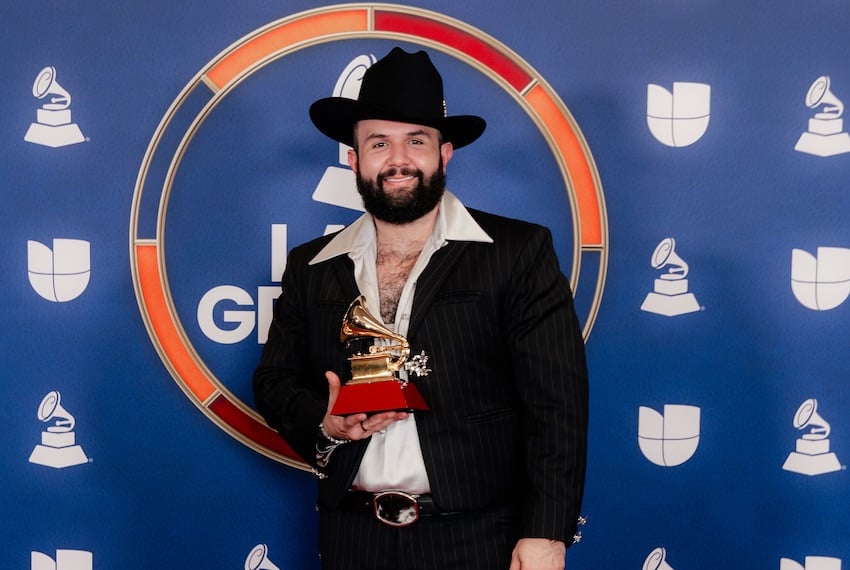
When FIFA announced recently that Carín León has recorded the lead vocal on the soon-to-be-released recording of the official World Cup 2026 song “Lighter,” the tens of millions of Mexican regional music fans needed no introduction.
But they’re far from the only ones. Ever since León switched to a solo career in 2018, his popularity has soared internationally along with the musical genre he is most identified with.
That’s no coincidence. Carín León has become the rising star of regional Mexican music by injecting new life into it. What was a blend of such regional sounds as norteño, banda and sierreño, now includes touches of blues, rock and country.
“We want to come and change the game in a certain way,” León told the newspaper El País. “We come with a very different proposal and I think it’s a great opportunity to show what we are capable of and where we want to take our music.”
In a sense, León conquered Mexican regional music by adapting it to his own style. And thanks to the innovation he is largely responsible for, León, 36, has achieved several breakthroughs in his career.
Most prominent these days is his shared lead (with the American Jelly Roll) on FIFA’s World Cup song, which Billboard calls one of the tournament’s “biggest collaborations yet.”

This year, he will also become the first Latino artist to perform at the Sphere in Las Vegas, with three shows scheduled for the city’s Sept. 11-13 run-up to Mexican Independence Day.
He was born Óscar Armando Díaz de León in Hermosillo, Sonora, a city traditionally linked to banda, one of the staple sounds of Mexican regional music. He gained success as the lead vocalist of Grupo Arranke before kicking off his solo career in 2018.
The artist’s big break, however, came thanks to “Primera cita” (First Date), a song that blends norteño, blues, rock and pop. The song’s video generated millions of views on YouTube and became a trend on TikTok.
“I wasn’t happy with the music I was making, I was a little frustrated,” León told El País. “I decided to abandon the dream of wanting to be a star in the market and started making the music I wanted, regardless of the fact that all the statistics told me this wasn’t going to work […] Thank God, things worked out for us.”
It worked not only in Mexico, but abroad as well. León has become a recognized Mexican artist within the U.S. music market. He has forged innovative collaborations with country stars like Kacey Musgraves, Leon Bridges and Kane Brown.
He recently announced a collaboration with rock legend Bon Jovi on the album Forever Legendary Edition.
In addition to his successful collaborations, he has won two Grammy Awards in the Best Mexican Music Album category for “Boca chueca, Vol. 1” and “Palabra de To’s (Seca),” in addition to several Latin Grammys.
With reports from El País