Mexico City is one of the cities in the world with the largest number of museums. There are at least 186 museums across the city, with 95 located in the Cuauhtémoc district alone, according to the Mexican government’s Cultural Information System. However, the situation is quite different in other districts, such as Iztapalapa.
Iztapalapa is home to at least one-fifth of Mexico City’s population. That makes it the second most populous district, with nearly 2 million inhabitants as of 2020. Yet, it suffers from issues related to poverty, inequality and insecurity, as well as a chronic lack of basic services. Therefore, the relatively new Yancuic Museum, built in 2015, represents progress by the city government. Both in terms of cultural offerings and social impact in an area that has long been characterized by low public investment.
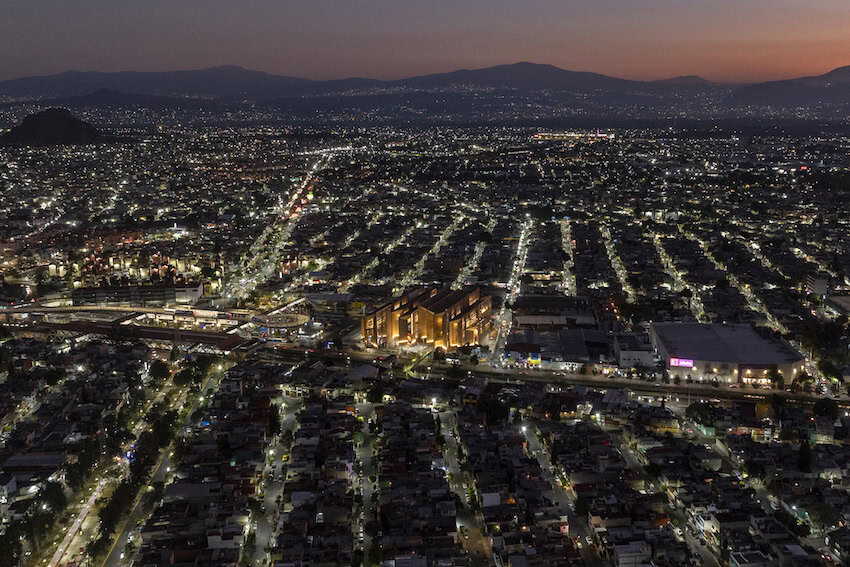
Admission is free at the museum, whose name is derived from Nahuatl and means “new.” It’s part of Mexico City’s “Let’s Build a City” government program, one of the aims of which is to diversify the capital’s cultural offerings.
Iztapalapa, it should be noted, boasts a rich cultural and historical heritage. Founded by the Culhuas in 670 AD between the northern foothills of Cerro de la Estrella and the shores of Lake Texcoco, it is also the site of the famous New Fire ceremony (Huizachtecatl). This Mexica ritual marks the end of a 52-year cycle and the commencement of another, symbolizing the renewal and continuity of life.
What makes the Yancuic Museum so special?
Opened in 2024, the Yancuic Museum features a distinctive aesthetic that can be appreciated from every angle. Its façade resembles a large piece of unfolded origami, characterized by big open windows that integrate indoor and outdoor spaces. The museum appears to expand, creating an enchanting atmosphere, particularly at night, thanks to its luminous design.
Yancuic is dedicated to environmental care and Nahua cosmogony. Thus, there is a wide variety of outdoor spaces. The entire ground floor is a public space, where, according to the museum, “A plaza extends into the museum, so access is through a diffuse boundary: A forest of wall columns that lead from the public lobby into the interior of the building.”
Additionally, the exhibition areas are interconnected by double-height spaces, providing sweeping views of Cerro de la Estrella, Cerro de la Mina and Volcán Tetlalmanche (commonly known as Cerro de Guadalupe). Visitors can also appreciate the vast territory inhabited by nearly two million people in the municipality. The museum showcases four exhibition halls designed to raise awareness about climate change, focusing on worldview, dialogue and action, ecosystems and biodiversity, and crisis and resilience, respectively.

There is also a bookstore run by the Fondo de Cultura Económica (FCE). Named Julieta Fierro, after the Mexican scientist, it offers around 20,000 titles across various subjects.
Awards and achievements
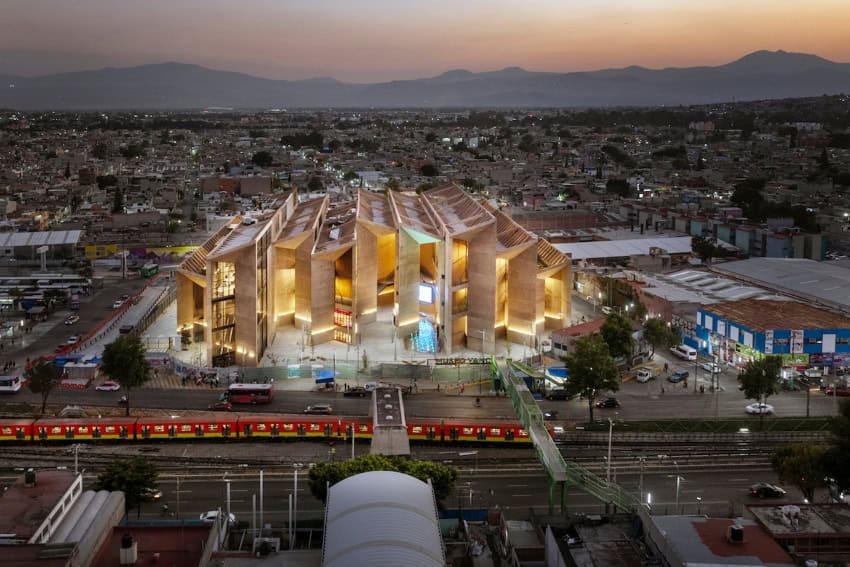
The Yancuic Museum covers an area of 20,000 square meters and consists of five floors, accommodating up to 5,000 visitors per day. According to the Secretary of Culture of Mexico City, it has welcomed over 214,000 visitors since February 2025.
This project stands out not only for its social impact but also for its architectural and aesthetic qualities. It gained initial recognition when architects Carlos Rodríguez Bernal, Laura Sánchez Penichet, Mara Gabriela Partida Muñoz and Héctor Mendoza Ramírez, along with Boris Bezan, presented it at the 2015 National Architecture Competition. It won first place.
The museum also received the Gold Medal at the 18th National Biennial of Mexican Architecture in 2024. This is organized by the Federation of Architects’ Associations of the Mexican Republic. It’s one of the most prestigious architecture awards in Mexico.
Set against an endless sea of concrete, the Yancuic Museum stands as an oasis. Visitors are welcomed with four enormous sculptures of the white-tailed deer, Mexican wolf, jaguar and axolotl. These are made from recycled materials by ‘El Volador’, a collective of artists, designers and builders based in Iztapalapa. Yancuic is, definitely, an architectural gem that enhances the cultural significance of this historical but relegated area of Mexico City.
Ana Paula de la Torre is a Mexican journalist and contributor for Milenio, Animal Político, Vice, Newsweek en Español, Televisa and Mexico News Daily.