The state of Guanajuato brings local and foreign tourists alike interested in exploring famous colonial towns and unique nature. But behind the manicured streets of San Miguel de Allende and Guanajuato City lie some of the most important stories in Mexican history.
On Sept. 28, 1810, Miguel Hidalgo y Castillo marched into Guanajuato with a ragtag army of tens of thousands at his back, kicking off the Mexican War of Independence. But why did it start here?
Mexico’s War of Independence 101: A quick overview for newbie expats
Just 12 days earlier in the town of Dolores, located approximately 60 kilometers from the capital city, Hidalgo issued his famous cry. The priest was fed up with Spanish colonial rule, which had conquered Mexico nearly 300 years prior. The cry was an urge to the people of Hidalgo’s congregation. He was pleading with them to revolt against the Spanish, and called his parish to arms.
The speech worked, and days later Hidalgo was the commander of an unofficial, untrained and unruly army, tens of thousands of soldiers strong. They were peasants, laborers and the poor. They had little equipment and even less training, but they had numbers.
The peasant army marched from Dolores to San Miguel de Allende and down to Celaya, where they looted and sacked Spanish homes, bringing more Indigenous and Creole people into their ranks.

Hidalgo’s forces reached Guanajuato with little resistance. Juan Antonio Riaño, the Spanish intendant of Guanajuato, chose to fight instead of surrendering the city. Riaño barricaded himself in the Alhóndiga de Granaditas, a massive, fortified stone structure made for storing grain.
Riaño’s force of around 400 men was greatly outnumbered. Spanish families moved into the granary, their wealth and belongings in tow, hoping to find shelter from the revolutionary horde. However, Riaño’s decision to only shelter Spanish families angered the local population in Guanajuato, who rallied behind Hidalgo.
With a massive force now ranging from 20,000 to 50,000 men, Hidalgo began the siege. He ordered his men to charge the gates of the fortress, where they took heavy losses but began to pound the front gate.
Riaño, now sensing defeat, tried to leave with a group of soldiers, but was shot and killed instantly. Riaño was previously a close friend of Hidalgo, who even wrote to Riaño before the siege to offer protection of him and his family, but the Spaniard had rejected — a decision which cost him his life.
The Spanish, however, still had one trick up their sleeve. They fitted a rifle with a white flag and waved it from the roof of the granary, signaling surrender. But as the rebellious forces began to drop their guard and approach the gates, the order was rescinded and the Spanish gunned down the unsuspecting soldiers.
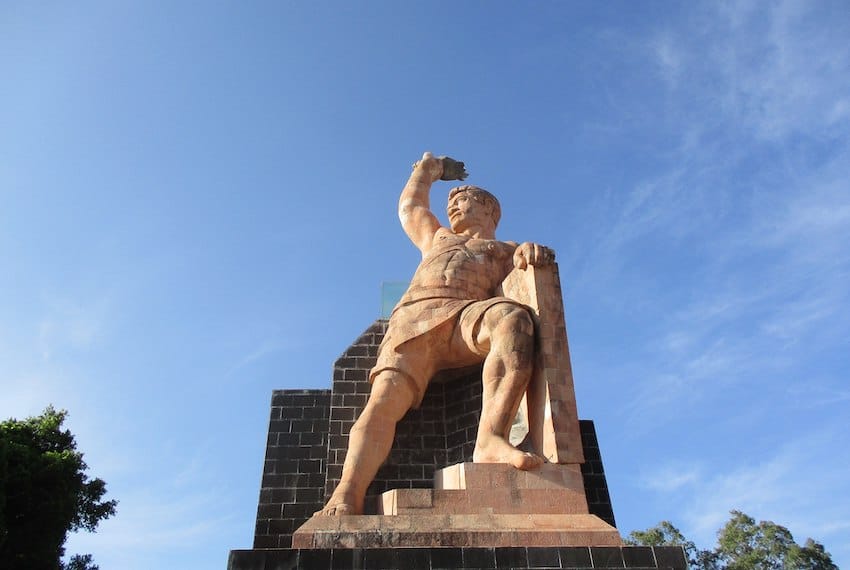
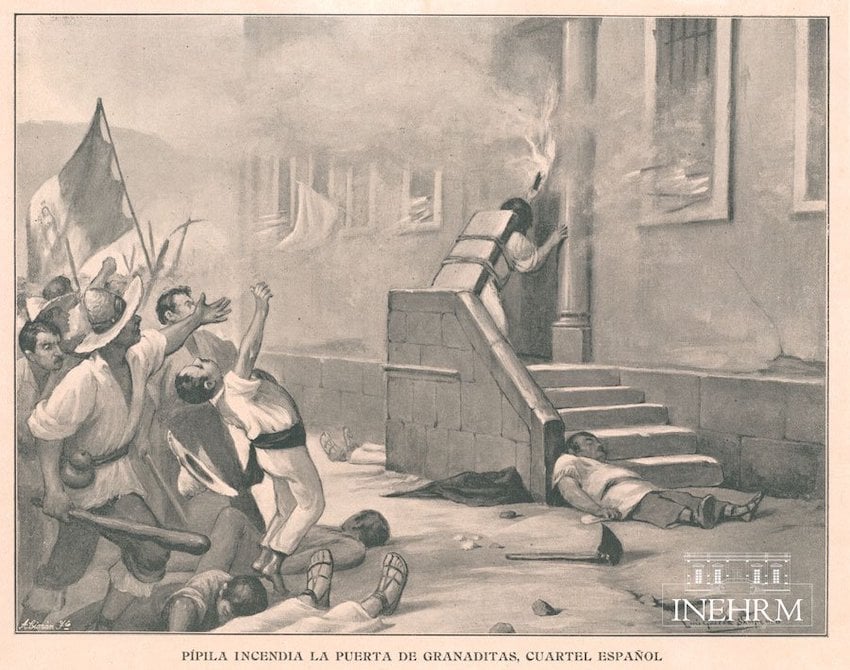
It was too little too late, however, as the fortress was breached by insurgent soldier Juan José de los Reyes Martínez Amaro, the unlikeliest of heroes. A local miner — whose appearance, according to legend, resembled a turkey or guajolote, giving rise to the nickname “El Pípila” — strapped a large stone to his back and approached the gate with tar and a torch. The stone shielded him from gunfire, and he was able to burn through the door.
El Pípila’s statue now stands high above the city at Guanajuato’s famous viewpoint. He is honored for his bravery and as a hero of the city.
With the gate open, Hidalgo’s forces flew inside and mercilessly slaughtered the Spanish, including the huddled families who entered the granary seeking shelter. Their wealth was pillaged and the violence spread into the streets, where the resistance army spent days destroying Spanish and Creole homes and stealing their possessions. Over 3,000 insurgents were killed during the siege and the ensuing violence, along with hundreds of Spanish in the granary.
The attack on Guanajuato was brutal, but the rebels had won the first battle of the War of Independence. Hidalgo continued to lead his forces through the Bajío, and the battle set the stage for Mexican victory, with the Spanish abandoning the country in 1821.
The bullet holes from the siege are still riddled throughout the walls of the granary. They serve as both a reminder of the fight that led to a free Mexico and a monument to the lives lost from war.
Jared Tucker is a summer intern at Mexico News Daily in San Miguel de Allende and a rising senior at the University of Washington in Seattle, where he is the sports editor for The Daily UW. He was previously a fellow at TheFulcrum.us, where he covered public participation in American democracy.