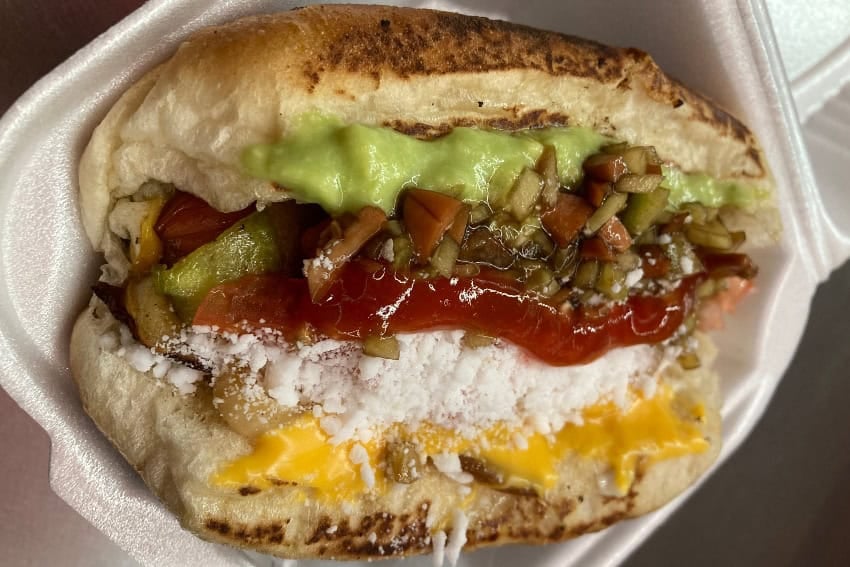
Most food stories don’t involve the FBI. But sometimes — if the food is worthy enough to create such a stir — an FBI investigation might follow. In this case, I’m talking about hot dogs along the U.S.-Mexico border, and in this particular instance, the FBI was brought in and concluded that one hot dog vendor set up an extortion racket against his top hot dog competitor. Such poor taste.
If you’ve ever spent time in Baja California, Sonora, California, Arizona or Texas, you’ve certainly come across it: hardworking immigrant vendors lining the sidewalk during a sports event or major concert, with a legion of pushcarts selling the same, heavenly-scented food: bacon-wrapped hot dogs.
The origin of the bacon hot dog in Mexico
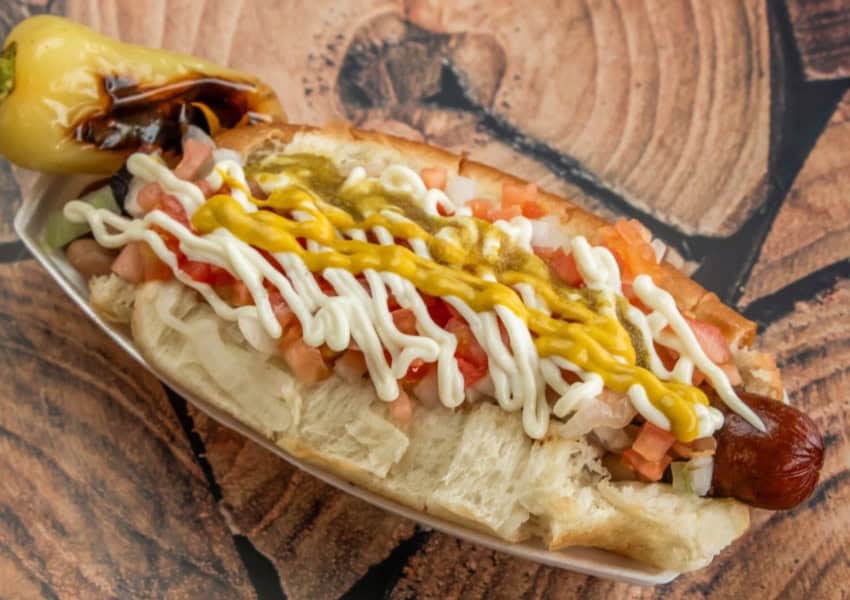
The smell of greasy bacon being grilled on a flat-iron hot dog cart, mingling with the sweet aroma of sautéed onions and peppers, is a welcome aroma at any public gathering (particularly after a late night out, when other traditional food businesses and restaurants have already closed their kitchens).
Many — including myself — would never surmise that one of the most ubiquitously American foods (a bacon-wrapped hot dog, of all things) actually arrived in the country through immigration patterns in northern Mexico. The ballpark-favorite frankfurter isn’t from Dallas or Phoenix or Los Angeles: it’s from Sonora’s arid capital, Hermosillo. There, the tasty regional item is considered as belovedly Mexican as tacos or tamales, and it has been around for longer than one might assume.
It all technically dates back to the 1940s, when historians believe that U.S.-style hot dogs first arrived in Mexico through either a traveling circus, bullfights or baseball games (the reports are conflicting). One American blogger claims that a young pair of entrepreneurs came to Mexico City and began to sell hot dogs at Plaza Mexico — a business plan that turned them into world-traveling millionaires, supposedly.
The Sonoran dogo
These still-baconless wonders were a hit with Mexican consumers, and from there began to proliferate into other arenas and avenues. From there, hot dogs made their way into the mainstream Mexican diet and were eventually adapted in local ways. Sonoran “dogueros,” in particular — street vendors who bordered the U.S. in a state already known for their beef affinity and baseball adoration — were in an ideal position to elevate the perro caliente for Mexicans and beyond.
Here’s what that looks like today: bacon-hugged “weenie” that gets sliced down the middle and filled with a stick of cheese, then grilled and inserted into a larger-than-usual bolillo-style bun to be topped with diced tomatoes, avocado, onions (both raw and grilled), pinto beans, lettuce, chorizo and other traditional and unorthodox condiments, from mayonnaise and ketchup to jalapeños and güero peppers. If it isn’t vividly clear, these greasy “dogos” are easily customizable and typically well-laden to the brim (there are double sausage, flour tortilla, and shrimp variations, too).

At least one Mexican American journalist has tried to trace the historical origins of this dogo — going from Los Angeles to Tucson. Most sources seem to point to El Güero Canelo — a hot dog joint in Arizona — as being a major driver in the invention’s popularity during the late 1980s and early 90s. Opened and owned by Sonoran immigrant Daniel Contreras in 1993, El Güero Canelo is generally considered to be the definitive source of the bacon-wrapped weenie’s zeitgeist takeover, which has earned Contreras a lauded James Beard Award. But its roots and essence are clearly still present across the border in Sonora.
Hermosillo’s battle for preeminence
@la_shamaka NOS FUIMOS A VISITAR LOS FAMOSOS DOGOS DEL MIAMI @Dogos del miami #comida #comidasonorense #hermosillo #sonora #lasdelishas #lashamaka ♬ La Cumbia Sabrosa – Marc Life
According to locals and food vloggers, there’s an ongoing battle today in Hermosillo for which dogo is the best and most emblematic of the city’s culinary pride. Dogos Del Miami is a popular one, known for their turkey dog options and, for $50 USD, the “Golden Dubai Dog” — a gold flake-covered Sonoran dog. But there are also nameless roadside stands that attract neighborhood clientele and have their own varieties and touches. Aside from the capital of Hermosillo, the state’s second-largest city, Ciudad Obregón, introduces its own regional flair that further ignites debates around which dogo is supreme (Hermosillo adds diced lettuce to the mix, for example, which Obregóneros loyally reject).
The food is easy and on-the-go, a perfect street-side dish and easy to wheel around or set up as a stall for hungry passersby. It is usually accompanied by a super-sized cup of “uvola” — a regional specialty beverage made from grapes and loaded with ice to stave off the desert heat.
It’s simple to see why this combination made its way across the border and became an instant classic in the American Southwest and beyond. Mexican culinary ingenuity never disappoints and knows no limits.
Alan Chazaro is the author of “This Is Not a Frank Ocean Cover Album,” “Piñata Theory” and “Notes From the Eastern Span of the Bay Bridge” (Ghost City Press, 2021). He is a graduate of June Jordan’s Poetry for the People program at UC Berkeley and a former Lawrence Ferlinghetti Fellow at the University of San Francisco. His writing can be found in GQ, NPR, The Guardian, L.A. Times and more. Originally from the San Francisco Bay Area, he is currently based in Veracruz.