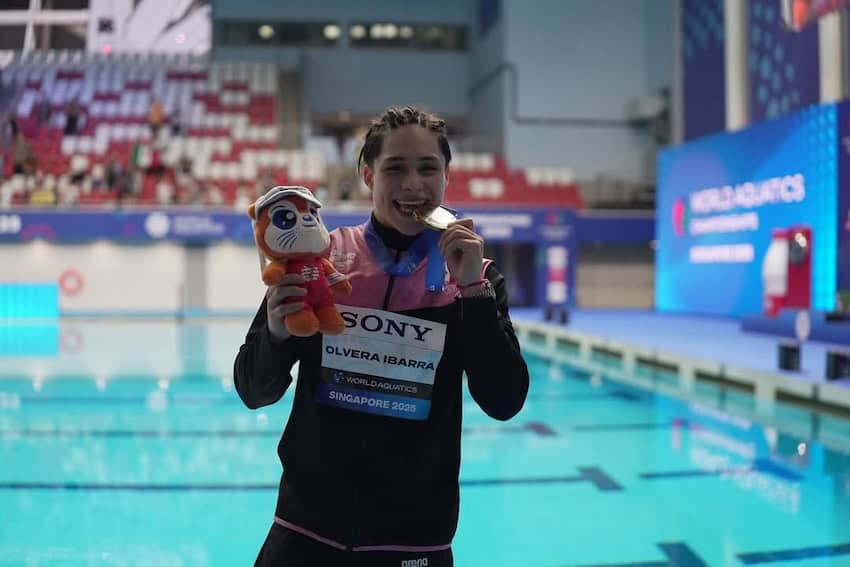
Mexican diver Osmar Olvera ended nearly two decades of Chinese dominance to claim the gold medal in the men’s 3-meter springboard competition at the World Aquatics Championships in Singapore on Friday.
Olvera, 21, overcame a poor third dive to surge past his two Chinese rivals with his next three dives, including a fifth dive of 102.60 points, and a flawless finish.
Osmar Olvera was flawless all day, even in the sixth round, he didn’t flinch 👀
His reward? A well-earned gold in the 3m Springboard! 🥇#Diving #AQUASingapore25 pic.twitter.com/cYyTOOEQci
— World Aquatics (@WorldAquatics) August 1, 2025
The Mexico City native finished with 529.55 points over six dives, edging four-time Olympic gold medalist Cao Yuan (522.70) who is also an 11-time World medalist, and three-time reigning World champion Wang Zongyuan, who scored 515.55.

Olvera became the first non-Chinese diver to win this event since Canada’s Alexandre Despatie won in 2005.
“I feel amazing,” Olvera said. “It’s a dream come true, to be a world champion … in an Olympic event.”
Olvera said he’ll now focus on maintaining his gold-medal form in order to continue battling the Chinese divers who have dominated these events, including a gold medal sweep at the Paris Olympics last year and taking seven out of eight golds at the two previous Olympics.
The Mexican diver’s victory is by no means a surprise. He won the 1-meter springboard competition at the 2024 World Championships in Doha and has eight career Worlds medals, including four this year in Singapore.
Olvera also won bronze in the 3-meter springboard event at the Paris Olympics last year as well as a silver in the 3-meter synchronized springboard competition.
Olvera’s gold on Friday was the sixth diving medal for Mexico at the Worlds, behind only China’s 14 and well ahead of the rest of the pack, including the USA’s one.
The path to gold for Olvera at the Worlds was not easy.
Wang was first and Cao was second in every round of the semifinals. But, according to Swimming World Magazine, Olvera leaped ahead in the finals with the best dive in each of the first two rounds.
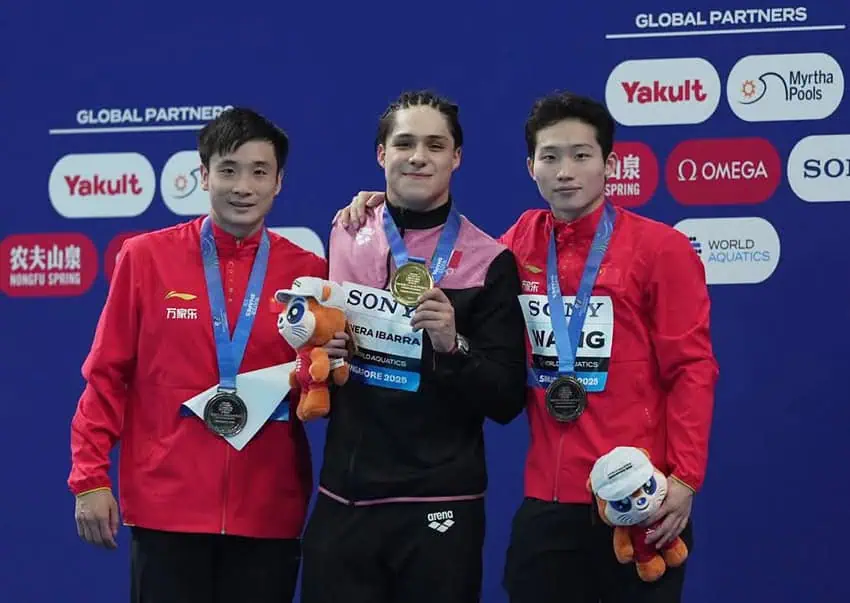
Olvera wobbled in Round 3 and was in third place after four rounds. Then came what Swimming World Magazine called “the best dive of the final and maybe the meet writ large.”
The Mexican nailed a forward 4 1/2 somersault dive in a pike position to move a half-point ahead of Cao. He clinched the gold medal with the best dive of the final round — a forward 2 1/2 somersault dive with three twists, performed in a pike position . It earned 97.50 points.
“I felt a lot of pressure [on the sixth dive],” Olvera said afterward. “I knew I needed a great dive, so I just focused, controlled myself and did my job.”
During her daily morning press conference, President Claudia Sheinbaum showed reporters a video of the event and applauded Olvera’s triumphant performance.
In a chat with El Universal newspaper afterward, Olvera thanked Mexican fans who followed his performance despite the time difference with Singapore, sharing an emotional message with them.
“Thank you to all those who supported me, to all of Mexico who stayed up all night to cheer me on, thank you for sending the best vibes,” he said. “And to those of you who didn’t, I ask you to support me too, because Mexico isn’t just about soccer.”
With reports from ESPN, El Universal and Swimming World Magazine