Although the first hotel in Los Cabos was built in the 1950s, the first few decades of tourism were defined by a dozen or so pioneering hotels. It wasn’t until the 1980s and 1990s that the first real building boom occurred, as the area grew from just over 2,000 rooms in 1990 to nearly 8,000 by the close of the decade. “Steel and stucco are on the move everywhere you look, and suddenly, Los Cabos has a skyline, still patchy, but indicative of what is obviously just around the corner,” wrote Larry Dunmire in the Spring 1989 edition of “Baja Traveler.”
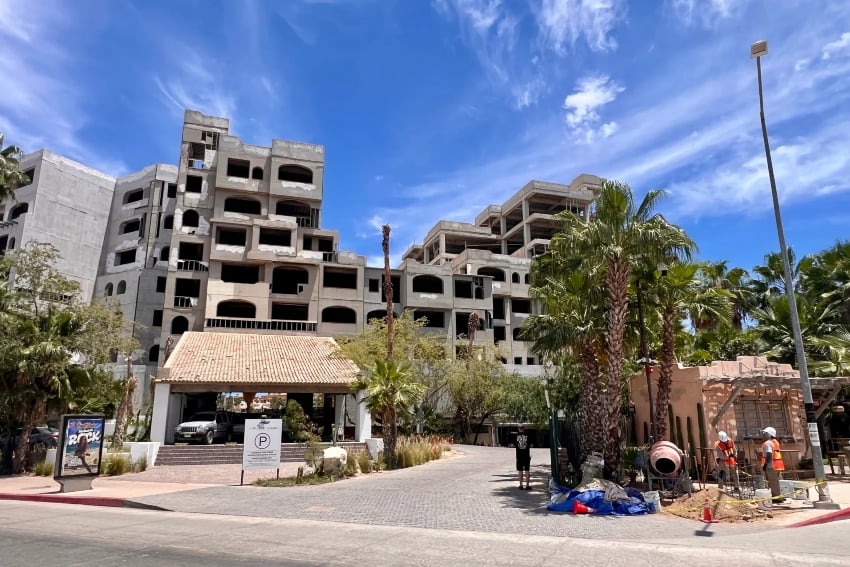
What was right around the corner for one notable hotel project of the era, however, was a historic peso devaluation, followed by a union dispute with the Revolutionary Confederation of Workers and Farmers (CROC) that left the construction unfinished. That hotel, known by locals as the “Gray Ghost,” has been haunting Cabo San Lucas’ downtown skyline as an eyesore ever since.
Plans for the ‘Gray Ghost’
View this post on Instagram
That’s not to say there haven’t been signs of improvement. In 2014, one of the investors in the original project, Eduardo Sánchez Navarro — president of Grupo Questro, and the most accomplished local developer since the original pioneer hotel builders — managed to negotiate a settlement with the union, thanks to the intervention of then-President of Mexico, Enrique Peña Nieto, opening the way for a future without a hulking monument to failure marring picturesque marina views.

Still, it was another eight years before a new conception of the property, A Place at Cabo, was unveiled. Since then, much has been done under that banner to bring the area around the “Gray Ghost” back to life, opening open-air restaurants and shops accessible from the marina boardwalk and from Marina Boulevard.
The “Gray Ghost” itself remains standing — or crumbling, depending on one’s perspective — although for how much longer remains to be seen. Sánchez Navarro has announced a recent deal with Universal Studios (though the company has not publicly affirmed its commitment) to build a 150-room hotel on the site of the long-stalled construction project, with a 1,500-seat theater to host live concerts and performances.
But there is still no definitive timeline for the projected opening. So the long wait continues.
A tragic occurrence that didn’t have to happen
“I am appalled, as is the entire community, because we are not at all accustomed to such acts here; in the history of Baja California Sur, there has never been anything like this,” Secretary General of the Los Cabos City Council, Alberto Rentería Santana, told El País, following a hit-and-run incident in which a car accelerated into a crowd of revelers in downtown Cabo San Lucas in the hours after Mexico’s 3-0 win over Czech Republic in the World Cup on June 24, injuring 17.
The driver, a 52-year-old identified only as Óscar “N”, was subsequently pulled from the car and beaten by the enraged crowd, which led to him being hospitalized in serious condition. So that makes 18 who were injured in the tragic event; plus the trauma done to the wife and two children of Óscar “N”, who were in the car, and witnessed the savage aftermath.
⚠️ Un conductor arrolló a un grupo de personas que celebraban el triunfo de la selección mexicana en el bulevar Lázaro Cárdenas, Los Cabos, Baja California, dejando 17 personas lesionadas que fueron trasladadas a diversos hospitales 🚑. Se reportó que el responsable fue detenido… pic.twitter.com/WhqbtiOZ30
— Guardia Nocturna (@GNocturnaMX) June 25, 2026
The sad part, for those affected and for the reputation of Los Cabos, is that it was all preventable — but to understand why, it’s first necessary to give some background on the intersection where the incident occurred, and on the infrastructure challenges that Cabo San Lucas specifically, and Los Cabos generally, are still struggling to try and overcome.
Unmanageable growth and traffic issues
Los Cabos had about 10,000 residents in 1970. But by 2020, that number had grown to over 350,000 (including more than 200,000 in Cabo San Lucas) … and it’s still growing. Tourism has likewise exploded, increasing over 130% in the last decade alone. The strain this has put on local infrastructure and traffic is, as might be imagined, immense.
Los Cabos, in its approach to urban planning, has tried to overcome some of these issues by establishing large transit corridors to expedite travel; and, on a municipality-wide basis, the creation of the Autopista Cabo San Lucas – San José del Cabo (Airport Toll Road) in 2015, the recently finished Fonatur roundabout project and a proposed Eje Interurbano (Interurban Axis) are positive steps forward.
Jesús Bojórquez Luque, in his 2014 academic assessment of the challenges, “Evolución y planeación urbana en la ciudad turística de Cabo San Lucas, Baja California Sur,” noted that local government had taken important action “to reverse the chaotic situation that resulted from the city’s rapid growth since the 1980s, and which manifested itself in the inability of the three levels of government to project harmonious growth and provide adequate services to a large population attracted by the development of tourism.”
In Cabo San Lucas, however, the city’s traditional downtown center has become choked and bottlenecked by traffic along the two main thoroughfares — Marina Boulevard and Blvd. Lázaro Cárdenas — which, since an expansion project circa 2009-2010, have been linked together with a loop. This traffic is problematic not only for drivers, but doubly so for pedestrians, a large percentage of whom are tourists. Crossing the street in the downtown area is, for the most part, done at one’s peril.
The worst pedestrian crossing in Cabo San Lucas
Perhaps the most dangerous of the pedestrian crossings is found just beyond where Marina Boulevard and Lázaro Cárdenas converge, at a crossing between traffic lights in front of Plaza Bonita and Los Cabos’ most concentrated nightlife district. This risk was recognized, which led to the implementation some years ago of topes, of the elevated rise variety. But while this did slow down drivers slightly, it didn’t have the intended effect of encouraging them to grant the right of way to pedestrians. Thus, during high-season days, transit cops are often stationed here to help tourists cross the road.
But when an official presence is really needed is at night. The El Squid Roe and Mandala nightclubs alone often have crowds spilling out the door into the intersection and onto the median that divides traffic lanes on Lázaro Cárdenas. This creates major traffic issues and serious potential for explosive situations, proven recently not just by the hit-and-run accident, but by the widely reported brawl that broke out in the street only 10 days prior in the same place.
The ATP Los Cabos Open tennis tournament will celebrate its 10th anniversary this year
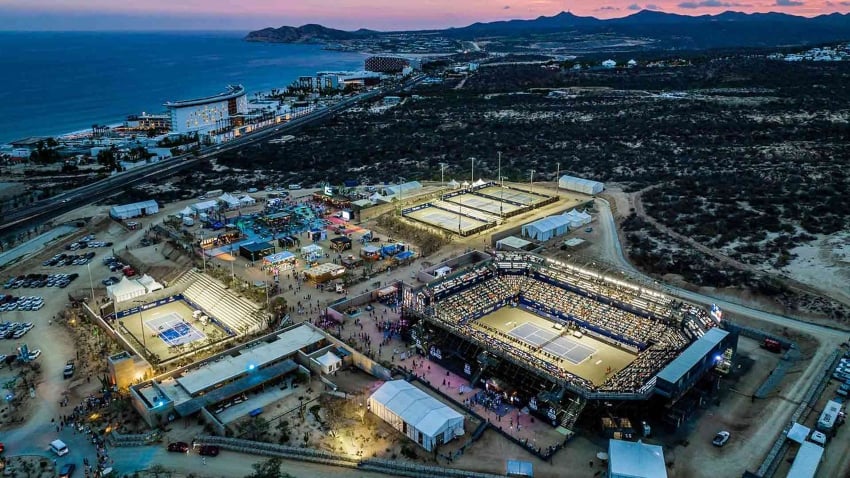
Although big-game fishing tournaments remain the most emblematic sporting competitions in Los Cabos, over the past 10 years, the area has also become a regular host of tennis and golf tournaments sponsored by the ATP and PGA, respectively. The tennis event — The Los Cabos Open, or Mifel Tennis Open by Telcel Oppo, in sponsorship language — came first, premiering in 2016. Since the 2020 event was canceled due to the coronavirus pandemic, that means the 2026 edition, scheduled from July 27 to Aug. 1, will mark its 10th anniversary.
A lot has changed in the course of the decade. Not only has attendance nearly tripled since Croatian Ivo Karlović won the inaugural event over Spaniard Feliciano López, growing from 12,000 to over 35,000, but prize money has also grown slightly (from US $850,000 to US $909,790), and the location has shifted: from the Delmar International School, site of the first four tournaments, to the Cabo Sports Complex, which has handled hosting duties since 2021.
Tickets for this year’s tournaments are still available
The tournament’s organization and attraction to talent remain, however. The Los Cabos Open is still an ATP 250 series event, welcoming 28 singles contestants and 16 doubles players, among whom are some of the best in the world. Since its premiere, it has showcased many of the best men’s players in the world, including Grand Slam champions Daniil Medvedev, Juan Martín del Potro and Alexander Zverev.
To find out more about this year’s tournament, including ticket availability, visit the official event website.
Chris Sands is a writer and editor for Mexico News Daily, and the former Cabo San Lucas local expert for the USA Today travel website 10 Best and writer of Fodor’s Los Cabos travel guidebook. He has also contributed to numerous other websites and publications, including The San Diego Union-Tribune, Marriott Bonvoy Traveler, Forbes Travel Guide, Porthole Cruise and Travel, and Cabo Living.