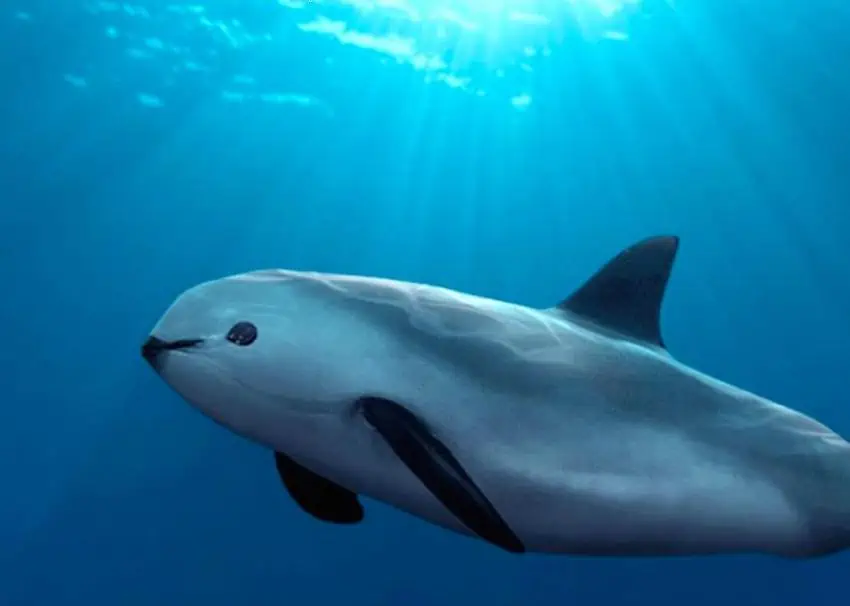
The vaquita, or “little cow,” is a species of porpoise only found in the Gulf of California. It is the smallest living cetacean and the most endangered, hovering on the brink of extinction. Not only does it live in a small and once remote area, but it is an elusive animal that tends to come to the surface for a gulp of air and then disappear again.
As a result, the vaquita escaped human detection until 1958, when a scientist examining skulls on the beach realized the porpoises occasionally spotted there were an unknown species. Marine biologists Kenneth Norris and William McFarland first introduced the animal in their article A New Harbor Porpoise of the genus Phocoena from the Gulf of California, published in the Journal of Mammalogy.
In Latin, it was identified as Phocoena sinus, or “porpoise of the gulf,” but its common name is vaquita, or “little cow,” which was how local fishermen had always referred to it.
A first discovery
It would be another 30 years before scientists caught a vaquita, offering them a full account of its appearance. The most notable points, apart from the small size, were the dark eye rings and large fin.
This work helped explain how the genus Phocoena adjusted to an environment that was not ideal. Porpoises generally like cold water, and around 2.5 million years ago a drop in ocean temperature allowed a few animals to migrate along cold water highways into the enclosed gulf.

As the planet once again warmed, they should have either fled the area or faced extinction.
However, their new home was rich in fish, squid and crustaceans, which fed off the nutrients flooding into the sea from the Colorado River. This abundant food supply tempted the porpoises to stay.
They became isolated from other groups and adapted to the warming waters, ultimately evolving into a new species. They became smaller, lost blubber and developed large dorsal fins that acted like a cooling radiator.
Over many generations, their decreasing size not only helped keep the vaquita cool but enabled them to hunt for smaller fish in the bay’s shallow waters. This in turn might have kept them away from predators.
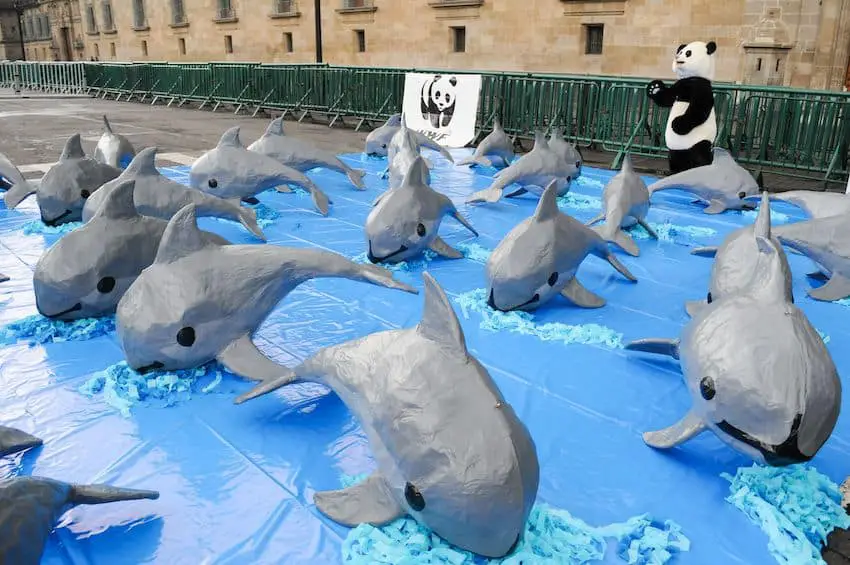
How many vaquitas are there in the wild?
We have no idea how many porpoises once lived in this small area of ocean, although academic studies suggest there were once around 5,000 animals. However, the first comprehensive survey took place in 1997 and estimated a population of just 567 individuals.
That number was already low, and the following decades proved disastrous. By 2007, the population was estimated to have fallen to 150. By 2018, it was less than 19.
While there might be other contributing factors, the deadliest and saddest danger currently comes from fishing. The porpoise is not the target, but fishermen place nets here hoping to catch totoaba, a large fish endemic to the Gulf of California.
Once abundant in these waters, the totoaba is hunted for its bladder, which is used in traditional Chinese medicine and luxury cuisine. As a result, much of the catch is sent to the lucrative Hong Kong market.
But here’s the issue with this practice: When catching the totoaba, fishermen employ gillnets — vertical panels of netting that hang from a line and are indiscriminate in what they catch. In addition to the initial catch, the trapped fish attract predators that also get caught.
As numbers declined, conservationists got desperate. In 2007, a team of scientists published an article in the journal Conservation Biology titled Saving the Vaquita: Immediate Action, Not More Data.
This was motivated by the shocking and disheartening news that another endangered cetacean, the Yangtze River dolphin, had been confirmed as extinct.

VaquitaCPR launched in desperation
Ten years later, an even more desperate step was taken. An international coalition called VaquitaCPR launched a $5 million last-ditch effort to save the tiny porpoise.
If nets could not be removed, then the vaquita would have to be kept away from them. The idea was to place the animals in the safety of floating sea pens. With a $5 million budget, the team captured two porpoises.
A mature female was placed in a sea pen but suffered acute shock and died within hours. The young calf was released after displaying signs of extreme stress and was released. With numbers becoming so critically low, the loss of two animals was a disaster.
Vaquita numbers have continued to drop. The most recent 2024 survey reported that the entire population was down to somewhere between six and eight individuals. Hopefully, this might be a slight underestimation.
Surveys have concentrated on a small area where the vaquita are known to be seen, but work with acoustic detectors suggests they might have a wider range. Even so, we are not looking at more than nine to 11 animals — the edge of extinction.
There are a few hopeful signs, and at the moment the vaquita is benefiting from a considerable amount of attention and goodwill. The Mexican government has implemented a vaquita refuge, where commercial fishing is prohibited.
Cement blocks fitted with metal hooks have been fixed throughout the exclusion zone, which capture abandoned and illegal gillnets.
A combination of monitoring by conservation groups, most notably Sea Shepherd Conservation Society, and support from the Mexican Navy has brought a notable reduction in illegal fishing activity within the protected area.
UNESCO gives Mexico 6 months to show ‘concrete actions’ to protect remaining vaquitas
Science of vaquita still being understood
One recent surprise concerns the animal’s reproduction cycle. It was previously believed that females only gave birth every two years, but that is now questioned.
The best evidence comes from observations of a female called Frida, who is easily recognized by a bent dorsal fin. She was spotted with a calf in 2023 and another newborn in 2024.
In 2025, she was seen with a calf that appeared to be a year old, but was showing physical signs that she may have been pregnant again. If the breeding pattern is changing, this could be linked to less competition between the porpoises for food and might offer a ray of hope for the animal’s long-term future.
Another positive discovery was made by genetic scientists who examined the historical library of DNA collected from porpoises caught in nets over the years. Their work revealed that the species has been isolated for so long that they seemingly adapted to the risks of inbreeding.
This phenomenon has been observed in other species on the verge of extinction, from Bengal tigers to right whales.
Had the current conservation measures been put in place 10 years ago, when vaquita numbers were still in the low hundreds, there might have been some optimism. Now there is a fear that all the good intentions might have come too late.
Helping the vaquita to recover will take years of protection and monitoring. Pushing them into extinction might only require a few months of neglect. There are also new problems looming on the horizon.
New problems emerge for vaquita
While the establishment of a protected area has been generally successful, it only covers a small percentage of the animal’s known range. Most alarmingly, it fails to cover a northwestern zone where vaquita might well be active.
In addition, fishermen continue to place gillnets on the outer edge of the exclusion zone where they might still pose a danger to the porpoises.
Fishing is big business with the ability to lobby the government.
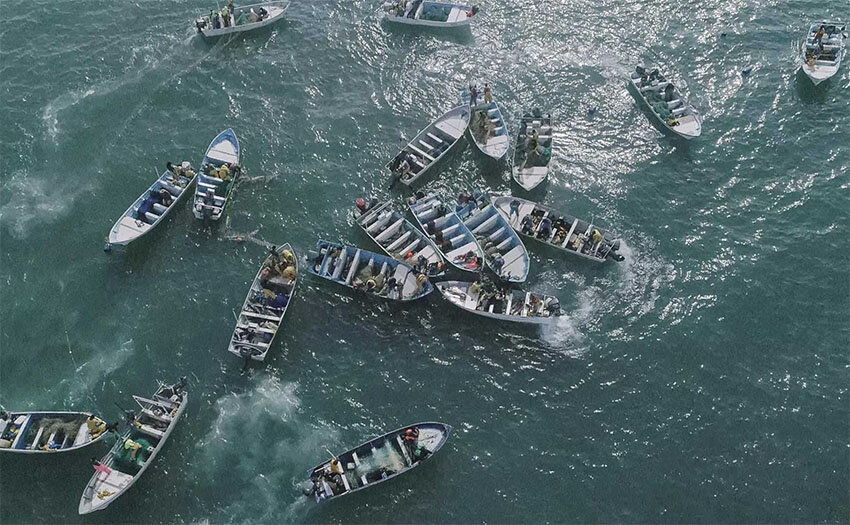
A 225-square-kilometer Zero Tolerance Area established in 2020 is also under attack. The argument is that with their declining numbers, vaquita are no longer found in much of the protected area, so unrestricted fishing could resume there.
There are other dangers building up that might be beyond our ability — or at least our will — to halt. Ever since the great Hoover and Glen Canyon Dams were built, little fresh water has flowed into the gulf. This has changed the salinity of the water and places another pressure on the ecosystem.
Plans to build distillation plants will only exacerbate this problem. Then, there is the whole question of climate change. The porpoises survive here because, over many generations, they have adapted to water that would normally be too warm for them.
How are they and their food source going to adapt to a future in which weather patterns appear to be changing, and doing so far more rapidly than ever before?
The vaquita is still with us, but its survival hangs by a thread.
Bob Pateman lived in Mexico for six years. He is a librarian and teacher with a master’s degree in history.