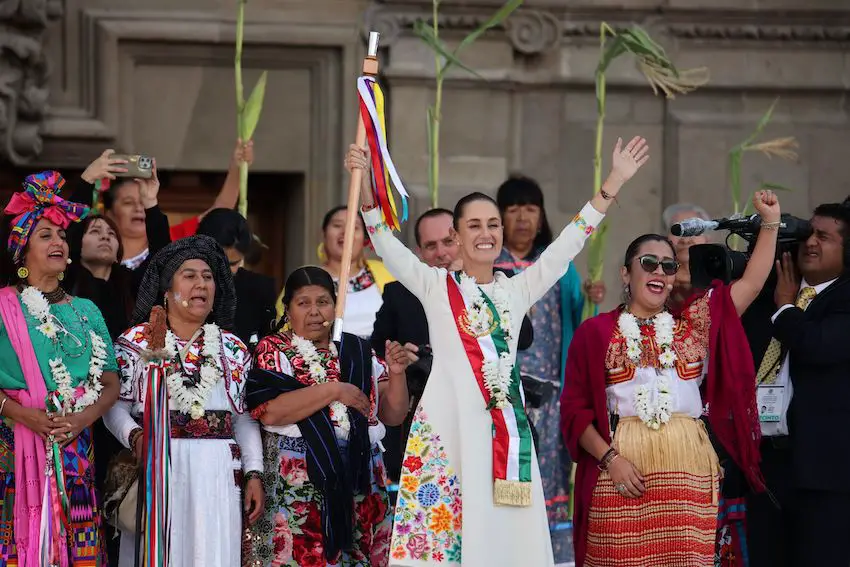
Claudia Sheinbaum, Mexico’s first female president, took office on Tuesday wearing a dress designed by embroiderer Claudia Vásquez Aquino.
Originally from Santa María Xadani in the southern state of Oaxaca, Vázquez, 41, told the newspaper El País that about a year ago, she met some people from Sheinbaum’s team, but didn’t know who they were at the time.
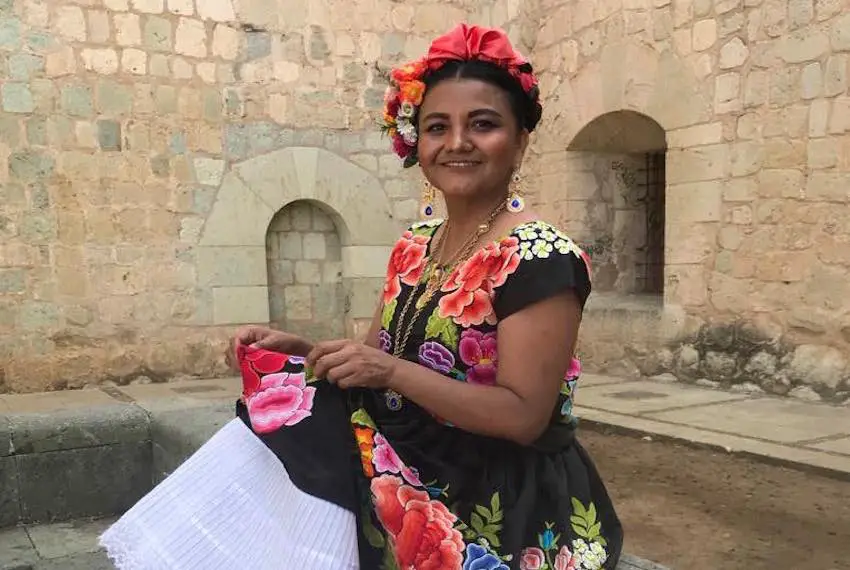
“They asked me for a dress, they gave me guidelines so I could decide on the embroidery and the flower design. But I didn’t know it would be for [Sheinbaum],” she said.
The president’s ivory inauguration-day dress, trimmed with colorful floral details, was made using the hand-knitting technique of crocheting on cotton fabric and elastane. “The embroidery features more than 100 flowers on the skirt and on the cuffs,” Vásquez explained.
“I feel very proud,” Vázques remarked of her design.
Vásquez told El Páis that she learned to embroider at the age of 10. “Just as I was born with Zapotec [her native language], I was born with embroidery,” she said proudly. “My mother taught me, first with needlework and then with weaving. My brothers Carlos and María also learned and together we have undertaken a small textile project.”
The project is called Lari Guie’, which means embroidered fabric in Zapotec. The designer’s Facebook page indicates that they sell online and at sales expos, and can be reached in Oaxaca city.

Vásquez is currently president of the Association of Indigenous Artisan Communities of the State of Oaxaca, which represents eight regions in the state.
This is not the first time that Claudia Sheinbaum has worn traditional clothing from the region. “From what I understand, the Doctor [Sheinbaum] obtains her pieces directly from artisans,” Vásquez said, adding that it is a “privilege” that the new president wears “typical clothing” from the different regions of Mexico.
“I am very excited that this piece of textile, woven by my hands, my heart and my mind, will be worn by the president. It is a very strong commitment, so we ask her to also defend our textiles. She is the voice of the people,” Vásquez said in a separate interview to news outlet Aristegui Noticias.
“I hope one day I can meet her personally and shake her hand,” Vásquez said. “I admire her a lot and I wish Mexico well with the first female president.”
The gold-colored national emblem on the presidential sash was also hand-embroidered. This work was carried out by First Auxiliary Soldier Evangelina Rentería de la Cruz, who also embroidered the sash bestowed on Sheinbaum’s predecessor, Andrés Manuel López Obrador, on Dec. 1, 2018.
With reports from El País