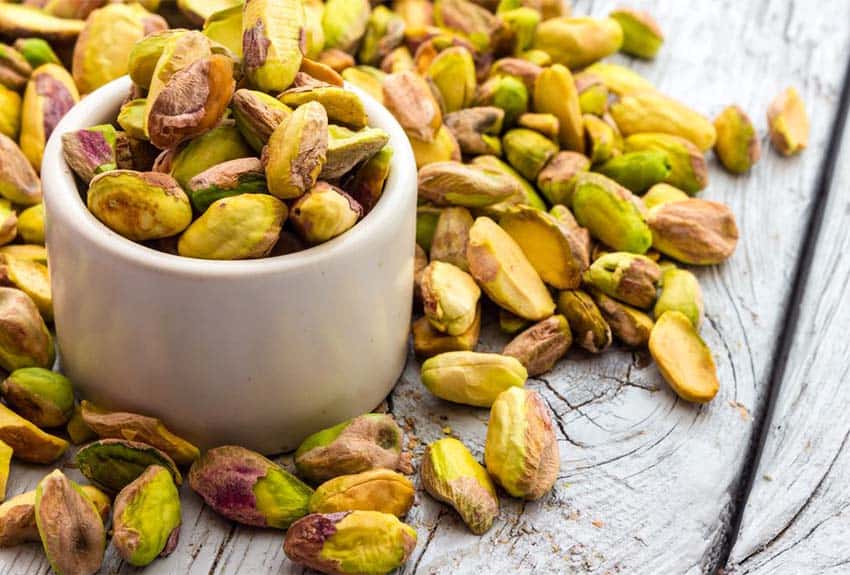
It seems that suddenly, at every stoplight in Mexico, someone is selling cellophane bags of pistachios. Is it harvest season for these nuts, I wondered?
Turns out, it is. Pistachios are harvested in early fall, and in Mexico, the desert climates of Chihuahua and Sonora are where they’re grown. The trees need long, hot, dry summers; and while it takes seven to 10 years for pistachios to begin bearing fruit and producing nuts, modern grafting techniques have shortened that time. Pistachio trees can live up to 300 years (!), and in Iran and Turkey, which have the tastiest and most popular varieties, old (dare we say “ancient”?) orchards abound. The southwest United States is the world’s biggest producer of pistachios, though.
Like cashews, pistachios grow inside an odd-looking fruit called a drupe. The distinctive half-open shell occurs naturally, once they ripen, with a perceptible pop. The nuts are then hulled, dried and sorted as “open-mouth” or “closed-mouth.” Harvesting and processing is time-consuming and labor-intensive, hence pistachio’s relatively high cost. Like blueberries and beets, they’re full of antioxidants.
In Mexican cuisine, pistachios are used in sweets like polvorones (the real Mexican wedding cookies), nut brittle and a variety of other candies. They can also be ground with cilantro to make flavorful sauces for chicken and pork. In other countries, pistachios are used in a wide variety of dishes, from Sicilian cakes, cookies and pasta sauces to Middle Eastern baklava, layered cakes and couscous. In China, pistachios are a traditional New Year’s gift, and their “smiling” shell represents happiness, health and good fortune.