In 2005, when my husband and I bought a house in Guanajuato, I was amazed at the lack of traffic lights in the city. Indeed, Guanajuato is famous for having no signals in its historic center, because as a UNESCO World Heritage site, it is dedicated to preserving its 16th-century character, which includes narrow streets.
Recently, I interviewed Guanajuato’s director of the Municipal Planning Institute, Lic. Maria Rocío Velázquez, about Mexico’s approach to traffic calming. I discovered that in 2020, Mexico became the first nation to declare access to safe mobility a human right. In 2022, the government passed the General Law of Mobility and Road Safety, which recognizes in Mexico’s Constitution the right to mobility, stating that “…everyone has the right to mobility in conditions of road safety, accessibility, efficiency, sustainability, quality, inclusion and equality.” The law also established a hierarchy that places pedestrians at the very top, followed by cyclists, users of public transit, commercial vehicles and lastly, private cars.
Mobility and road safety
This law also mandates reducing vehicle speeds and better-designed infrastructure, such as crosswalks, increased visibility at intersections, chicanes (sidewalk extensions that create a zigzag pattern, forcing drivers to slow down) and pedestrian refuges (raised medians between multi-lane avenues, allowing pedestrians to cross in separate stages).
According to Velázquez, pedestrians come first not only at the national level but also at the local level. “In our planning hierarchy, pedestrians are the priority,” she said.
And Guanajuato is not unique. Pedestrians are legally recognized as the highest priority in the hierarchy of road users in many Mexican towns and cities.
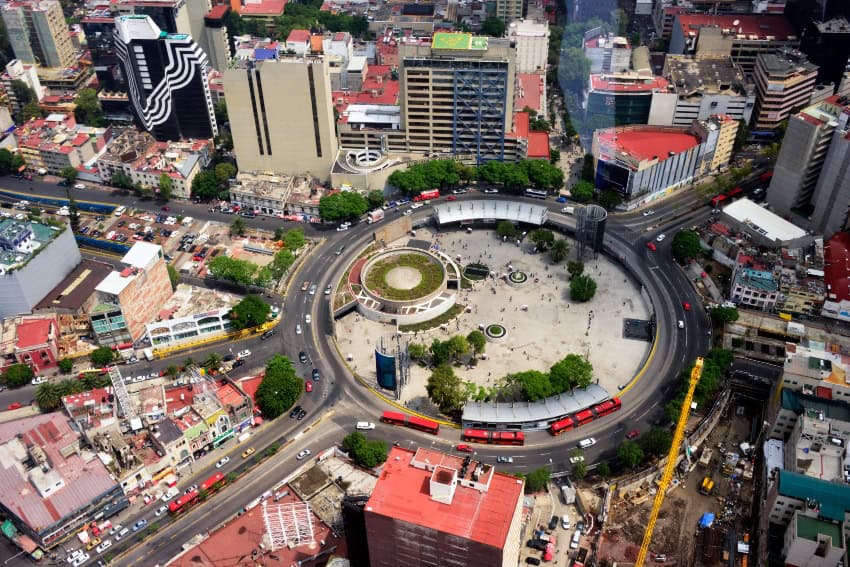
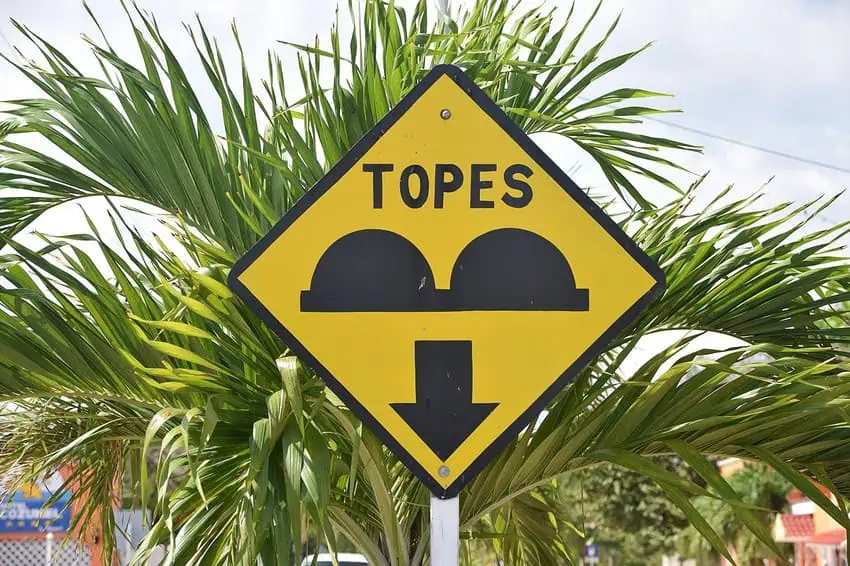
Rather than prioritizing speed, Mexico’s goal is to improve coexistence on public roads and protect the most vulnerable users. Mexico uses widespread topes (speed bumps) and glorietas (traffic circles) to calm traffic. Both have their drawbacks, but they’re more efficient than traffic lights because they reduce speed and require less waiting time.
Topes
Velázquez shared with me the pluses and minuses of topes, Mexico’s most frequent — and infamous — road feature. “In cities like Guanajuato, with complex topography and narrow streets, vehicles tend to ignore speed limits. Speed bumps are a low-cost solution that forces drivers to reduce speed in school zones, residential areas and areas with high pedestrian traffic.”

I asked Velásquez why so many types of topes exist. First, Guanajuato’s status as a UNESCO World Heritage Site means that it has specific criteria for conservation and historical character. Of course, this is equally true for other UNESCO cities, such as Puebla, San Miguel de Allende, Querétaro, Morelia, Zacatecas and Oaxaca.
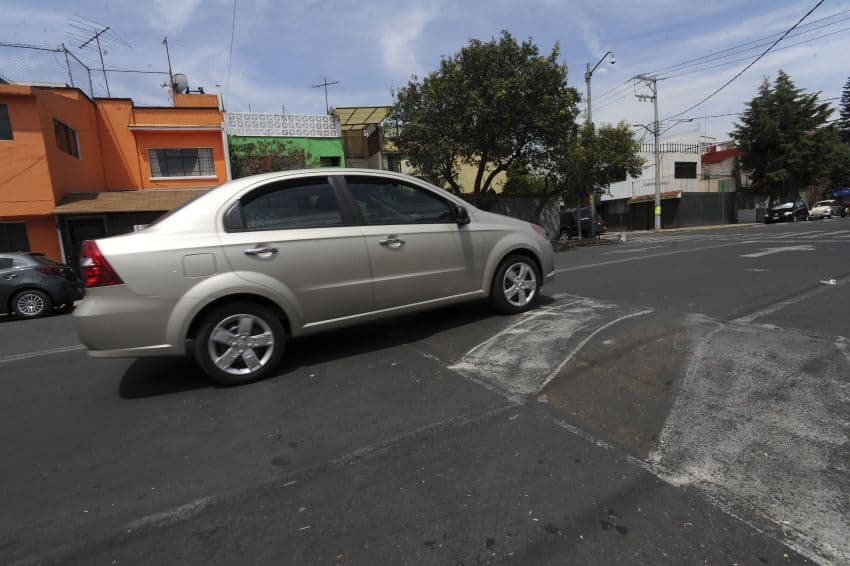
Also, some streets and highways fall under municipal jurisdiction, while others are under state and federal jurisdiction, and each level of government acts with its own guidelines, leading to differences in type and design. In addition, when budget constraints prevent topes from being installed, some residents get tired of waiting for the government to act, and add them themselves without adhering to regulations.
The future of topes
According to Velázquez, many topes are requested directly by residents through neighborhood meetings, because they perceive their streets as unsafe due to speeding. But topes are going through significant changes, as Mexico is gradually shifting toward wider speed humps, which are less jarring and less damaging to suspensions.
Some Mexican cities are upgrading topes by implementing technological solutions to improve road safety, using sensors to remain flat for drivers traveling at or under the speed limit, only rising if a vehicle approaches too fast. In other areas, topes are gradually being phased out due to air pollution concerns and mechanical wear, to be replaced with chicanes, pedestrian refuges and modifications in street design, so that speed is reduced naturally by the physical layout.
Glorietas
As for glorietas, in Mexico, they aren’t just functional intersections, but are often aesthetic, treated as public art installations and vibrant urban focal points, featuring elaborate sculptures, historical monuments, murals, fountains and lush, ornamental landscaping.
Mexico City has the highest concentration of glorietas, followed by Guadalajara, Monterrey, Tijuana and Mérida. But they exist in smaller towns as well, where they’re often used to define the entrance to the town or guide visitors into the historic center. That’s the case in Pueblos Mágicos such as Ajijic, Atlixco, Cuautepec, Orizaba, Tepoztlán, and Taxco.
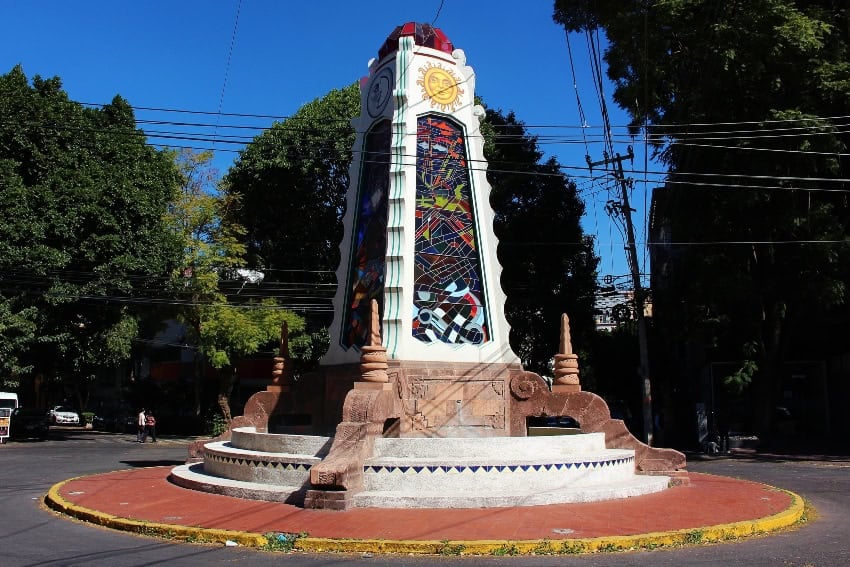
Glorietas can be small, sometimes only having one lane for traffic. For example, Glorieta Plaza de Sevilla, in Mexico City’s Roma neighborhood, is a small traffic circle that also features a 1920s-style fountain with geometric designs, stained glass and representations of the sun and moon.
From the Yucatán and Chiapas to the northern border states, creative traffic calming features and street design are growing throughout the country. Mexico still has a long way to go in transforming its vision of a pedestrian-friendly culture into physical reality, but the recent laws and on-the-ground improvements show that the government takes innovation seriously and is a world leader in this area.
Louisa Rogers and her husband Barry Evans divide their lives between Guanajuato and Eureka, on California’s North Coast. Louisa writes articles and essays about expat life, Mexico, travel, physical and psychological health, retirement and spirituality. Her recent articles are available on her website, authory.com/LouisaRogers.