
Eleven criminal groups operate in Guanajuato, four of which have links to official security forces or government, according to a new study about crime in the state.
Presented in Irapuato on Monday by a former National Public Security System chief, the study by consultancy firm Lantia Consultores said two criminal groups with a national presence operate in the state along with four “regional mafias” and five fuel theft gangs.
Juan Manuel Alcántara Soria said the number of criminal groups in Guanajuato has increased from six to 11 in the past two years and that a turf war between two of them – the Jalisco New Generation Cartel and the Santa Rosa de Lima Cartel – is largely responsible for the high number of homicides that has made the state the most violent in Mexico since October 2017.
Criminal groups have links to authorities in at least seven municipalities, the study said.
In León, Pénjamo, Irapuato, Salamanca and Jerécuaro there is evidence of links between criminal groups and municipal police or the local council.
In Valle de Santiago, evidence points to collusion between organized crime and municipal police or the council as well as state police.
In Villagrán, there are signs of complicity between organized crime and municipal police or the council as well as with federal security forces.

Links have been identified between the suspected leader of the Santa Rosa de Lima Cartel, José Antonio “El Marro” Yépez Ortiz, and Villagrán Mayor Juan Lara Mendoza, the study said.
Lara has previously rejected allegations that he is in cahoots with the Santa Rosa de Lima Cartel and denies knowing “El Marro.”
Low police salaries, insufficient training and poor quality or non-existent equipment are among the reasons why criminal groups have been able to establish connections with or infiltrate security forces, the study said.
It also said there is a link between the infiltration of authorities by organized crime and the high number of police deaths.
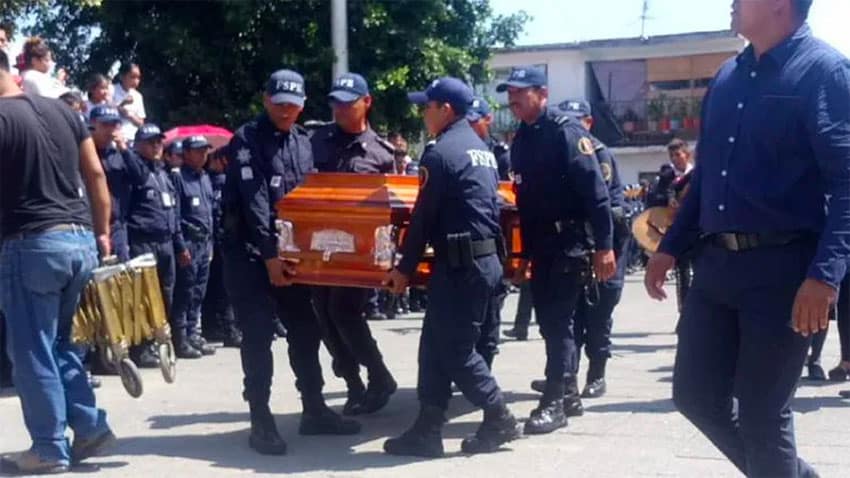
Thirty-nine police have been murdered in Guanajuato this year, more than any other state.
Michoacán, where 14 state police officers were killed in a cartel ambush on Monday, has recorded the second highest number of police deaths with 37.
The study said there were 1,878 homicides perpetrated by criminal groups in Guanajuato in the first seven months of 2019, a 7% increase compared to the same period last year.
Alcántara said that León, Salamanca and Irapuato were the most violent municipalities in the first seven months of the year, recording 252, 249 and 243 homicides respectively.
He said homicides spiked after President López Obrador took office last December and when petroleum pipelines were closed in January as part of the government’s crackdown on fuel theft.
The closure of the pipelines, Alcántara said, prompted criminal groups to turn to extortion, kidnapping and other forms of robbery.
He claimed that state and municipal authorities have failed to respond adequately to the violence generated by organized crime groups and have manipulated crime statistics to support their denial of the extent of the problem.
The former security official said that a security strategy for Guanajuato must be based on crime prevention at the municipal level and charged that the deployment of the navy or National Guard won’t be effective unless authorities of all three levels of government share information and work together to combat violence.
Source: Periódico Correo (sp), Zona Franca (sp)