A federal judge has allowed a legal challenge seeking to stop construction of a 14-tower tourist complex in Yucatán’s coastal dunes — the latest in a string of environmentally contentious beach developments halted or rejected under the Sheinbaum administration.
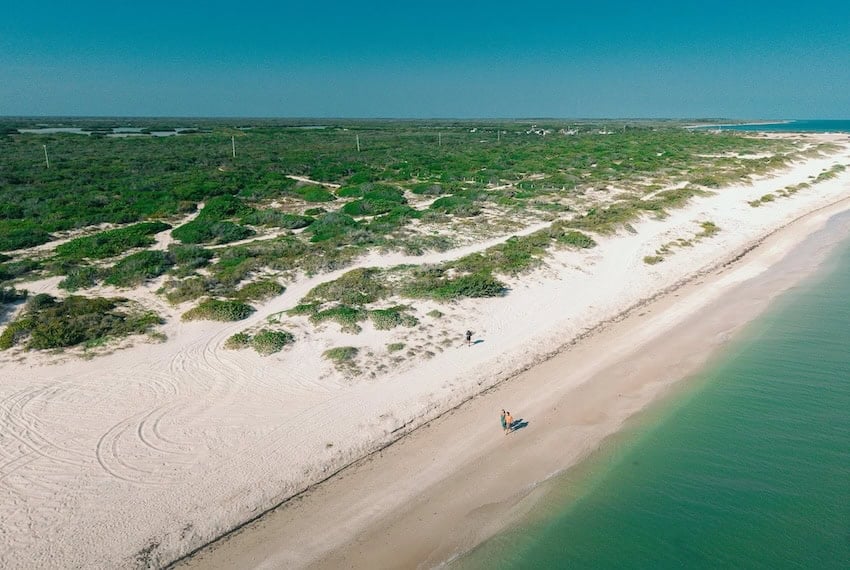
The project, known as Las Dunas, is in Chuburná Puerto, a fishing village on the Gulf coast of Yucatán where remaining dunes, mangroves and wetlands buffer an erosion-prone shoreline. The community is about 15 kilometers west of Progreso, a port city and beach town.
The temporary closure of the worksite, announced Aug. 2 by Mexico’s Federal Attorney for Environmental Protection (Profepa), follows two other high-profile coastal reversals earlier this year.
In May, the Environment Ministry (Semarnat) rejected Royal Caribbean’s Perfect Day Mexico project near Mahahual, Quintana Roo, after Sheinbaum ordered a new environmental review. The proposed cruise destination was planned for about 90 hectares of jungle and mangrove.
Then last month, Semarnat revoked the federal coastal concession for the Las Cocinas luxury development in Punta Mita, Nayarit, citing unauthorized works and environmental violations. The project had included a 145-room hotel and more than 60 luxury residences.
Now, legal action filed by Salvemos Las Dunas (Save the Dunes) and Chuburná Puerto residents seeks a court-ordered suspension of the Las Dunas project while authorities review alleged environmental violations.

State officials said 58,740 square meters of the property — including coastal wetland and federal maritime-terrestrial land — must remain conserved and unoccupied.
They stressed that a state urban-environmental feasibility assessment is not a construction permit; Semarnat holds federal authority over the environmental-impact authorization.
In ordering the total temporary closure, Profepa said its inspectors found clearing and sand movement over 1.3 hectares, or 31% of the authorized land-use-change area, that had damaged protected flora and breached environmental and forestry authorizations. Protected species were present on about half the cleared area, authorities said.
The newspaper La Jornada reported that activists have warned that Las Dunas could threaten protected species including the Mexican sheartail hummingbird and Yucatán wren.
“The dunes represent our identity as Maya people because they have been passed down from generation to generation as a source of sustenance for many families,” Chuburná resident Karen Sosa told the newspaper El País.
The Las Dunas development is represented by Auralux Representaciones and identified by El País as a Designia Desarrollos project. The project would include 138 apartments in 14 towers on roughly 92,000 square meters.
Taken together, the actions on Las Dunas and other projects point to a more visible federal willingness to intervene in contested coastal tourism developments. They do not, however, amount to a formally announced national policy.
With reports from La Jornada, El País and Animal Político