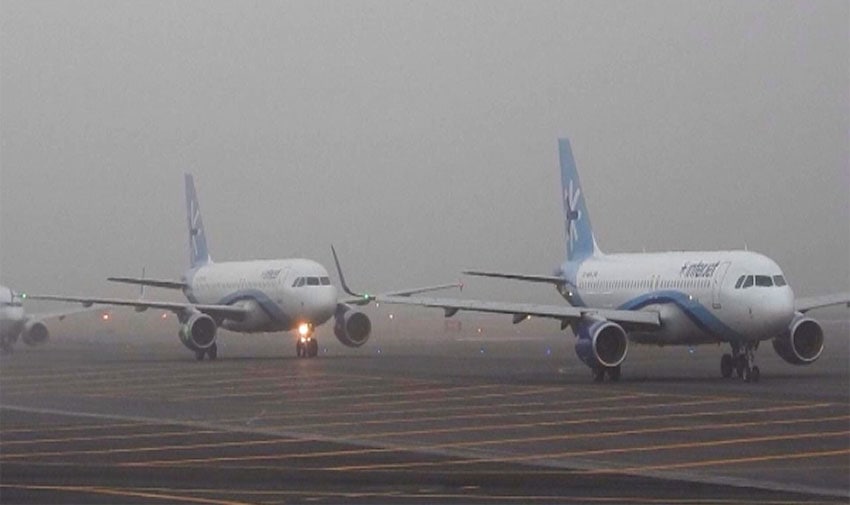
Aborted landings at Mexico City airport increased 52% in the first five months of the year, and those caused specifically by crowding on the runways rose by 84%.
Data obtained by the news agency Bloomberg through a freedom of information request shows that pilots of 541 planes were forced to perform go-arounds – as aborted landings are called – before they could touch down at the Benito Juárez International Airport between January and May.
Of that number, 83 were caused by the presence of aircraft that had not yet cleared the runways.
In the first five months of 2018, there were 357 go-arounds of which 45 were due to clogged runways.
Bloomberg reported that aborted landings are still rare in Mexico City but the increase to six out of every 1,000 landings between January and May compared to four in the same period last year is nevertheless cause for concern.
Go-arounds cost airlines both time and money because they force planes to use more fuel.
Richard Bloom, an aviation security professor at Embry-Riddle Aeronautical University, said that for every 1,000 landing attempts at a global level, between one and three will result in a go-around.

The increase in aborted landings in Mexico City should at the very least “lead to a review of the typical factors involved in go-arounds,” he said.
Gabriel Yee, flight operations manager for Aeroméxico, said that sudden changes in weather conditions have caused aborted landings in Mexico City in recent months.
However, he told Bloomberg that Mexico City airport doesn’t have a policy known as “minimum runway use” to get planes off the runway quickly, adding that “there’s no denying the airport has more operations than before.”
Passenger traffic grew 6.6% last year to 47.7 million people. The airport has two runways but they can’t be used simultaneously because they are too close together.
Yee pointed out that there is no short-term solution other than finding ways to make the airport “work more efficiently.”
To ease congestion at Mexico City airport, Latin America’s busiest airport, the federal government is pursuing a three-pronged plan – but relief is still some way off.
The Defense Secretariat has been given the responsibility of building a new airport at the Santa Lucía air force base in México state and the existing airports in Mexico City and Toluca will be upgraded. A third terminal will be built at the existing facility in the capital.
The Santa Lucía project, however, is currently mired due to legal opposition and even if it materializes, aviation experts doubt that it will be able to meet the growing demand for runway space caused by the rise of budget domestic airlines.
In that context, President López Obrador’s decision to cancel the previous government’s Texcoco airport project – after a legally questionable public consultation – becomes an even greater target for criticism.
Aviation experts at Mitre Corp.’s Center for Advanced Aviation System Development have questioned the viability of the Mexico City and Santa Lucía airports to operate simultaneously due to their proximity to each other.
Aeroméxico CEO Andres Conesa said that he had similar concerns.
“We haven’t seen the analysis,” he said. “We’d like to see the ability to increase operations in this dual system. We prefer to have one airport because we’re under a hub-and-spoke model.”
As for Toluca, the chances of success of the plan to increase traffic at that airport is dependent on cost, the CEO of budget airline Volaris told Bloomberg.
“We stopped operating out of Toluca because of what it cost us,” Enrique Beltranena said. “We need more clarity” about how much it would cost to return.
Source: Bloomberg (sp)