Former President Andrés Manuel López Obrador (AMLO) was “very concerned” about the information the United States could get from Ismael “El Mayo” Zambada, the Sinaloa Cartel kingpin who was arrested in the U.S. in July 2024.
In his forthcoming memoir, former U.S. ambassador to Mexico Ken Salazar wrote that he was told exactly that by a Mexican businessman who was a “friend and confidant” to AMLO.
The former president feared that “El Mayo” would “spill the beans” on corrupt Mexican officials, Salazar wrote, citing information he received from an unidentified businessman he refers to as “the AMLO whisperer” or simply “the Whisperer.”
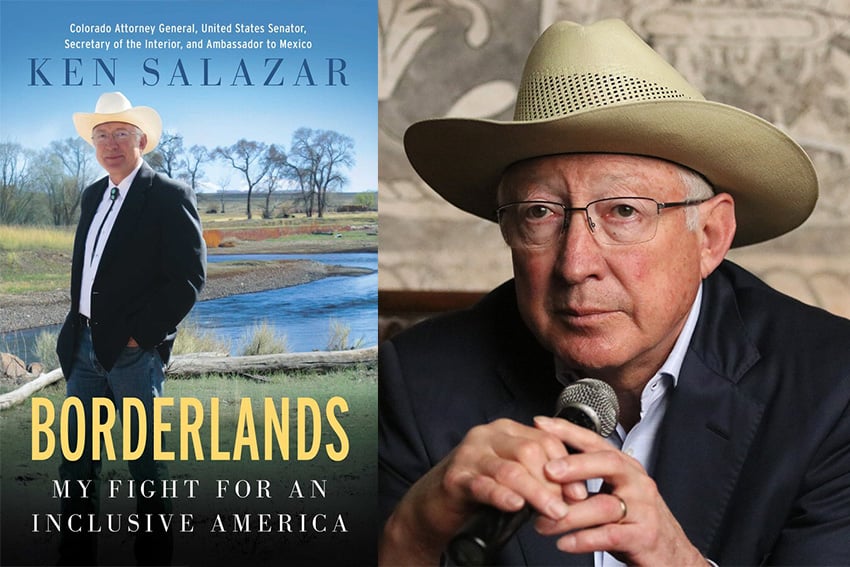
Those excerpts from “Borderlands: My Fight for an Inclusive America” were published on Sunday by the newspaper Reforma, which received an advance copy of the ex-ambassador’s book.
A day later, Salazar’s prose reached the morning press conference of President Claudia Sheinbaum, who asserted that López Obrador — the founder of the “fourth transformation” political movement she now leads — in fact had no concerns about what Zambada might testify to U.S. authorities.
AMLO’s concern, rather, was about the possible participation of the U.S. government in events that led to the arrest of “El Mayo,” as U.S. authorities’ involvement would constitute “interference and violation of sovereignty in Mexico,” Sheinbaum said.
Whether Zambada has in fact informed U.S. prosecutors about corrupt Mexican officials remains publicly unknown, The Los Angeles Times reported on Monday.

“El Mayo” was arrested at an airport in New Mexico after he was kidnapped by Joaquín Guzmán López, a son of imprisoned drug trafficker Joaquín “El Chapo” Guzmán, and forced onto a private plane that took him to the U.S.
As president, López Obrador asserted that the United States carried out the “operation” that resulted in the arrest of Zambada in the United States. With his use of the word “operation,” he apparently meant a negotiation with Guzmán López that he believed resulted in the delivery of Zambada to U.S. law enforcement authorities at a New Mexico airport near El Paso, Texas, on July 25, 2024. U.S. authorities have denied any involvement in an operation aimed at the capture of “El Mayo,” who last August pleaded guilty to drug trafficking charges in U.S. federal court. He has not yet been sentenced.
U.S. authorities’ denial of involvement in an operation to capture “El Mayo” is referenced in a U.S. Department of Justice statement released in December 2025 after Guzmán López pleaded guilty to drug charges in the U.S.
“Guzmán López admitted to coordinating and committing the kidnapping [of Zambada] in the hopes of receiving cooperation credit from the United States. As stated in the plea agreement, the United States did not induce or condone the kidnapping, and Guzmán López will not receive any cooperation credit for it,” the Justice Department said. Guzmán López has not yet been sentenced.
AMLO, who has made few public comments since leaving office in late 2024, hasn’t responded to Salazar’s written remarks about his alleged concern about information Zambada might provide to U.S. authorities. He has previously denied allegations that he had cartel ties before and during his presidency.
Salazar tells LA Times he ‘never saw’ any proof of ties between AMLO and cartels
In “Borderlands,” which will be released next month by Dallas-based publisher BenBella Books, Salazar, ambassador to Mexico from September 2021 to January 2025, wrote that “[i]t was well known that Mexico’s powerful transnational criminal cartels had compromised many government officials.”
While the ex-ambassador and former U.S. secretary of the interior cited claims by “The Whisperer” in his book, thus adding to speculation and allegations that AMLO had cartel ties, Salazar told The Los Angeles Times that he had never seen any evidence linking López Obrador to criminal organizations.
“I never saw any proof of it,” he told the L.A. Times in a telephone interview.
“As far as I know, Andrés Manuel López Obrador was a president who strongly believed in Mexico and the sovereignty of Mexico,” Salazar said.
The former ambassador maintained a close relationship with AMLO during much of the time he was posted to Mexico City. However, shortly after Salazar voiced concerns about the Mexican government’s proposed judicial reform (which is now law), and just a month after Zambada was arrested in the United States, López Obrador announced a “pause” in his administration’s relationship with the U.S. Embassy.
“How are we going to allow [Salazar] to opine that what we’re doing is wrong,” AMLO said on Aug. 27, 2024.
The L.A. Times reported that the ex-ambassador wrote in his memoir that he was “frozen out” by AMLO after the arrest of Zambada and never spoke to the president again. The newspaper also reported that Salazar wrote that he became a “persona non grata” in Mexico City following Zambada’s arrest, and noted that he resigned after the election of Donald Trump in November 2024.
Salazar dedicates around 1/3 of ‘Borderlands’ to his ambassadorship in Mexico
Salazar, who served as attorney general of Colorado and as a U.S. senator before becoming secretary of the interior during the first term of former U.S. President Barack Obama, dedicates more than 100 pages of his 347-page memoir to his ambassadorship in Mexico, according to the Ciudad Juárez-based newspaper El Diario mx.
In addition to detailing information passed on to him by “the Whisperer,” Salazar wrote about a range of other topics related to Mexico in “Borderlands.”
- He wrote that he penned several letters to AMLO expressing his concerns about the judicial reform, which was approved by federal Congress in September 2024, paving the way for Mexico’s first-ever judicial elections to be held in June 2025. Salazar said he suggested alternatives to the judicial reform to López Obrador, but received no response. The ex-ambassador said publicly in August 2024 that he believed that the popular direct election of judges was “a major risk to the functioning of Mexico’s democracy.”
- Salazar wrote that “the Whisperer” helped him get his first lengthy meeting with AMLO in late December 2021, two months after he became ambassador. At that three-hour meeting, Salazar wrote that he and the then president of Mexico agreed to promote the modernization of the Mexico-U.S. border and to work together to combat cartels.
- In his memoir, Salazar criticized AMLO’s so-called “hugs, not bullets” security policy, describing it as “insufficient.” Near the end of his ambassadorship, Salazar publicly declared that the “hugs, not bullets” security strategy — which favored addressing the root causes of crime over combating criminal groups with force — failed. At the same time, he blamed AMLO for a breakdown in the bilateral security cooperation. In his book, Salazar wrote that initiatives such as educational scholarships and employment schemes — i.e., the “hugs” part of the former Mexican government’s security strategy — should have been accompanied by more decisive actions against cartels. He also wrote that Mexicans felt unsafe in Mexico during AMLO’s presidency — the most violent six-year period of government in Mexico on record — and disclosed that he told the ex-president on several occasions that “without security, there is no prosperity.”
- Salazar wrote that AMLO submitted a request in late 2022 for former U.S. President Joe Biden to land in Air Force One at the Felipe Ángeles International Airport (AIFA) in México state rather than at the Mexico City International Airport. The presidential aircraft did indeed touch down at AIFA in January 2023, a month in which AMLO, Biden and then Canadian Prime Minister Justin Trudeau participated in the 10th North American Leaders’ Summit in Mexico City. Salazar wrote that the U.S. Secret Service didn’t initially authorize the landing of Air Force One at AIFA. However, he wrote that AMLO was insistent that the plane land there. Salazar wrote that López Obrador told him that AIFA represents “the new relationship” between Mexico and the United States, and that if Biden lands there, he will show that he understands what the two nations are trying to build together.
- Salazar claimed that AMLO’s prioritization of spending on “mega-projects,” such as the Maya Train railroad and the Isthmus of Tehuantepec trade corridor, was one of the causes of a migration crisis at the Mexico-U.S. border in late 2023. He wrote that the U.S. Embassy in Mexico City heard from the then-head of Mexico’s National Migration Institute, Francisco Garduño, that there were scant resources for migration control in Mexico as so much money was being spent on infrastructure projects.
- Salazar also wrote in his memoir that he told himself in July 2024 that he “should run for president.” He gave himself that advice, Politico reported, after growing “increasingly frustrated with the White House’s border plan” during his ambassadorship in Mexico. Politico, which obtained an advance copy of “Borderlands” and recently interviewed Salazar, also reported that the ex-ambassador “says he begged for a ‘border czar’ to run point on interagency coordination.” However, “he never got one, and instead, the moniker was inaccurately and problematically affixed to then-Vice President Kamala Harris,” Politico wrote. While Salazar didn’t run for president in 2024, he is now “positioning himself as his party’s immigration whisperer, meeting with [Democratic Party] presidential hopefuls and pitching them on his “borderlands platform,” which says the U.S.’ borders are ‘broken’ and ‘must be fixed,'” according to Politico.
With reports from Reforma, Los Angeles Times, Politico and El Diario mx