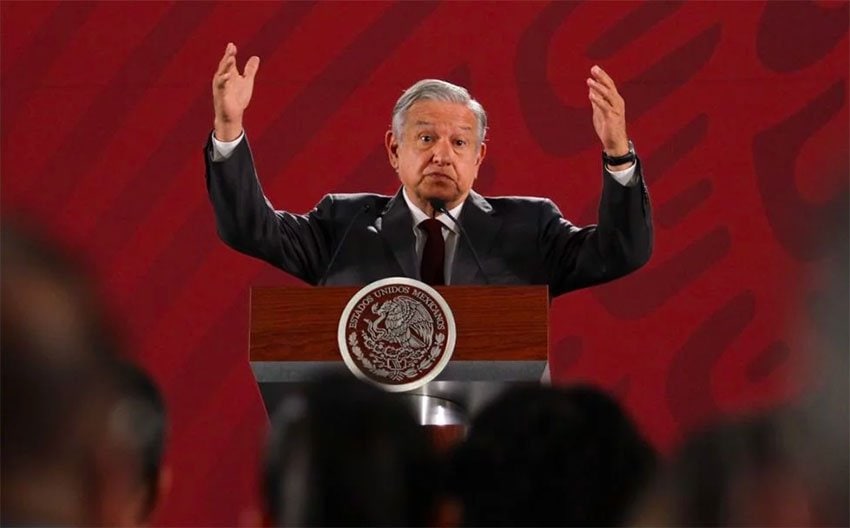
President López Obrador warned researchers and scientists earlier this week that his government’s austerity measures mean that the days of “academic tourism” are over, but it turns out he was misinformed.
The president told reporters at his morning press conference on Monday that he has received more than 300 requests from public university academics asking for approval to travel overseas on the public purse.
In a May 3 memorandum, López Obrador said all overseas trips by government officials must be authorized by him and that allowances for approved travel had been cut by 50%.
On Monday, he said that scientists and researchers must be able to justify their proposed trips, charging that in the past academics traveled abroad largely for pleasure and that many of them flew in “classes above economy.”
The president added that a lot of international scientific work and collaboration can now be completed via the internet.
He called on the National Council of Science and Technology (Conacyt) to draw up new protocols that stipulate in which cases overseas travel will be approved, adding that he will cede responsibility for authorization to the agency’s director.
“. . . Only those who really need to will travel, and they’ll do it for the benefit of science,” López Obrador said.

However, Conacyt said in a statement yesterday that researchers can indeed travel without presidential authorization as long as they do not hold management positions. The latter must seek approval from the head of the science agency.
The statement was released following a meeting between Conacyt director María Elena Álvarez-Buylla and Public Administration Secretary Irma Eréndira Sandoval Ballesteros to clarify the legal requirements for obtaining travel approval.
The issue has generated concern within the scientific community.
The former president of the Mexican Academy of Sciences said neither the president nor the federal cabinet was qualified to determine whether a researcher should travel.
“It seems the president has a lot of other things to attend to rather than review travel plans to decide if they are pertinent . . .” said José Franco, who said it was a shame that López Obrador was receiving distorted information.
A researcher at the National Polytechnic Institute’s Center for Investigation and Advanced Study posted a letter to social media in which she challenged López Obrador’s crackdown on travel for academic purposes.
“Mr. President, I understand that in this government the poor come first and that we must help millions of people who, because of the place . . . where they were born, didn’t have the same opportunities as other . . . people. We have to create study and work opportunities for those who didn’t or don’t have them. However, can you explain to me, why the malice towards those who did have them?” Eugenia Roldan wrote.
She said that when Luiz Inácio Lula da Silva was president of Brazil between 2003 and 2010, his government not only brought millions of people out of poverty but also significantly increased investment in higher education and research.
“Thousands of Brazilian researchers traveled to international conferences [and] created networks and research projects,” Roldan said before questioning why Mexicans can’t be afforded the same opportunities.
“Why in your government do those who had the opportunity to study have to be cut down, discredited and punished?”
Source: El Economista (sp)