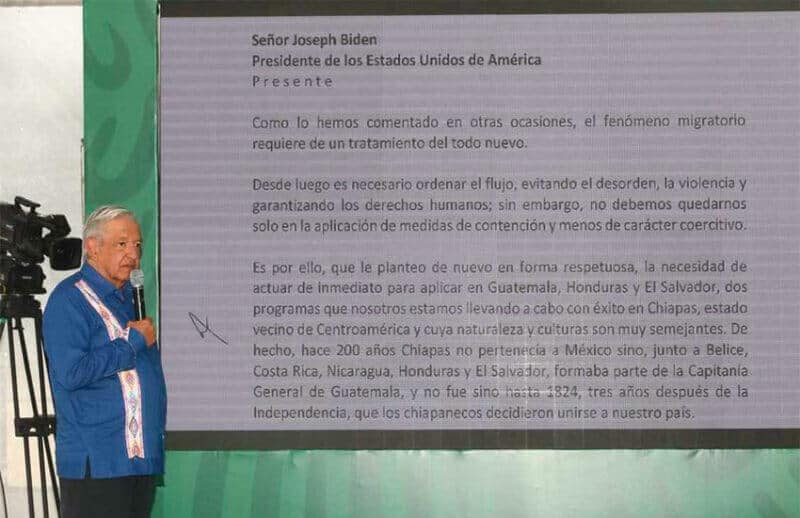
President López Obrador has disclosed a letter he sent to United States President Joe Biden to seek his government’s financial support for the implementation of two employment programs in Guatemala, Honduras and El Salvador.
López Obrador presented his letter – which also asks Biden to consider offering temporary work visas to participants in the programs – at his morning press conference on Monday.
“As we have mentioned on other occasions, the migratory phenomenon requires a completely new treatment,” opens the letter, dated September 7.
“Of course ordering the [migratory] flow, avoiding disorder and violence and guaranteeing human rights is necessary. However, we mustn’t limit ourselves to the application of contention measures, especially ones of a coercive nature,” López Obrador wrote, perhaps referring to Mexican authorities’ recent use of force to detain migrants in the south of the country.
In that context, the president proposed once again the extension of his government’s tree-planting employment program Sembrando Vida (Sowing Life) and the apprenticeship scheme Youths Building the Future to the northern triangle Central American countries.
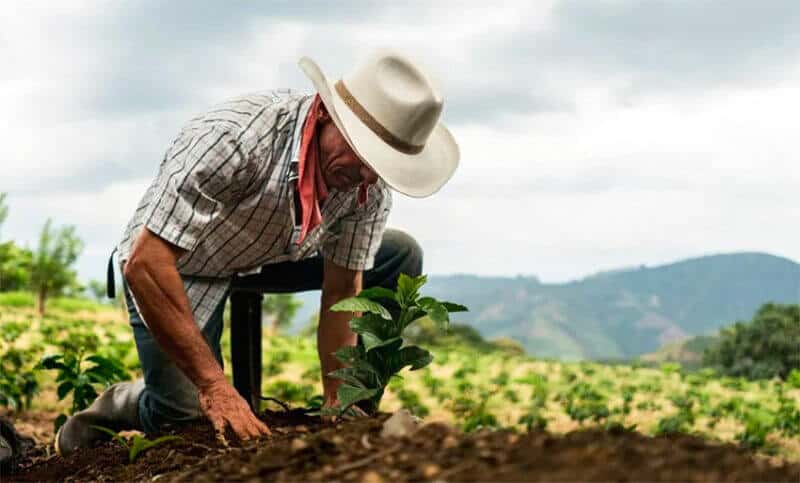
He suggested that the size of the programs in each of Guatemala, Honduras and El Salvador be the same as those already underway in Chiapas.
“Today we’re planting 200,000 hectares of fruit and timber-yielding trees in Chiapas, and that program provides work to 80,000 planters who receive a salary to cultivate their land. This same procedure can be immediately applied in the three Central American countries of greatest migration (Guatemala, Honduras and El Salvador), through which the area of sowing would expand by 600,000 hectares and employment would be provided to 240,000 farmers,” said the letter, dated two days before the federal government announced that the United States had agreed to collaborate with Mexico on employment programs in the south of the country and Central America.

“Another of our relevant social programs that is being applied in Chiapas consists of providing work as apprentices to 30,000 young people who receive a minimum wage in order to undertake training in workshops, companies and in other productive and social activities. If this action was immediately applied in Guatemala, Honduras and El Salvador, 90,000 people among those who emigrate due to a lack of work could be kept in their countries of origin,” López Obrador said.
The president noted that a total of 330,000 Central Americans could be supported by the programs, which he estimated could commence within six months. If the U.S. government agrees to support the programs financially, the Mexican government will be “fully willing” to collaborate, López Obrador said, pledging that it would provide advice, experience and labor.
“Mr. President Biden, to the measures signaled, I add another that we believe is very effective: signing agreements with those registered in these programs to offer them in the medium term – in an orderly way and in accordance with demand – temporary work visas for the United States,” he wrote.
“Nobody would be harmed by that because it’s known that the great nation you preside over needs an additional workforce to boost economic growth, strengthen production and reduce imports from Asia,” the letter said, adding that the United States will need a “great army of workers” to construct a range of infrastructure projects the Biden administration intends to build.
“… I believe that the combination of these circumstances opens up a perfect opportunity to plan, put order to and humanize migration flows.”
The United States hasn’t publicly indicated any support for the president’s temporary work visa proposal.
Just a week after penning his letter to Biden to seek the United States’ support, López Obrador sought to influence Mexico’s neighbor on a very different issue, calling on the superpower to lift its long-running trade embargo on Cuba.
“The government I represent respectfully calls on the United States government to lift the blockade against Cuba,” he said at an Independence Day event last Thursday. “Because no state has the right to subjugate another people, another country.”
The president appears to be trying to distance Mexico from the United States while paradoxically and simultaneously seeking a more collaborative relationship.
Perhaps wary that his government is perceived as being subservient to the United States by deploying security forces to halt the advance of migrants to the northern border, López Obrador seems keen to highlight that Mexico is also prepared to take positions that are very different from those of its powerful neighbor.