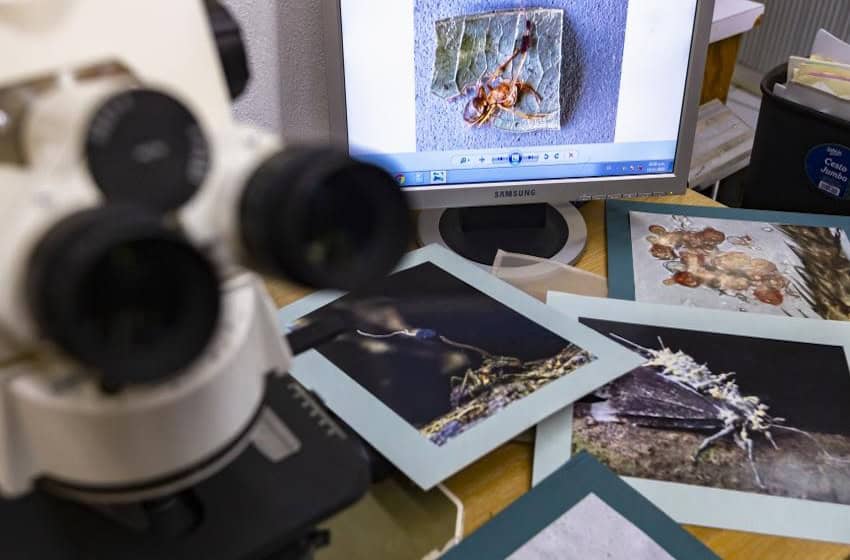
Six newly documented species of “zombie fungi” — parasites that hijack the behavior of ants and drive them to their deaths — have been identified in western Jalisco, marking the first scientific record in Mexico of the unusual fungus.
One of the new described species, Ophiocordyceps deltoroi, was named for Guadalajara-born filmmaker Guillermo del Toro, whose work often blends horror and fantasy.
Researchers from the University of Guadalajara (UdeG) found the fungi in a tropical forest near the Haravéri Botanical Garden in San Sebastián del Oeste, Jalisco.
Their study was published online late last year, then drew wider attention this month after reports highlighted the species named for Del Toro.
The six species belong to the Ophiocordyceps unilateralis complex, a group of ant-parasitizing fungi found in tropical forests worldwide.
After infecting an ant by penetrating its outer cuticle, the fungi produce metabolites that alter the ant’s behavior.

The infected ants ultimately clamp their mandibles onto tree bark, leaves or rocks in the forest. After the ant dies, the fungus grows from its body and releases spores, helping infect new hosts.
“It’s both monstrous and beautiful at the same time,” César Ballesteros Aguirre, the UdeG mycologist who led the work, said in a university news release.
The discovery is the first scientific record in Mexico of the so-called “zombie-ant fungi,” according to the university. The team is also studying fungi near metropolitan Guadalajara and parasites of butterflies and wasps.
The fungi are not known to pose a threat to people. Their highly specialized relationships with insect hosts differ sharply from portrayals such as “The Last of Us,” a fictional HBO series in which a mutated Cordyceps fungus spreads to humans and turns them into violent, zombie-like creatures.
Beyond the taxonomy, the UdeG work establishes a baseline for studying Mexico’s fungal biodiversity, the parasites’ relationships with their ant hosts and the chemical compounds they produce.
Their discovery provides a starting point for researchers to catalog the fungi’s metabolites and test them for biological activity.
Some related insect-pathogenic fungi have produced compounds of interest to researchers studying potential biomedical applications and pest control.
However, the new Jalisco species have not been shown to treat any disease, and any potential scientific applications would require substantially more study.
With reports from TV Azteca, Tribuna de México and Infobae