Mexican authorities have intercepted Amazon parrots, peacock turtles, howler monkeys and even baby crocodiles in recent years, but the country’s latest case of illegal wildlife trafficking centers on a far smaller animal: queen ants.
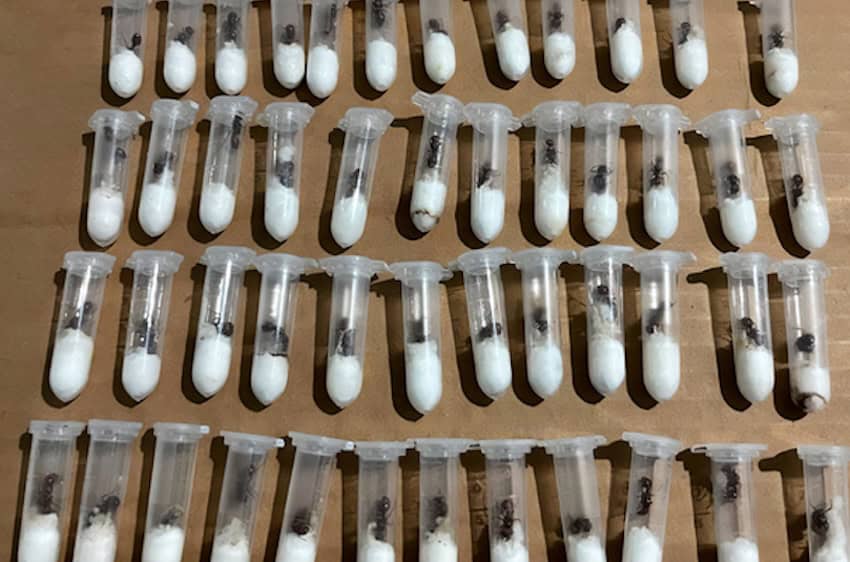
Earlier this month, environmental officials in the west-central state of Jalisco seized 105 queen ants hidden inside plastic toys and labeled as “collectible figures” in a shipment bound for Southeast Asia, the Federal Attorney for Environmental Protection (Profepa) said.

The discovery was made July 9 after a parcel company flagged a suspicious package in El Salto, Jalisco, outside Guadalajara. The package was addressed to Laos, a landlocked country between Vietnam and Thailand.
Inside, inspectors found the insects sealed in individual test tubes and concealed within toy figures, including one containing 22 tubes and another with 83. Each small tube appeared to contain cotton and moisture, the standard way to house queen ants in test tubes.
Experts determined that it was not feasible to keep so many ants alive in that manner because of their biological needs.
According to a Profepa press release, 87 ants survived and were later released into the Cerro Viejo Protected Natural Area, while 18 died.
The seized ants belong to the genus Pogonomyrmex and are commonly known as harvester ants. They are native to Mexico and play a role in seed dispersal and soil health in arid ecosystems.

The seized ants fit into a growing niche hobby in Europe and Asia, where buyers use queen ants to stock formicariums, specialized terrariums that house and display ant colonies. Owners watch the ants build tunnels, haul seeds and care for larvae.
The ant farms are promoted as do-it-yourself ecosystems built around a single fertilized queen, which can eventually produce thousands of workers.
Collectors and hobbyists sometimes pay 200 to 400 pesos (US $11 to $22) for a queen ant online, while more exotic ants can fetch up to 1,200 pesos (US $68), according to the newspaper El Sol de México.
Illegal wildlife trafficking remains a major issue in Mexico. Authorities have seized hundreds of turtles on highways and at airports, along with parrots, reptiles and other species trafficked through parcel services and border crossings.
The numbers especially surged during the coronavirus pandemic, according to Profepa.
Globally, illegal wildlife trafficking affects more than 4,000 plant and animal species in at least 162 countries and territories, according to the United Nations Office on Drugs and Crime. Some assessments have valued the illegal wildlife trade at up to US $23 billion a year.
Despite the enforcement action in Jalisco, no arrests have been reported so far.
“Profepa will follow up on the corresponding administrative procedure,” the agency stated, adding that it will continue to fight illegal wildlife trafficking through surveillance and other means.
With reports from El Sol de México and Milenio