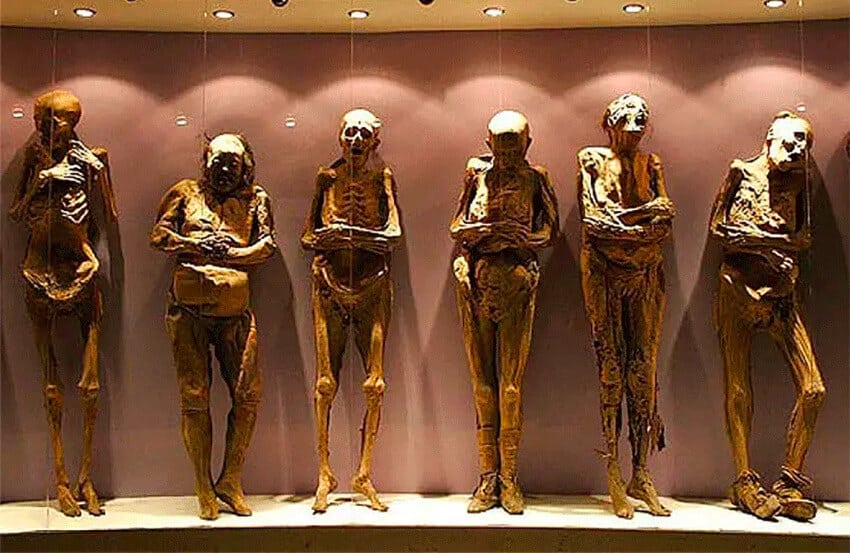
A team of experts will attempt to establish the identity of the mummies on display at the Museum of the Mummies of Guanajuato and two other locations in the capital of the Bajío region state.
The National Institute of Anthropology and History (INAH) announced Monday that it had formed a commission of four specialists in physical anthropology and conservation to work on a research project aimed at identifying the more than 100 mummies in the museum’s collection as well as those held at the Sangre de Cristo tourism center and the Santa Paula Cemetery Museum.
Their work will be supervised by INAH’s physical anthropology chief Juan Manuel Argüelles San Millán.
In a statement, Argüelles noted that the mummies are the bodies of people who had a name, age and family when they died during a 19th century cholera outbreak in Guanajuato city.
However, the identity of the mummified victims – some of whom possibly have living descendants – is unknown today, leaving many to be referred to by nicknames such as “El ahogado” (The Drowned Man), “La china” (The Chinese Lady) and “La bruja” (The Witch).
Argüelles said that establishing their identity will help restore dignity to the bodies, which have deteriorated over the years due to a lack of specialist care.
He said the INAH team – made up of two men and two women described as “specialists in mummified human remains” – will trawl through municipal, state and church archives to aid their efforts to identify the mummies, whose mummification occurred naturally after entombment due to the absence of moisture or oxygen exchange.

They have already made a first visit to Guanajuato city to obtain information they will use to draw up their plan of action, Argüelles said.
He said the experts will use a “precise” methodology to examine the mummies and stressed that their commitment to the identification task is “complete and impartial.”
Most of the famous mummies of Guanajuato – the first of which was exhumed almost 160 years ago – are displayed nude because their clothes disintegrated over time. The Museum of the Mummies of Guanajuato is a major tourism attraction, with over 600,000 visitors in 2019.
With reports from El País