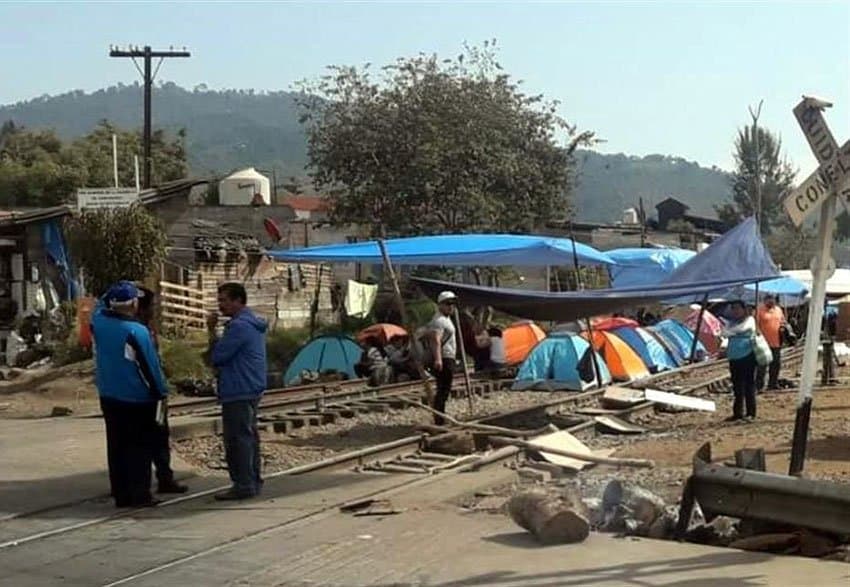
The National Human Rights Commission (CNDH) has warned the federal government that it cannot delegate its responsibility to protect people’s rights after the latter asked the former for advice on how to end teachers’ rail blockades in Michoacán.
In a statement, the CNDH said that “authorities of the different levels of government are obliged to protect and guarantee . . . people’s rights, a mandate that they can’t relinquish or seek to delegate to third parties.”
The commission urged the federal executive to fulfill that obligation, stating that the government’s responsibility cannot “depend on or be made conditional on a declaration or resolution by an organization for the protection and defense of human rights.”
President López Obrador said yesterday that the government had filed a complaint with the CNDH against those responsible for the rail blockades and sought the commission’s opinion on what action to take in the context of its determination not to use force against the teachers.
The CNDH commended the government’s commitment not to use force but added that the position doesn’t absolve it of the responsibility to act if protesters are found to have broken the law.
“While it is positive that other ways [to end the blockades] are favored over the use of force, if the relevant government authorities were to determine the existence of an illegal act, such an attitude cannot justify it being permissible that authorities relinquish or hold back from fulfilling their constitutional obligation,” the statement said.
The CNDH urged that “the parties involved in the conflict seek a solution through the building of agreements, within the framework of the law, establishing a process of dialogue that contributes to the building and strengthening of a culture of peace in the country.”

López Obrador told reporters at his morning press conference yesterday that his government has been available for dialogue and had done everything asked of it to satisfy the demands of Michoacán teachers, who say they are owed billions of pesos in unpaid salaries and benefits.
He also asked the CNTE teachers’ union to clarify whether teachers who continued to block railway tracks in Uruapan and Pátzcuaro were its members.
Speaking later in the day at an event in Huetamo, Michoacán, the president urged dissident teachers to not be “rebels without a cause,” and asked them to wait patiently for their demands to be resolved and for the “misnamed educational reform” to be repealed.
“I’ve just seen my Interior Secretariat file, what they were saying about me 40 years ago; they spied on me because I was in the opposition, so I know what it’s like to fight for just causes,” López Obrador said.
“. . . None of this intransigence and waiting [on the railway tracks] thinking that . . . you’ll provoke me and that I’ll use public force so that you can accuse me of being an oppressor, an authoritarian . . . No, I’m not going to fall into provocation,” he added.
While the CNTE teachers’ union last week agreed to lift the seven rail blockades in Michoacán, radical teachers belonging to the National Front of Struggle for Socialism (FNLS) and the National Democratic Executive Committee have maintained those in Pátzcuaro and Uruapan.
Section 18 union leaders said in a statement Thursday that the CNTE was not associated with any groups that choose to defy the directive to lift the rail blockades.
However, early yesterday CNTE-affiliated teachers reestablished a blockade on tracks in the port city of Lázaro Cardenas, where thousands of shipping containers are stranded, and barricaded at least 60 government offices in Michoacán.
The newspaper Milenio reported that the CNTE members returned to the tracks in a show of solidarity with three teachers who were summoned to the federal Attorney General’s office in Morelia after railway company Kansas City Southern filed a criminal complaint against them.
The blockades, which were first erected on January 14, have cost the economy close to 30 billion pesos (US $1.6 billion), while the teachers’ work stoppage has left students in Michoacán without classes for almost a month.
The CNTE said later yesterday it had agreed to “a tactical withdrawal” of all rail blockades in Michoacán and that it was ready to resume trilateral talks with state and federal authorities. However, this morning the blockade in Caltzontzin, Uruapan, remained in place.
Despite the ongoing blockade, Michoacán Education Secretary Alberto Frutis Solís said yesterday that talks between the three parties would resume today and it is believed they will be held in Mexico City.
Teachers have previously said that they want 5 billion pesos before they will return to the classroom but Section 18 CNTE leader Víctor Manuel Zavala said yesterday that the union is seeking commitments worth around 6 billion pesos (US $313.7 million) in order for the conflict to be resolved.
To date, state and federal governments have released more than 2 billion pesos in funding to pay salaries and bonuses in response to teachers’ demands.
Source: Milenio (sp), El Financiero (sp), Reforma (sp)