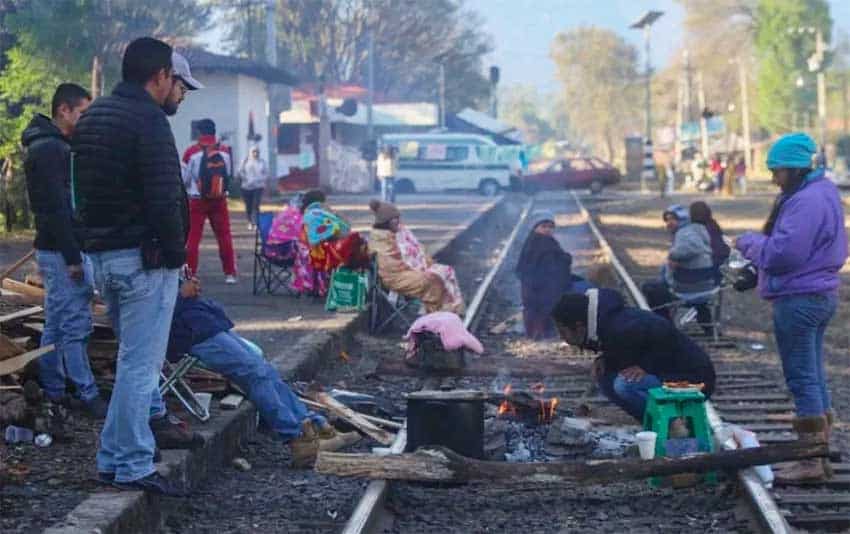
Teachers protesting in Michoacán want 5 billion pesos (US $263 million) before they will end their rail blockade and return to the classroom.
At a meeting with state and federal education authorities, leaders of Section 18 of the CNTE teachers’ union said the 1-billion-peso (US $52.6-million) offer made by the federal government was not enough.
That amount, they said, would only cover one month of wages that teachers are owed.
The union leaders argued that the additional 4 billion pesos is needed to pay benefits and bonuses to teachers, stipends to teaching students and retirement bonuses, all of which they say were agreed to with previous federal governments.
“The work stoppage will be maintained . . . We call for [the government’s offer] to be strengthened . . .” the leaders said.
However, neither the federal government nor the Michoacán government appears to have enough funds available in their budgets to give the union the money it is asking for.
Héctor García, head of the administration and finance division of the Secretariat of Public Education (SEP), said the federal government’s offer could only go up to 1.2 billion pesos.

He called on teachers to remove their railroad blockades, pointing out that uninvolved third parties including the manufacturing sector and students are suffering as a result.
The blockades, which started at the beginning of last week, have caused economic losses in the hundreds of millions if not billions of pesos.
Supplies destined for factories in Michoacán and other parts of the country have been stranded in the ports of Lázaro Cárdenas and Manzanillo, while auto makers and other manufacturers have been prevented from getting their products to the ports for export.
Trains transporting gasoline have also been unable to supply parts of the country, such as Jalisco, which are still experiencing fuel shortages.
Michoacán Governor Silvano Aureoles yesterday called on the federal Secretary of the Interior to clear the tracks.
In a statement, the governor said that “under the rule of law, the illegal blockade of transport routes cannot be allowed,” adding that the state’s railroads are not only crucial to the economy of Michoacán but to that of the whole country.
Aureoles said that state authorities are willing to cooperate with the federal government on the operational actions it deems necessary to clear the tracks.
But Interior Secretary Olga Sánchez has ruled out forcibly removing the protesting teachers from the railroads.
Despite the “grave damage” caused by the blockades, “there will be no repression, [the federal government] will not resort to using public force,” she said.
“We are going to negotiate, and when negotiations are over, we will negotiate some more.”
Source: Reforma (sp), El Universal (sp)