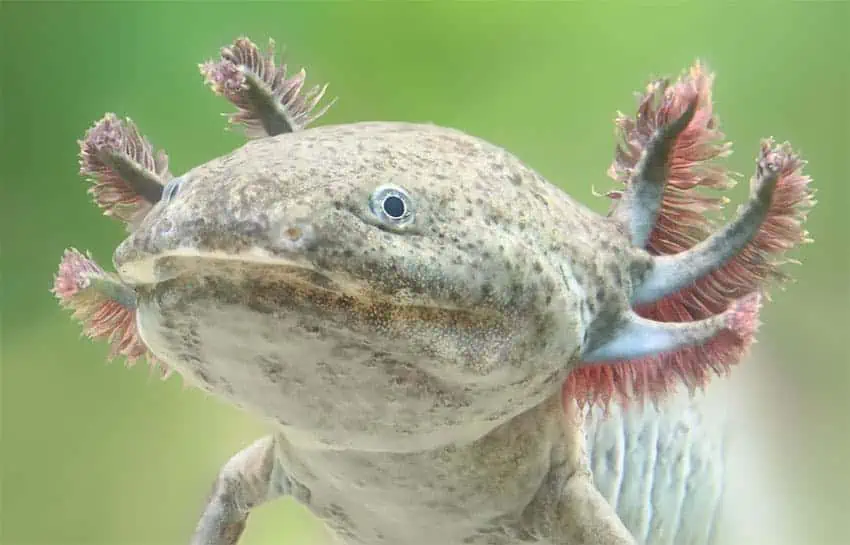
The National Autonomous University of Mexico (UNAM) has launched the international fundraising campaign called AdoptAxolotl to fund an environmental plan safeguarding the habitat of the axolotl, an endangered Mexican salamander.
The campaign was announced by Mexican biologist Luis Zambrano, who has been working on conservation projects to protect the axolotl’s natural environment for more than 20 years.
One of those projects is the maintenance of “chinampa refuges.” The chinampas are the artificial islands built on Mexico City’s freshwater lakes for agricultural purposes. The refuges consist of many protected areas within the lake that seek to maintain the original ecosystem of the axolotl while protecting the species from predators.
According to Zambrano, the AdoptAxolotl campaign is an extension of the chinampa refuge project, an initiative also promoted by UNAM.

To adopt an axolotl, Diana Laura Vázquez Mendoza, the campaign coordinator, explained that there are two types of donations. The first one is called “invite an axolotl to dinner” and seeks to raise funds to buy supplies for the maintenance of the colony. The other one, “tune up an axolotl’s house,” is aimed at supporting the maintenance of the chinampa refuges in Xochimilco.
Through the campaign’s website, 200 pesos (US $10) buys “dinner for an axolotl” and 1,000 pesos (US $50), “tunesup an axolotl’s house.” With larger gifts, donors can adopt a specimen or a chinampa refuge for six months to a year.

To personalize the adoption process, Vázquez Mendoza said that donors will receive informative posters and postcards with some donations allowing for the donor to name an axolotl or a chinampa refuge.
Currently, the UNAM and the chinamperos (those taking care of the chinampas) work with 48 chinampa refuges, which correspond to just over five linear kilometers of canals in which the axolotl and other species can live without threats.

“We must protect the species and let it reproduce in its natural ecosystem, which is in our country,” Zambrano said regarding growing interest around the world inkeeping axolotls as pets. In fact, there are more axolotls in captivity than there are in the natural world.
This interest is attributed to Minecraft — a video game that includes — and the social media platform TikTok. Jake Pak, co-owner of a U.S. breeding sanctuary in Dallas, Texas, told the news agency NPR that nearly every kid who goes to his store to buy a pet axolotl learned about the salamander in the game.
The amphibian has also gained popularity thanks to the award-winning children’s book “My Life At The Bottom,” which recounts the idyllic life of an axolotl at the bottom of a lake that is threatened by climate change.
The book depicts the reality of the axolotl’s natural habitat, which is threatened by several factors: the urbanization of Xochimilco, the quality of the water (which is full of waste from a treatment plant), and the introduction of predators — carp and tilapia — between 1970 and 1980 with the intention of a green revolution.
All these reasons have led the axolotl to be classified as critically endangered by the International Union for Conservation of Nature, which estimates only 50 to 1,000 mature adults are left in the wild.
More information about how to adopt an axolotl and support the recovery of its natural habitat is available on the AdoptAxolotl project website.
With reports from El Universal and UNAM Global