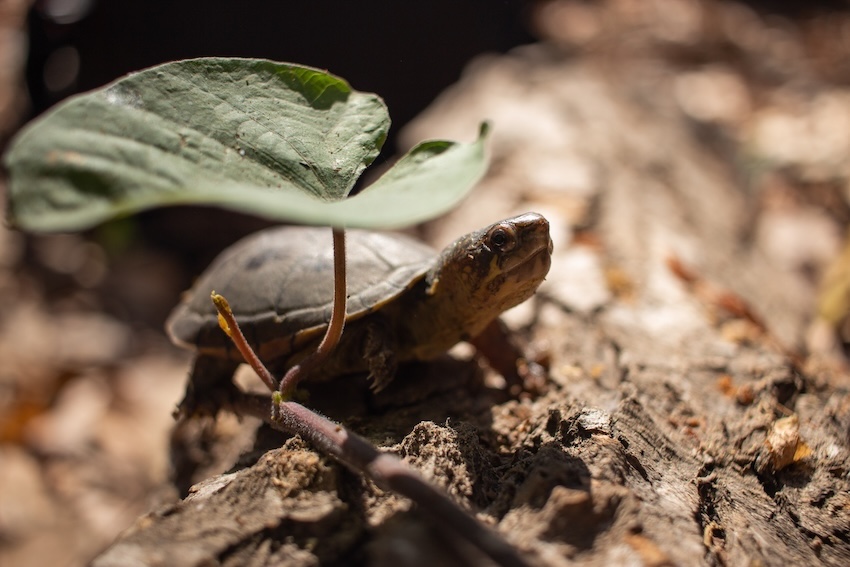
The Guadalajara Zoo has scored a conservation victory by breeding the world’s smallest turtle in captivity for the first time.
In late August, the zoo announced the birth of a baby Vallarta mud turtle, a recently discovered species popularly known as casquito de Vallarta. The birth had occurred nearly two months earlier, on June 30.
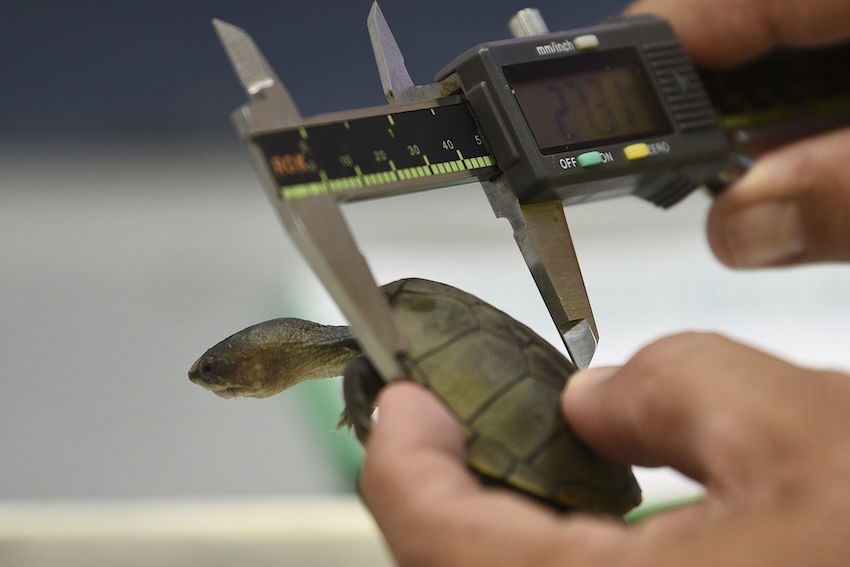
AFP’s Ulises Ruiz photographs a Vallarta mud turtle – considered the smallest turtle in the world – after Mexico’s Guadalajara Zoo achieved the first birth of the reptile in captivity.
The Vallarta mud turtle is threatened by illegal trafficking, severe habitat loss and is… pic.twitter.com/lzUc0lbXnv
— AFP News Agency (@AFP) August 26, 2025
The hatchling weighed just 2.8 grams and was only 2 centimeters long, about the width of an adult human thumb.

This species of endangered turtle, Kinosternon vogti, was discovered in 2018 and is found near Puerto Vallarta along the wetlands of the Ameca River, a tributary that divides the western Mexican states of Nayarit and Jalisco.
Only about 300 to 500 remain, according to scientists’ estimates, making it critically endangered.
The casquito turtle is distinguished by its small size, with adults reaching just 10.2 centimeters (4 inches) in length. Males have a characteristic yellow spot on their noses.
As the world’s smallest turtle, the species has become a target for illegal trafficking, increasing its risk of extinction.
Within the last year, two men reportedly disguised as Federal Environmental Protection Agency (Profepa) inspectors stole 55 of the tiny turtles from a university laboratory in Puerto Vallarta.
Moreover, a significant number of Vallarta mud turtles have died off due to urban expansion around Puerto Vallarta, said biologist Ricardo Dávalos, head of the Guadalajara Zoo’s reptile-amphibian house.
“If we add to that the fact that it’s a rare species, it becomes even more attractive to traffickers,” he added. “We know that these animals are already being trafficked in Japan, China and Korea.”
Two years ago, the Guadalajara Zoo received 37 turtles confiscated by the Ministry of Environment and Natural Resources (Semarnat), an allotment that included nine fertile females.
Dávalos said that he and his team managed to mate some casquito pairs that live in a part of the herpetarium that has conditions similar to their natural habitat. The female turtles laid some eggs, which were incubated under strict temperature and humidity controls.
One baby — nicknamed “Crumb” for his diminutive size — hatched. Not all eggs have survived during this process, but six more are currently developing in the incubator; the incubation period is 120 days.
The Guadalajara Zoo’s breeding program hopes to one day increase the wild population of these tiny reptiles. This summer’s birth marked the first milestone in that process.
“In the future, we can consider releasing some of these specimens [into the wild] once we have a safe place in Puerto Vallarta, a place where they’re not in danger,” Dávalos said.
With reports from Associated Press, Forbes México, El Economista and Telesurvtv.net