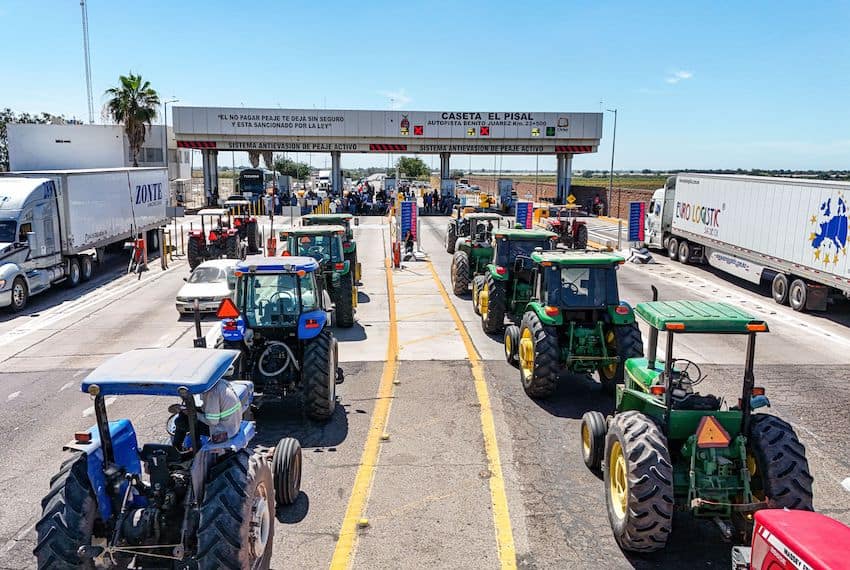
Protesting farmers and truckers decried intimidation tactics while declaring on Tuesday that the highway blockades would continue, though to a lesser extent.
On Monday, blockades were established on a dozen federal highways in protest of highway insecurity and rising business costs, including high fuel prices and extortion. As of 1 p.m. on Tuesday, the only active blockades were in the states of Guanajuato (Federal Highway 110 at several points), Baja California (San Luis Río Colorado-Mexicali), Tamaulipas (Ciudad Victoria-Matamoros) and Michoacán (a stretch of the Mexico City-Guadalajara highway near Contepec).
#TomePrecauciones en #Tamaulipas se registra cierre total de circulación por presencia de personas, cerca del km 200+500, en la carretera Cd. Victoria – Matamoros. Atienda indicación Vial. pic.twitter.com/TpC708KIU7
— Guardia Nacional Carreteras (@GN_Carreteras) April 7, 2026
A Monday evening Interior Ministry press release said “constant coordination with state governments and representatives of the sectors involved” throughout the day led to the dissolution of six of the 11 highway blockades across the country.
Citing the goal of minimizing the impact on citizens, while “respecting the right to free expression,” the government urged the remaining protesters “to use institutional channels of dialogue and clear the roads to … guarantee free transit on the country’s highways.”
In contrast, the National Association of Truckers (ANTAC) and the National Front for the Rescue of the Mexican Countryside (FNRCM) said the government had “sabotaged” their protests, while insisting the strike had not been canceled.

ANTAC spokesperson Jeannet Chumacero accused the authorities of using strikebreakers in the transport and agricultural sectors to sow confusion among truckers and farmers.
Chumacero also criticized the intimidation tactics and said the government would be held responsible for any aggression against leaders and participants in the strike action.
The newspaper El Universal reported that ANTAC claimed some protesters in the state of Tlaxcala were threatened at the point of a gun and beaten, while insisting several others were allegedly “disappeared.”
The Tlaxcala government said any action taken by the authorities was in strict accordance with the law, adding that there was no record of anybody being detained.
“State intervention was carried out under containment protocols and proportional use of force,” the government said, insisting that officials employed non-lethal deterrent agents such as water and tear gas to disperse the protesters.
Although ANTAC insisted the blockades would continue, the federal government said protesters had withdrawn from blocked highways in Tlaxcala and Morelos early Tuesday morning.
Other protesters ended blockades in northern Mexico, allowing the Mexicali–San Luis Río Colorado highway — the main interstate linking Baja California to Sonora — to reopen.
Although truckers have shown support for the strike, freight companies have distanced themselves from the blockades.
The National Chamber of Freight Transportation said that while it is sympathetic to the issues motivating the mobilizations, dialogue is the best way forward.
With reports from La Jornada, El Financiero and El Universal