Border issues, metal tariffs and the tomato trade were all on the agenda at a meeting between Mexican and United States business leaders in Mérida, Yucatán, yesterday.
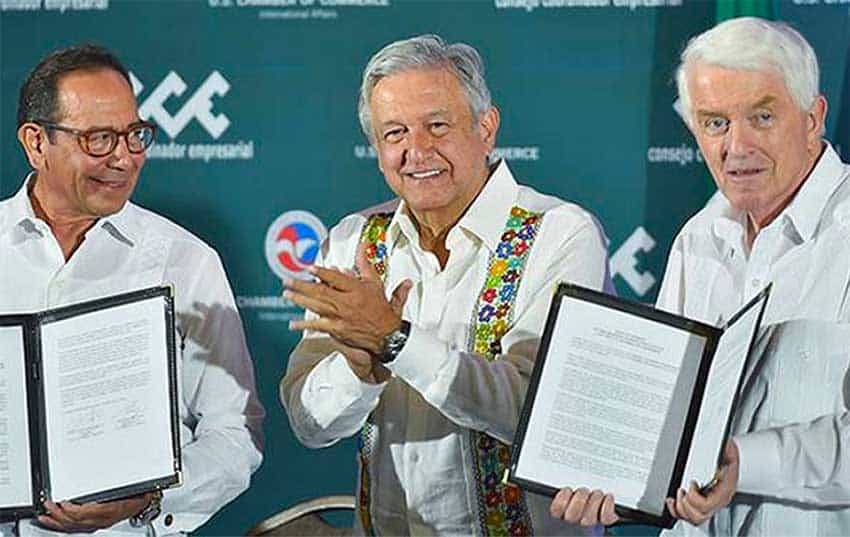
The United States-Mexico CEO Dialogue, a biannual event organized by Mexico’s Business Coordinating Council (CCE) and the U.S. Chamber of Commerce (USCC), was also attended by government officials from both countries, including President López Obrador.
Both business groups called on United States President Donald Trump to stop his threats to close the border, where recent delays caused by a redeployment of U.S. border agents cost Mexican exporters an estimated US $800 million a day.
A complete closure of the border would have a devastating impact on trade between the two countries, which is worth about half a trillion dollars a year.
USCC president and CEO Tom Donohue told a press conference that the United States should exempt both Mexico and Canada from steel and aluminum tariffs imposed by Trump last year before the U.S. Congress ratifies the new North American trade deal reached in November.
He described the relationship with Mexico as a top priority, adding “that is why we are the first out of the gate to warn against the disastrous consequences of closing the U.S.-Mexican border.”
López Obrador, who was seated next to the business leader, applauded warmly.

The lower house of Mexico’s Congress this week approved a landmark labor reform package, legislation that is considered crucial for the ratification of the new North American trade agreement in the United States.
In turn, Mexico and Canada want the U.S. to drop the metal tariffs imposed on national security grounds last June before their respective legislatures move to ratify the new trade pact, which will replace the 25-year-old NAFTA.
Another issue that is hindering the process to ratify the new United States-Mexico-Canada Agreement (USMCA) is migration.
In addition to threatening to close the border, Trump said on April 4 that his administration could also impose tariffs on Mexican auto imports in one year if Mexico doesn’t do more to stop northward flows of migrants.

Despite Trump’s threats, CCE president Carlos Salazar said at yesterday’s press conference that he hoped that the United States government understood the importance of keeping the border open.
He also repeated a Mexican government line that trade and migration are separate issues and one shouldn’t be allowed to affect the other.
“. . . Let’s not confuse migration problems with trade problems and industry problems,” Salazar said.
López Obrador, who since taking office has been careful not to publicly criticize the United States government, continued that approach yesterday, only thanking Trump for “being open to deal with our commercial, migratory and security matters with respect.”
Foreign Secretary Marcelo Ebrard told reporters that a Texan businessman presented a proposal yesterday which called for both Mexico and the United States to invest in infrastructure at the border “to facilitate an orderly exchange both of people and goods.”
He also said that Mexican and United States officials reached an agreement to not allow migration to affect trade and to put an end to delays at the border that have stranded thousands of trucks for up to 20 hours.
“. . . We’re going to try to normalize the situation at the border. What the [United States] administration tells us is that [the reassignment of border agents] is not a political decision, they’re not seeking to harm Mexico but rather they suddenly had too many Central Americans [to deal with],” Ebrard said.
The highest ranking United States official who traveled to Mérida, Secretary of Commerce Wilbur Ross, didn’t address the media yesterday but at a dinner Thursday night he thanked Mexico for helping to confront the migration “crisis.”
On the sidelines of the event, Ross met with Economy Secretary Graciela Márquez, who urged the United States to end the metal tariffs.
She also asked Ross to push forward talks aimed at reaching a deal in a dispute between Mexican and United States tomato producers.
Ross’ department said in February that the United States intended to withdraw from a six-year-old trade agreement with Mexico on tomatoes, a move that clears the way for new tariffs to be imposed.
The two secretaries agreed that the U.S. Department of Commerce would continue to seek a new deal that would be beneficial to tomato farmers in both countries.
Márquez and Ross also discussed Mexico’s new plan to protect the vaquita marina porpoise in the upper Gulf of California and agreed to develop a working agenda for future meetings.
Source: Reuters (sp), El Economista (sp), El Financiero (sp)