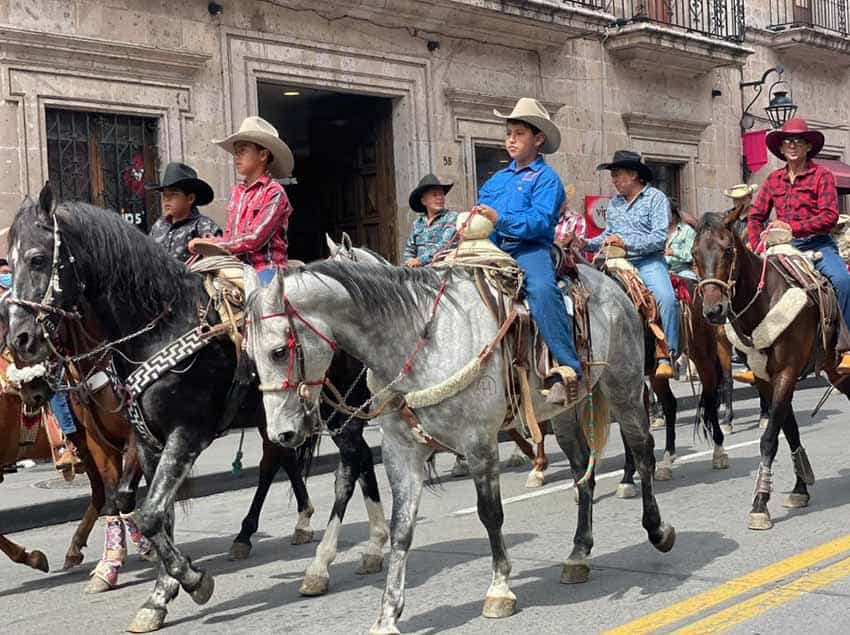
Several hundred people took to the streets of Michoacán’s capital this week to protest a prohibition on bullfighting in the state.
Led by members of the United Federation of Traditions in Mexico (Fetumex), the protesters said that outlawing bullfighting and cockfighting or other forms of entertainment involving animals — such as rodeos and horse racing — will cost millions their jobs and incomes.
“There are always attempts to end the traditions that we are out here defending now … there are millions of people that will be affected throughout the country,” said Fetumex president Efraín Rábago Echegoyen.
The group, which included locals as well as bullfighting aficionados from Baja California, Sinaloa, Coahuila, México state, Guanajuato and Puebla, marched or rode on horseback from the Plaza de Toros bullfighting ring through the city, ending up at Michoacán’s congressional building to meet with legislators and their aides, hoping to encourage public support and increase publicity for their cause.
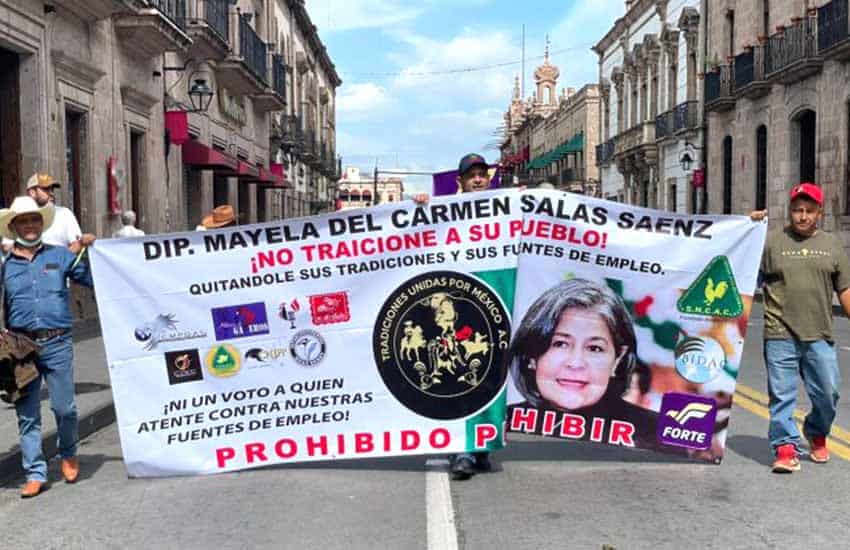
They also directed their message specifically at state Deputy Mayela Salas Sáenz, who in June proposed a ban on the practice to Michoacan’s Congress.
The protesters included locals as well as bullfighting aficionados from Baja California, Sinaloa, Coahuila, México state, Guanajuato, and Puebla — the latter a state which has a bullfighting arena in the capital and where, despite protests, the sport has been added to Zacatlán’s annual apple festival this month.
Many of the protesters in Morelia on Tuesday also protested in the nation’s capital last November as the Mexico City legislature was in the process of outlawing bullfighting on the grounds that the tradition involves cruelty to animals.

Majority support in the Mexico City Congress for such a law ultimately proved elusive, but bullfighting was effectively banned in the city in June, when the famous Plaza México, the world’s largest bullfighting ring, was forced to close its doors to bullfighting after a federal judge validated a lawsuit that argued that the ‘degrading and stigmatizing’ treatment of bulls in the sport is unconstitutional.
Mexico is one of the few places in the world that still carries on the bullfighting tradition, brought to the Americas by the Spanish. However, it has already been prohibited in five states: Sonora, Guerrero, Sinaloa, Coahuila and Quintana Roo.
In contrast, the states of Aguascalientes, Tlaxcala, Hidalgo, Querétaro, Zacatecas, Michoacán, Nayarit and Guanajuato consider bullfighting intangible cultural heritage, although in June, the Supreme Court invalidated a Nayarit decree giving that status to bullfights and cockfights.
Over the past decade, opinions in Mexico have shifted about the tradition, with 59% of the public now saying they favor outlawing the practice and 73% saying they believe it to be cruel to animals.
- CORRECTION: This story was updated after publication to edit the estimated number of people participating in the protest.
With reports from El Sol de Morelia and Debate, El Pais, Magnate and Infobae