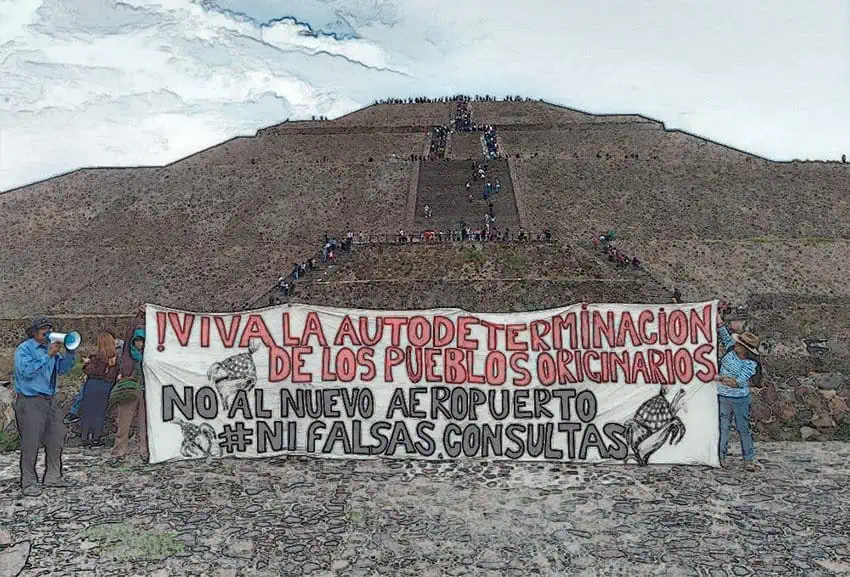
The new Mexico City International Airport (NAICM) project has been given the green light by a study completed by the influential Business Coordinating Council (CCE).
At a press conference today, CCE president Juan Pablo Castañón presented six key recommendations of its analysis:
1. Continue the project at its current site (Texcoco, México state) in order to meet the demand for air travel now and over the next 50 years.
2. Review the cost of materials used in the construction of the project as long as it doesn’t compromise the functionality of the airport.
“We don’t want a sumptuous airport but we do want one that is functional . . .” Castañón said.
3. Review the project’s funding via the securitization of debt.
4. Increase the project’s social impact through development and job creation in surrounding municipalities, all of which are highly-marginalized areas.

“The Texcoco airport’s transformational potential is an opportunity that we must consider,” the CCE chief stated.
5. Don’t suspend the project.
“The cost of suspension [in terms of] time and finances is very high. In addition, the solution to the saturation of the current airport and the benefits for the population would be delayed.”
6. Consider the legal and financial implications of canceling the airport currently under construction, the consequences with creditors and contractors and the resultant reputational risk.
“The NAICM is a project with which all Mexicans win, with a multiplying effect . . . one that will enable new employment opportunities through trade and tourism,” Castañón said.
The CCE president outlined advantages of the new airport such as its projected capacity of up to 135 million passengers a year, which he said was more than double the combined capacity of the current airport and an air force base in México state which president-elect Andrés Manuel López Obrador has proposed as an alternative.
Castañón also said the new airport will help airlines cut costs that can be passed on to passengers in the form of cheaper fares.
Javier Jiménez Espriú, López Obrador’s nominee for secretary of communications and transportation, appeared alongside Castañón at today’s conference. He said the incoming government would analyze the CCE study with a view to informing the public about the pros and cons of keeping or scrapping the project.
He also said that the president-elect’s transition team is waiting for a report from the International Civil Aviation Organization about the viability of operating the current airport at the same time as commercial flights leave and take off from the Santa Lucía Air Base.
López Obrador, who will be sworn in as president on December 1, railed against the airport project during the election campaign period and threatened to scrap it, placing him at loggerheads with the private sector.
However, he later softened his stance and said last month that a public consultation, which could take the form of a national survey or referendum, will be held in the late October to decide the fate of the US $13 billion airport project.
Source: El Financiero (sp)