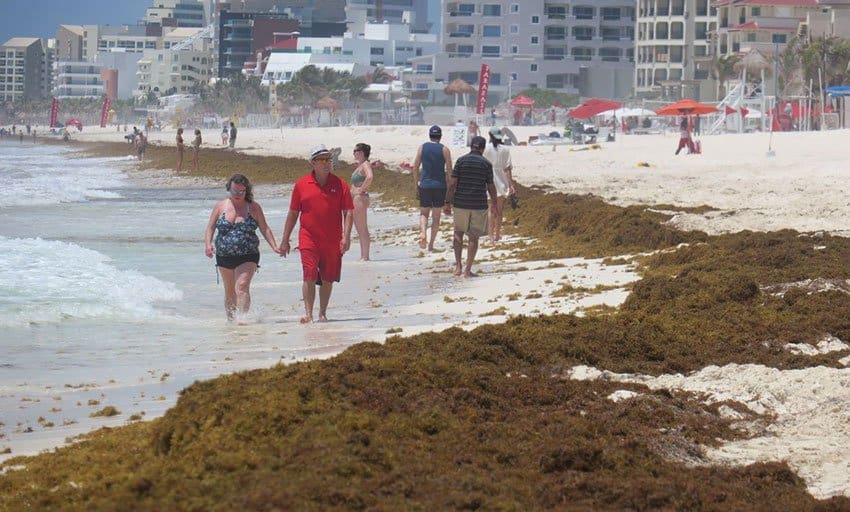
Hotel owners in Quintana Roo say that government inaction is forcing them to act on their own to deal with the tonnes of sargassum that are washing up on beaches in the state.
Pablo Azcárraga, president of Grupo Posadas, Mexico’s largest hotel company, told El Financiero that a lack of coordination among government agencies is partly to blame for the crisis.
“It’s not an issue the navy should be dealing with, we need specialists, people who know about this,” he said. “The navy has more important priorities, which aren’t necessarily collecting sargassum on beaches.”
President López Obrador announced earlier this month that the navy would lead efforts to combat the macroalgae’s annual arrival on Mexico’s Caribbean coast.
Hector Tamayo, tourism director for Puerto Morelos, a Quintana Roo municipality that has been hit hard by sargassum, told El Financiero that there has been little support from the federal government to address the problem.
Cancún hotels are cleaning up much of the sargassum on the beaches but according to El Financiero, they don’t use proper methods for disposing of the seaweed.
Sargassum often has high levels of heavy metals, which can contaminate aquifers if the algae is mixed with other waste.

Luis, a man who was hired by a hotel to collect sargassum from the beaches, told El Financiero that it is only removed from hotel beaches, while no one cleans public areas of the coast.
“We leave the sargassum with the rest of the trash,” he said. “There’s no special treatment, we just collect it from the beach.”
Hotels have also been putting up barriers to prevent sargassum from washing up on beaches. However, about 30% of the sargassum still manages to get past them.
The large amounts of sargassum that have been washing up on beaches since 2014 have hit hotels especially hard. The Association of Hotels of Cancún, Puerto Morelos and Isla Mujeres estimates that hotels lost US $100 million in the first quarter of 2019 because of sargassum and other factors, and that they may be forced to lower prices by as much as 15% in the summer.
Source: El Financiero (sp), El Universal (sp), El Economista (sp)