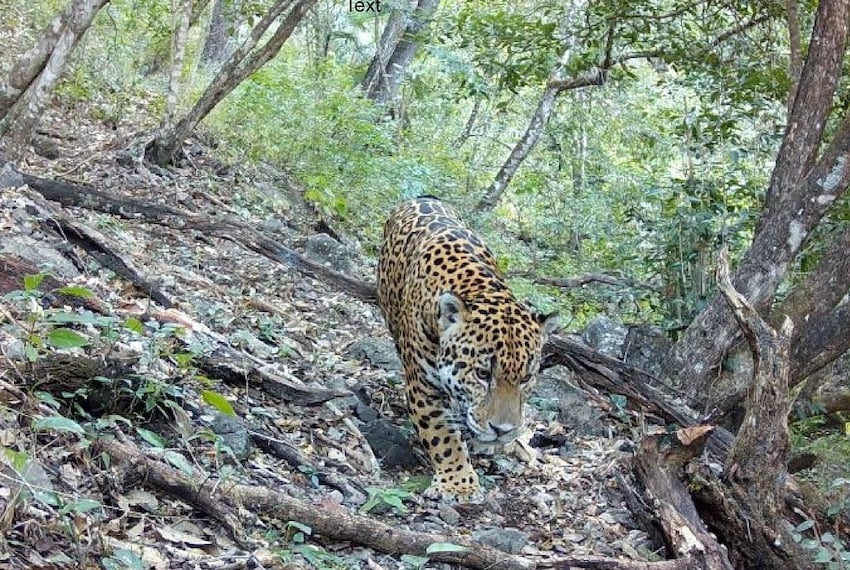
Camera traps installed in the woods of the Sierra Gorda Biosphere Reserve of Guanajuato have recorded the first official images of a jaguar (Panthera onca) in that area, according to the National Commission of Natural Protected Areas (Conanp).
The Conanp reported that the images were obtained via a 75-trap camera system operated by community monitors.
The country’s biggest cat was spotted in an area of continuous forest with minimal human disturbance, functioning as a biological corridor that links feline populations from central to eastern Mexico. This Natural Protected Area (ANP) extends 236,882 hectares, representing 8.92% of the total territory of Guanajuato state.
A recent study found that the jaguar’s habitat extends through 16 states, or half of Mexico: Sonora, Sinaloa, Nayarit, Jalisco, Michoacán, Guerrero, Chiapas, Quintana Roo, Yucatán, Campeche, Morelos, Hidalgo, San Luis Potosí, Nuevo León and Tamaulipas.
Thanks to these latest images, scientists have added the Guanajuato jaguar to the national distribution and conservation map of the species. The sighting also marks a milestone for the reserve itself: scientists have now confirmed the presence of all six wild cat species native to Mexico within Sierra Gorda — ocelot, margay, jaguar, jaguarundi, lynx and puma.
According to Conanp, these apex predators are essential to the health of entire ecosystems. Their role in regulating herbivore populations curbs overgrazing, sustains biodiversity, and supports the broader environmental services on which the region depends.

Experts note that the finding validates the functionality of the biological corridors that connect Guanajuato with Querétaro, San Luis Potosí and Hidalgo along the Sierra Madre Oriental.
Furthermore, the jaguar’s presence in Guanajuato’s reserve adds to the list of priority species for conservation that inhabit the region. These include the green macaw, the mountain axolotl, the golden eagle, the black bear and rattlesnakes.
Lastly, the Conanp recalled that the discovery of the jaguar was made possible by a research project conducted between August 2024 and May 2025, led by biologist Juan Felipe Charre-Medellín and his team. The project was funded by the Toyota Group and the Science, Humanities, Technology and Innovation Ministry (Secihti).
Mexico News Daily