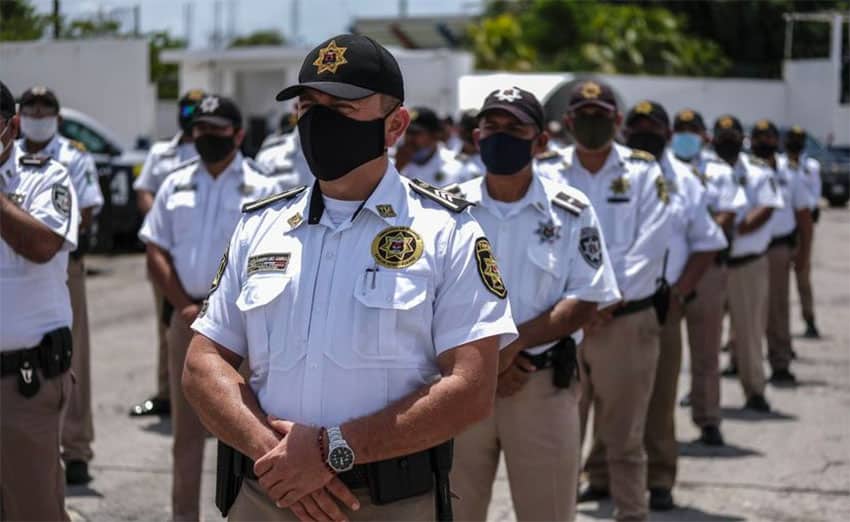
The Quintana Roo Security Ministry is investigating an extortion ring within Cancún traffic police that charges officers varying amounts depending on where they are stationed and the duties they are carrying out.
The officers in turn collect bribes from truck drivers and other motorists so that they can raise the cash needed to satisfy their superiors’ demands.
A report published Monday by the newspaper Reforma said that according to the Cancún officers, the extortion ring is made up of three former traffic police chiefs and the current one, Jorge García Cohuo.
It’s estimated that up to 2.8 million pesos (US $132,500) is collected per month via the scheme.
According to Reforma, officers say they have been charged weekly “fees” of up to 46,000 pesos (US $2,200) to work at sobriety checkpoints. The officers presumably meet the payments by collecting bribes from intoxicated drivers in exchange for letting them off formal charges.
Officers stationed in the hotel zone say that traffic police commanders ask them to pay 14,000 pesos a week while those patrolling the city’s downtown say they’ve been directed to make 9,000-peso payments. Motorcycle officers have been asked to turn over 30,000 pesos a week to their superiors.
Requested by Mayor Mara Lezama, the investigation into the extortion racket was launched as taxi drivers, truck drivers, transport companies and motorists in general were complaining that police extortion was on the rise.

The Quintana Roo Security Ministry has detected that the extortion scheme collects income from three different sources.
Officers with the traffic police “verification unit” collect illegal payments from truck drivers transporting goods such as fruit, vegetables, soft drinks and beer.
Officers collect some 1.2 million pesos a month in exchange for allowing the “free circulation” of freight trucks, according to the Security Ministry.
Traffic police patrolling Cancún in police cars, on motorcycles and on foot collect an average of 760,000 pesos a month via bribes paid by general motorists, according to official estimates.

Police commanders also benefit from illegal payments that motorists, transport companies and freight companies are asked to pay when applying for permits or seeking to retrieve impounded vehicles. Some 250,000 pesos per month is sourced from the “procedures and services” racket.
In addition, police commanders top up their regular salaries with payments they demand of tow truck operators and “coyotes,” people who carry out bureaucratic procedures at traffic police offices on behalf of others.
Although extortion has increased recently, the Security Ministry investigation has found that police bureaucracy-related corruption and the collection of “fees” by traffic police commanders has been a problem in Cancún since at least 1998.
The corruption has persisted despite the replacement of several traffic police chiefs and the election of new municipal governments in the Caribbean coast resort city.
Most recently, Jesús Ángel Salas Cruz, one of the former traffic police chiefs allegedly involved in the extortion ring, was replaced by García Cohuo at the end of last month.
At the same time, Cancún authorities launched an initiative known as the “Crusade for Honesty and Efficiency in the Traffic Police.”
The scheme distributed 90 body cameras to traffic police as part of efforts to combat corruption.
“We must make use of digital tools to combat corruption,” Mayor Lezama said at the time. “There are also honest police who thanks to the cameras will make themselves known.”
Source: Reforma (sp)