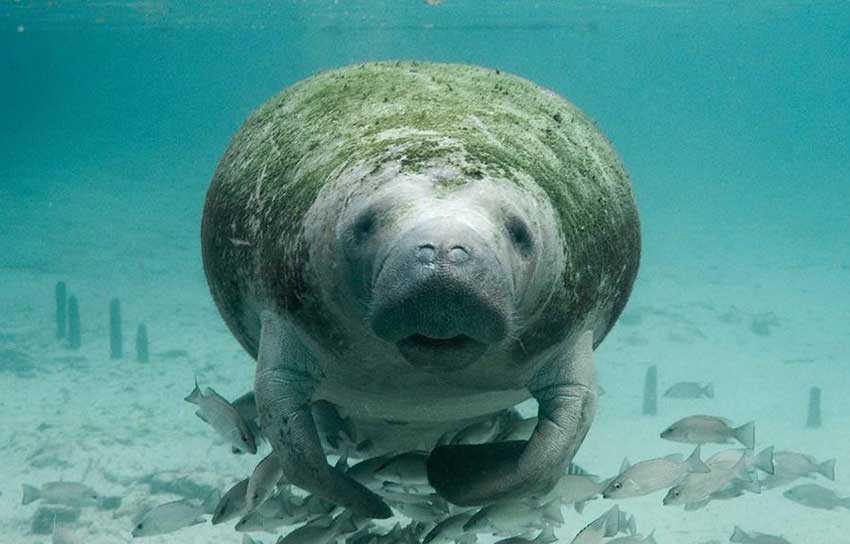
Cause of manatees’ deaths still unclear but private study finds heavy metals

Environmental authorities have been unable to determine what has caused the death of at least 30 manatees in Tabasco, but an independent study found elevated heavy metal content in the animals’ habitat.

The manatees have died over the last two months, and all three levels of government have struggled to find the cause.

The federal environmental protection agency Profepa has worked with the National Autonomous University (UNAM), the agriculture sanitation authority Senasica, the National Water Commission (Conagua) and Mexican Institute of Water Technology (IMTA) to test the water in their habitat and samples of the dead manatees’ tissue.

The results have found no evidence that acute toxicity is behind the death of the animals. Specialists are now planning to collect tissue samples from live specimens, as well as from the lagoon beds and surrounding plant species.

Profepa theorized that a number of factors could be involved, including water temperature, the dry season, the accumulation of pollutants and stress on the animal’s food sources, making it difficult to identify a single cause.

Late last month, a manatee rescue and relocation plan was put in motion.

Meanwhile, an independent study by the Institute of Technology of Boca del Río has come up with different results: it detected heavy metal levels well above safe limits.

Ernesto Zazueta, president of the Association of Zoological Parks, Breeding Centers and Aquariums (Azcarm) said that traces of cadmium and lead were found not only in the water but in the carcasses of the dead mammals.

Cadmium levels were seven times greater than the allowed two milligrams per unit, while lead levels were 64 times greater than the acceptable 0.15 milligrams per unit.

Zazueta said the dead animals also showed indications of cerebral edema, which appears after exposure to a toxic agent.

Environment Secretary Rafael Pacchiano Alemán wrote on Twitter that he had not been notified of those test results but his department would get in touch with the researcher in charge in order to collect samples from the same sources.

Source: Univision (sp)

Have something to say? Paid Subscribers get all access to make & read comments.
Manzanillo, Colima, México, 13 de marzo de 2026. La doctora Claudia Sheinbaum Pardo, presidenta Constitucional de los Estados Unidos Mexicanos en conferencia de prensa matutina, “Conferencia del Pueblo” desde Colima. La acompañan Indira Vizcaíno Silva, gobernadora Constitucional del Estado de Colima; Omar García Harfuch, secretario de Seguridad y Protección Ciudadana (SSPC); Raymundo Pedro Morales Ángeles, secretario de Marina (Semar); Bulmaro Juárez Pérez, divulgador de lenguas originarias, presentador de la sección “Suave Patria”; Ricardo Trevilla Trejo, secretario de la Defensa Nacional (Sedena); Jesús Antonio Esteva Medina, secretario de Infraestructura, Comunicaciones y Transportes; Bryant Alejandro García Ramírez, fiscal general del Estado de Colima; Fabián Ricardo Gómez Calcáneo; Rocío Bárcena Molina, subsecretaria de Desarrollo Democrático, Participación Social y Asuntos Religiosos de la Secretaría de Gobernación; Efraín Morales López, director general de la Comisión Nacional del Agua (Conagua); Marcela Figueroa Franco, secretaria ejecutiva del Sistema Nacional de Seguridad Pública (SESNSP) y Guillermo Briseño Lobera, comandante de la Guardia Nacional (GN). Foto: Saúl López / Presidencia

Mexico’s week in review: Congress deals Sheinbaum her first legislative defeat

0
The week of March 9 in Mexico was marked by standoffs between allies in Congress and adversaries at the airport. Here's what you missed.
A soldier displays seized handguns

The US and Mexico, growing together and growing apart: A perspective from our CEO

1
From a historic drop in homicides to opposite bets on electric vehicles, Mexico News Daily's CEO breaks down where the U.S. and Mexico are converging — and where they're not.
Veracruz Gov.

Veracruz governor blames private vessel for 200-kilometer Gulf Coast oil spill

1
The spill, which has spread to over 200 kilometers of Mexico's Gulf Coast beaches, has been traced to a private oil tanker off the coast of Tabasco.
BETA Version - Powered by Perplexity