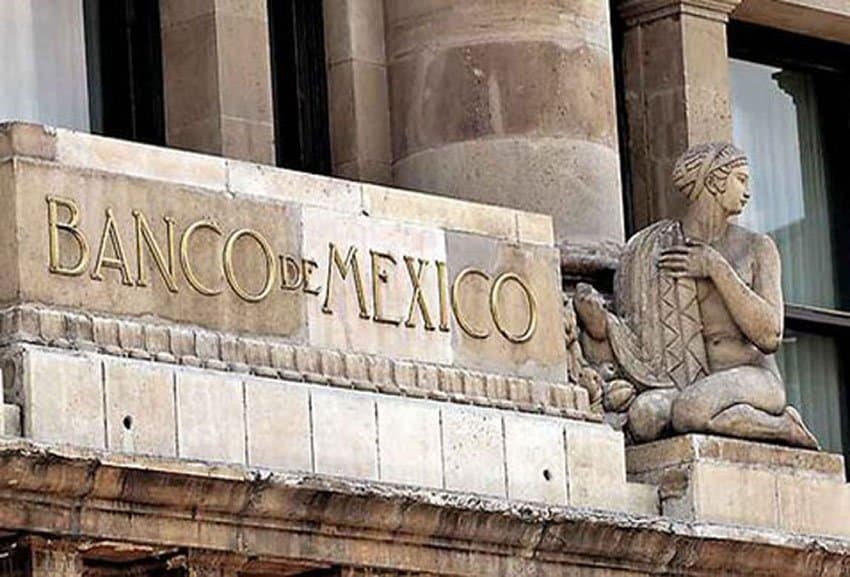
The Bank of México (Banxico) raised its benchmark interest rate to the highest level in 10 years yesterday, and there are signs it could go even higher in 2019.
The central bank’s board voted unanimously to increase the rate by 25 basis points, as expected, to 8.25%, the highest level since the introduction of a new benchmark rate policy in 2008.
Banxico cited higher than expected inflation and uncertainty generated in part by the new federal government’s economic policies as factors that contributed to the hike, the fourth this year.
“The balance of risks with respect to the expected inflation trajectory has deteriorated and maintains an upward bias within an environment of marked uncertainty,” the bank said in a statement.
The central bank targets 3% annual inflation with 1% tolerance in both directions but inflation in the first half of December was 5%, according to statistics institute Inegi, and 4.87% in the last half of November.
Banxico warned that the minimum wage increases announced earlier this week could “bring about wage revisions that exceed productivity gains and create cost pressures.”
It also said that “the balance of risks for growth is still skewed to the downside and has deteriorated.”

Last month, the bank cut its growth forecast for next year to between 1.7% and 2.7%, while many analysts are predicting that economic expansion will be at the lower end of that range.
In its 2019 budget presented Saturday, the federal government predicted 2% growth although Finance Secretary Carlos Urzúa said that it was a “conservative” estimate.
Banxico also recognized that the value of the peso has recently declined – particularly after President López Obrador announced that the US $13-billion Mexico City airport project would be cancelled – although it rallied yesterday on news that the government had won investor support for an airport bond buyback offer.
“The Mexican peso exchange rate continued to reflect the uncertainty regarding the policies of the new administration,” the bank said.
Bank of México Governor Alejandro Díaz de León told the newspaper El Financiero that Banxico could raise rates again next year if inflation doesn’t begin to trend downwards.
“It’s important for us to remain alert to the balance of risks environment . . . and in case it is necessary, maintain the benchmark rate [at its current level] as long as it is needed or, when appropriate, strengthen the [bank’s] monetary policy position so that inflation resumes a downward trajectory towards the inflation target,” he said.
“What the interest rate hike seeks to do is consolidate an environment of stability. If the anchor of [positive] expectations in the economy was lost, it would be very costly in terms of economic activity . . .” de León said.
In its statement, Banxico also called on the government to provide “a climate of confidence and certainty for investment, higher productivity and a sustainable consolidation of public finances.”
Its 2019 Economic Package was generally described as fiscally prudent and realistic although with some reservations.
According to derivatives market forecasts, there is an 85.6% chance that Banxico will raise borrowing costs next year, and there is some speculation it will do so the next time the bank’s board meets on February 7.
“The guide to the future continues to be hawkish. Therefore, we can’t rule out another rate hike during the first quarter of 2019, particularly if inflation continues to trend upwards,” said Alberto Ramos, chief economist for Goldman Sachs in Mexico.
Alonso Cervera, chief Latin America economist for Credit Suisse, also said that Banxico’s decision was “a hawkish hike,” adding “there’s nothing in the statement that suggests the bank is done hiking.”
However, a survey of analysts conducted by Citibanamex forecast that there would be no new rate hikes in 2019.
Source: El Financiero (sp)