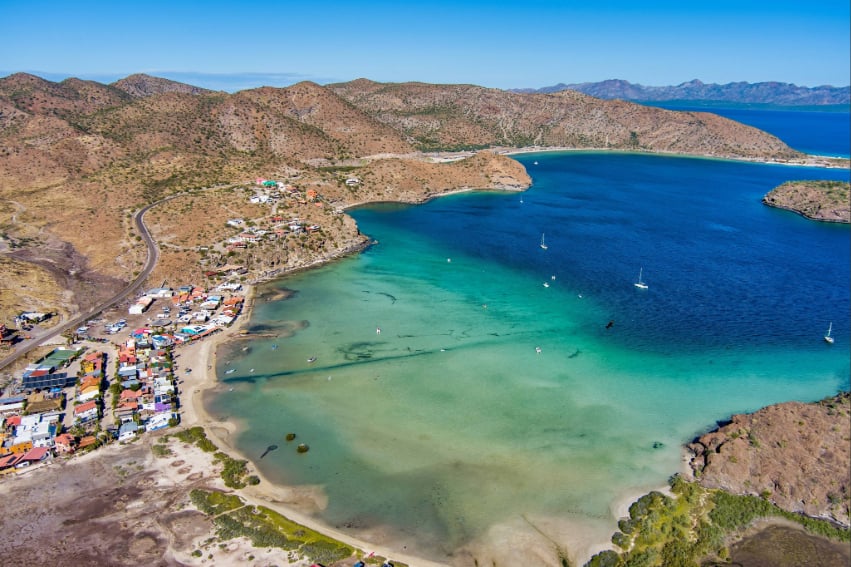
The Federal Electricity Commission (CFE) is developing a solar project to bolster the electricity supply of the picturesque Baja California Sur town of Mulegé, in a region with no direct connection to the national electric system and that has historically relied on fossil fuels.
Mulegé, a natural oasis in the northern part of the state, is situated at the mouth of the Mulegé River near the Gulf of California.
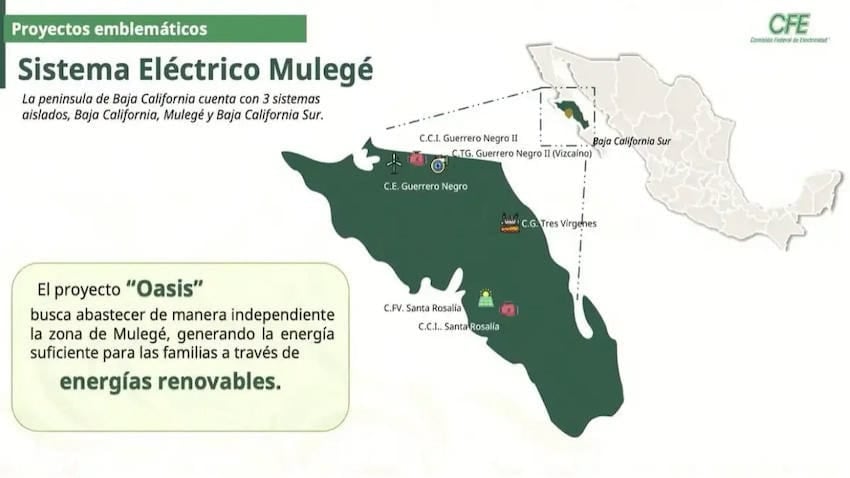
Dubbed the Oasis BCS Project, the initiative seeks to address the region’s key energy challenge of ensuring reliable electricity in an area that operates as an isolated system —and meeting that challenge sustainably through the integration of solar energy, batteries, and green hydrogen.
“At CFE, we are working to provide a solution that enables the utilization of that region’s natural resources and advances us toward a clean, efficient, and self-sufficient supply,” head of the CFE Emilia Calleja said in June in anticipation of the project.
The project includes a 72-megawatt (MW) photovoltaic plant, a 20 MW battery system, 20 MW electrolyzers to produce hydrogen, and 6 MW fuel cells to convert that fuel back into electricity.
The goal is to harness solar radiation during the day, store some of the energy in batteries, and use another portion to generate hydrogen that can be stored and utilized when there is insufficient sunlight or when backup power is required.

In an official description of the project, the CFE anticipates that the initiative will provide electricity to 40,000 households and supply 120 cubic meters of water to the local population.
In addition to energy benefits, the public company stated that the project will contribute to reducing polluting emissions by avoiding the annual consumption of 23,000 cubic meters of diesel and fuel oil — an amount corresponding to over 93,000 tonnes of CO2 emissions, or the equivalent of taking 31,463 vehicles off the road.
Additionally, the project includes the treatment of water after its use in the process, generating further benefits for communities in the region.
The project represents a shift in approach for the CFE; instead of relying on emergency power plants fueled by diesel or heavy fuel oil to meet peak demand, the CFE is proposing a solution based on renewable energy and energy storage.
If it materializes, it would become the first green hydrogen power generation project operated by the CFE and one of the company’s most ambitious developments regarding the energy transition.
With reports from La Jornada and Expansión