
The government of China has called on Mexico to abandon its plan to impose new and higher tariffs on a wide range of Chinese products.
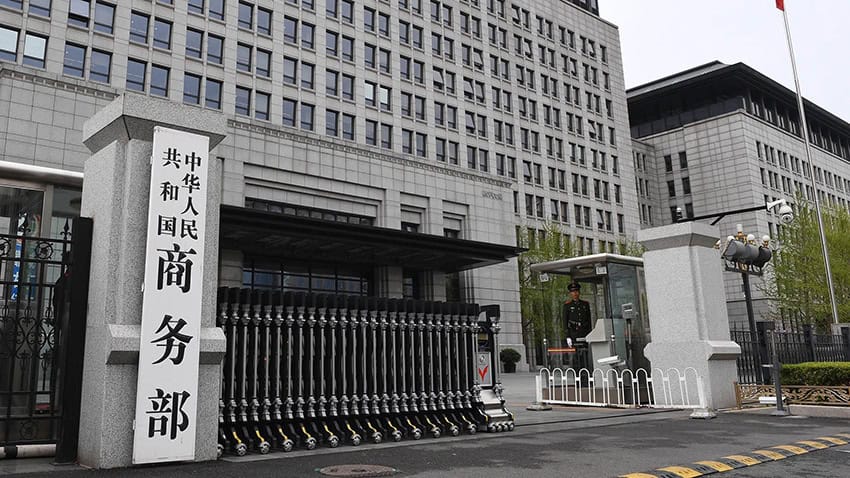
A spokesperson for China’s Ministry of Commerce on Thursday urged Mexico to “correct its wrong practices of unilateralism and protectionism at an early date,” according to Chinese state news agency Xinhua.
The appeal came after Mexico’s Chamber of Deputies and Senate approved legislation on Wednesday that will increase, or implement for the first time, tariffs on imports of more than 1,400 products from China and other countries with which Mexico doesn’t have trade agreements, including India, South Korea, Thailand and Indonesia.
The tariffs — which cover more than a dozen sectors including auto parts, light vehicles, plastic, toys, textiles, furniture, footwear, clothing, aluminum and glass — range from 5% to 50%. They are scheduled to take effect in January, following promulgation by President Claudia Sheinbaum.
According to Xinhua, the Commerce Ministry spokesperson said that the tariffs approved by the Mexican Congress “will substantially harm the interests of relevant trading partners, including China.”
The spokesperson acknowledged that some downward “adjustments” were made to the tariffs originally proposed by Sheinbaum in a bill she submitted to Congress in September.
Still, China clearly sees Mexico’s protectionist plan as an affront, and an action designed to appease the United States ahead of the 2026 USMCA review.

“We hope that the Mexican side will attach great importance to this matter and act prudently,” the Commerce Ministry spokesperson said.
The spokesperson also “emphasized that China highly values the China-Mexico economic and trade relationship and actively promotes the healthy and stable development of trade and investment cooperation,” according to Xinhua.
In addition, the spokesperson noted that “to safeguard the interests of relevant Chinese industries, the Ministry of Commerce initiated a trade and investment barrier investigation against Mexico at the end of September in accordance with the law, and the investigation is underway.”
Meanwhile, Reuters reported that “Mexico’s decision to raise tariffs as high as 50% will affect [US] $1 billion worth of shipments from major Indian car exporters, including Volkswagen and Hyundai, despite industry lobbying to persuade New Delhi to prevent such a move.”
The news agency said its reporting was based on information from two sources and a letter it reviewed from an industry group, the Society of Indian Automobile Manufacturers.
Mexico Approves Up to 50% Tariffs on China, Other Asian Nations
“According to the legislation, Chinese cars face among steepest tariffs at 50%. The country’s massive auto sector currently holds 20% of Mexican market, up dramatically from minimal vehicle imports just 6 years ago” pic.twitter.com/2mecdFd9A8
— Danielle DiMartino Booth (@DiMartinoBooth) December 11, 2025
Volkswagen, Hyundai and various other automakers have plants in India, while U.S. automakers that export vehicles to Mexico from plants in China will also be affected by the tariffs.
With the new and higher tariffs that mainly target goods from Asian countries, the Mexican government is seeking to provide greater protection for Mexican industry — which includes sectors that struggle to compete with cheap imports — and increase domestic output.
It is also aiming to reduce reliance on imports from Asian countries, especially China, a country with which Mexico has a significant trade imbalance.
Ebrard: ‘They’re not political measures, they’re economic and trade measures’
In an interview on Thursday with Radio Fórmula, federal Economy Minister Marcelo Ebrard said it was clear that countries such as China, South Korea, India and Indonesia are not happy that Mexico is imposing tariffs on their exports.
He said that Mexico would hold talks with such countries with a view to “improving trade conditions,” but declared that the Mexican government wouldn’t be lifting the tariffs approved by Congress.
Those tariffs, Ebrard said, “are not political measures, they’re economic and trade measures.”

The economy minister emphasized that Mexico is “trying to protect” Mexican industry from cheap imports.
China and certain other countries are “using very low prices, in some cases below inventory [value],” he said.
Ebrard also noted that Mexico has “unbalanced” trade relationships with “several” of the countries it is imposing higher tariffs on — most notably China, whose exports to Mexico were worth US $62.1 billion in the first half of 2025, more than 13 times higher than its outlay on Mexican goods.
He said that Mexico is mainly targeting “finished goods,” including vehicles, with its new tariffs, rather than intermediate goods, which he noted are needed to “produce, assemble and export.”
Tariffs on vehicles from China and other Asian countries will be as high as 50%, according to the legislation approved by Congress.
Ebrard said that more than 30% of all manufacturing jobs in Mexico depend on the auto sector.
“You’re talking about more than a million, maybe 1.3 million, jobs,” he said, emphasizing the need to protect the Mexican auto sector, which generates a significant portion of Mexico’s export revenue.
Congress approves new tariffs on goods from China and non-FTA countries
Ebrard highlighted that cars coming into Mexico from Asia “don’t provide anything” to the Mexican economy, and indicated that that the flow of such vehicles into the country needs to be combated before its too late.
“The pace of growth of … [these vehicles] is amazing,” he said, referring mainly to the sales of Chinese cars in Mexico in recent years.
Ebrard said that the tariffs approved by Congress only affect 8% of Mexico’s foreign trade and are aimed at protecting “very specific sectors,” including the auto and textile industries, which has lost jobs due to the prevalence of cheap imports.
He said that all countries seek to protect their domestic industries, including those that “are telling us today not to do it.”
“All countries have policies to protect certain sectors,” Ebrard added.
When interviewer Ciro Gómez Leyva put it to him that he was using the arguments of U.S. President Donald Trump to justify the tariffs, the economy minister responded:
“What we’re trying to do is surgical measures. We’re not imposing generalized tariffs because if we wanted to impose tariffs on all of Mexico’s foreign trade like the United States is doing with other countries, it would be very complicated for our economy. … The argument of President Trump is different, the argument of President Trump is that everything has to be made in the United States.”
Ebrard acknowledged that “a lot of modifications” were made to the original tariffs bill after consultation with Mexican industry. Tariffs for many goods were lowered from the proposal Sheinbaum sent to Congress in September.
The legislation approved is “quite reasonable” and “I’m not thinking it will change in the short term,” Ebrard said.
With reports from Xinhua, Radio Fórmula and El Financiero